
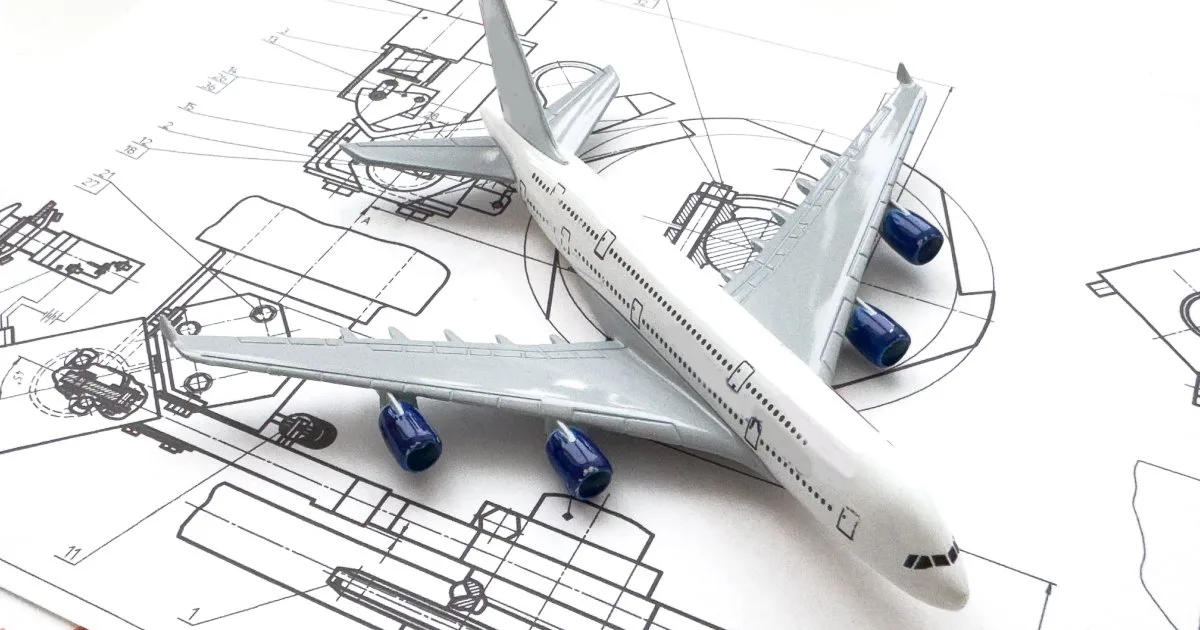
Three turbine-powered engine types: Bypass ratios, efficiency at different speeds, and why each has its ideal operating envelope.
Turbofan vs. Turbojet vs. Turboprop — The Differences in Detail
Aviation employs various types of gas turbine engines that differ fundamentally in design, efficiency, and operating envelope. Whether an aircraft is powered by a turbojet, turbofan, or turboprop has direct implications for speed, range, operating costs, and noise levels. This article explains the differences in detail and helps you understand the respective strengths and applications of each type.
Turbojet — The Pure Jet
The turbojet is the oldest type of jet engine, originating from the developments of Sir Frank Whittle (United Kingdom) and Hans von Ohain (Germany) in the 1930s. The principle is comparatively straightforward: air is ingested, compressed in an axial compressor, mixed with jet fuel in a combustion chamber, and expelled through a turbine and nozzle.
In a turbojet, the entire airflow passes through the core engine. There is no bypass — all ingested air travels through the compressor, combustion chamber, and turbine. Thrust is generated exclusively from the high-velocity exhaust of hot gases.
Characteristics of the Turbojet
- High exhaust velocity: Gases exit the nozzle at 2,000 to over 3,000 ft/s, which is efficient at high flight speeds.
- Excellent supersonic performance: At Mach 2+, the turbojet outperforms the turbofan as propulsive efficiency increases at higher speeds.
- High fuel consumption: TSFC typically ranges from 0.8 to 1.1 lb/(lbf·h) — significantly more than modern turbofans.
- Loud: The high jet velocity generates considerable noise, which led to noise restrictions starting in the 1970s.
Pure turbojets have virtually disappeared from civil aviation. The last major civil turbojet aircraft was the Concorde with its Rolls-Royce/Snecma Olympus 593 engines. Militarily, turbojets remain in service on some fighter aircraft and particularly in cruise missiles (e.g., the Williams WJ38 in the Tomahawk), where their simplicity and low weight offer advantages.
Turbofan — The Modern Standard
The turbofan is the evolution of the turbojet and today's dominant engine type in both civil and much of military aviation. The key difference: in front of the core engine sits a large fan that generates an additional airflow bypassing the core — the so-called bypass stream.
The ratio between bypass airflow and core airflow is called the Bypass Ratio (BPR) and is the defining metric of a turbofan engine.
Low-Bypass Turbofan (BPR 0.5:1 to 2:1)
Low-bypass turbofans are found primarily in military fighter aircraft. The relatively low bypass ratio enables:
- Compact design with low frontal drag
- Good supersonic characteristics
- Compatibility with afterburners, which boost thrust by 50–80 percent for short periods
- Examples: Pratt & Whitney F100 (F-15, F-16), General Electric F110, EuroJet EJ200 (Eurofighter)
High-Bypass Turbofan (BPR 5:1 to 13:1)
High-bypass turbofans are the standard in civil aviation. The large fan generates a massive bypass stream that is expelled at lower velocity but in far greater volume than the hot core stream. At a bypass ratio of 10:1, for every kilogram of air through the core, ten kilograms bypass it.
The advantages are substantial:
- Significantly lower fuel consumption: TSFC of 0.5 to 0.6 lb/(lbf·h) — nearly half that of a turbojet.
- Considerably quieter: The lower jet velocity of the bypass stream drastically reduces noise. Additionally, the cool bypass stream "envelops" the hot core stream, acting as a sound suppressor.
- High propulsive efficiency: Optimal at typical cruise speeds (Mach 0.78–0.85).
The most important modern high-bypass engines and their associated aircraft:
| Engine | Bypass Ratio | Thrust (lbf) | Aircraft |
|---|---|---|---|
| CFM LEAP-1A | 11:1 | 24,500 – 32,900 | Airbus A320neo |
| CFM LEAP-1B | 9:1 | 23,000 – 28,000 | Boeing 737 MAX |
| PW1100G (GTF) | 12.5:1 | 24,000 – 33,000 | Airbus A320neo |
| Rolls-Royce Trent XWB | 9.3:1 | 84,000 – 97,000 | Airbus A350 |
| GE9X | 10:1 | 105,000 | Boeing 777X |
| Williams FJ44 | 3.3:1 | 1,900 – 3,600 | Citation CJ Series |
| Honeywell HTF7000 | 4.2:1 | 6,400 – 7,000 | Challenger 300/350 |
CFM LEAP — The New Benchmark
The CFM LEAP engine (Leading Edge Aviation Propulsion) is the successor to the legendary CFM56 and sets new standards in efficiency and environmental performance. It burns 15 percent less fuel than its predecessor and emits 50 percent less NOx than ICAO CAEP/6 limits require. Key technologies include CFRP fan blades made from 3D-woven carbon fiber composite and Ceramic Matrix Composite (CMC) components in the high-pressure turbine.
PW GTF — The Geared Revolution
Pratt & Whitney's Geared Turbofan (PW1000G family) uses a reduction gearbox (epicyclic gear system) between the fan and the low-pressure turbine. This gearbox, with a reduction ratio of approximately 3:1, decouples the speeds: the fan turns slowly (optimal aerodynamic efficiency), the low-pressure turbine turns fast (optimal mechanical efficiency). The result is 16 percent lower fuel consumption compared to the V2500 predecessor and a 75 percent smaller noise footprint around the airport.
Turboprop — Propeller Power with a Gas Turbine
The turboprop engine uses a gas turbine to drive a propeller through a reduction gearbox. The turbine extracts nearly all the energy from the gas stream and converts it into shaft power. Only a very small residual thrust (approximately 5–10 percent) comes from the exhaust stream.
Turboprops are optimized for speeds below 350 knots (400 mph) and are exceptionally efficient on short sectors of 200 to 800 nautical miles. Their fuel consumption is significantly lower than that of turbofan engines, making them ideal for regional and utility aircraft.
Pratt & Whitney PT6A — The Legend
The Pratt & Whitney Canada PT6A is the most-produced turboprop engine in aviation history, with over 60,000 units built. It is a free-turbine type with a centrifugal compressor and a power turbine driven through a separate shaft. The PT6A is renowned for its exceptional reliability (In-Flight Shutdown Rate below 0.5 per 100,000 flight hours) and versatility: it is found in over 200 different aircraft types, from the Pilatus PC-12 and Beechcraft King Air to the de Havilland DHC-6 Twin Otter.
A distinctive feature of the PT6A is its installation orientation: it is mounted "backwards," with the air inlet at the rear and the output shaft at the front. Air is drawn in from the rear, flows through the engine, and power is transmitted forward via a shaft to the propeller.
Propeller Control in Turboprops
The propeller on a turboprop aircraft is a constant-speed propeller with a pitch-change mechanism. The propeller governing system adapts to different operating conditions:
- Flight Range: Normal pitch range from fine to coarse for takeoff, climb, cruise, and descent.
- Beta Range: Blade angle range for ground operations, including Ground Fine (minimum blade angle for taxiing) and Reverse (negative blade angle for braking after landing).
- Feathering: Maximum blade angle of approximately 85 degrees, where the propeller aligns with the airflow to produce minimal drag. Activated automatically or manually in the event of engine failure.
Modern turboprop systems use an Electronic Propeller Control System (EPCS), which works in conjunction with the engine FADEC for automatic optimization of RPM and blade angle.
Key Turboprop Aircraft
| Aircraft | Engine | Power | Role |
|---|---|---|---|
| ATR 72-600 | PW127M | 2 x 2,475 SHP | Regional Airline |
| De Havilland Dash 8-400 | PW150A | 2 x 5,071 SHP | Regional Airline |
| Beechcraft King Air 350 | PT6A-60A | 2 x 1,050 SHP | Business / Air Ambulance |
| Pilatus PC-12 NGX | PT6A-67P | 1,825 SHP | Business / Utility |
| Daher TBM 960 | PT6A-66D | 850 SHP | Owner-Pilot Business |
Turboshaft — The Helicopter Powerplant
The turboshaft is a specialized variant of the gas turbine that delivers shaft power exclusively — there is no residual thrust from the exhaust. All the energy in the gas stream is absorbed by the turbine and transmitted via a gearbox to the main rotor and tail rotor of the helicopter.
Turboshaft engines typically use a free turbine that is mechanically independent of the gas generator (compressor + combustion chamber + gas generator turbine). This allows the rotor speed to be decoupled from the gas generator speed, facilitating autorotation in an emergency.
Key turboshaft engines:
- Safran Arriel 2: H135, H145, AS365 — widely used by HEMS (Helicopter Emergency Medical Services) and law enforcement operators worldwide
- Pratt & Whitney PT6T (Twin Pac): Bell 212, Bell 412 — two PT6 cores in a single housing
- General Electric T700: Sikorsky S-70 Black Hawk, Leonardo AW149
- Safran Makila 2: Airbus H225 Super Puma — offshore operations
The Grand Comparison: All Engine Types at a Glance
| Criterion | Turbojet | Low-Bypass Turbofan | High-Bypass Turbofan | Turboprop |
|---|---|---|---|---|
| Optimal Speed | Mach 1.5–3.0 | Mach 0.9–2.0 | Mach 0.78–0.90 | 200–350 KTAS |
| Fuel Efficiency | Low | Medium | High | Very High |
| Noise | Very Loud | Loud | Quiet | Medium (Propeller) |
| Typical Cost/hr | High (military) | $2,200–$5,500 | $1,650–$8,800 | $550–$2,750 |
| Maximum Altitude | FL600+ | FL500+ | FL410–FL450 | FL250–FL350 |
| Civil Use Today | None | Rare (older BizJets) | Dominant | Regional / Utility |
Future Technologies: Open Rotor and Hybrid-Electric
The future of aircraft propulsion is shaped by two revolutionary concepts:
Open Rotor / Propfan
The open rotor concept — also referred to as propfan or unducted fan — combines the efficiency of a propeller with the speed of a turbofan. Instead of enclosing the fan in a nacelle, large, scimitar-shaped blades rotate freely in the airstream. CFM International is advancing the development of an open-fan engine through the RISE program (Revolutionary Innovation for Sustainable Engines), targeting production readiness by 2035. The goal: 20 percent lower fuel consumption than the current LEAP engine at cruise speeds of Mach 0.78 to 0.80.
The biggest challenges are noise reduction (the unducted blades generate more noise than enclosed fans) and airframe integration (the large rotor diameters require new aircraft configurations, potentially with rear-mounted engines).
Hybrid-Electric Propulsion
Purely electric propulsion remains unfeasible for large aircraft for the foreseeable future, as battery energy density is far below that of jet fuel (by a factor of approximately 50). Hybrid-electric systems, however, show real promise: a gas turbine generates electricity that powers electric motors, which in turn drive propellers or fans.
Advantages of this approach:
- Distributed propulsion: Multiple small electric motors instead of a few large engines enable new aerodynamic concepts (e.g., Boundary Layer Ingestion).
- Optimal operating point: The gas turbine can run at its most efficient point regardless of the current thrust demand.
- Electric taxi: On the ground, engines can remain shut down while the aircraft taxis on electric power.
Airbus, Rolls-Royce, and Pratt & Whitney are actively working on hybrid-electric demonstrators. The Airbus E-Fan X (since discontinued, but its technologies feed into other programs) and the Pratt & Whitney Canada hybrid program for regional turboprops indicate the direction of development.
Which Engine for Which Purpose?
The choice of engine type follows clear operational and economic criteria:
- Short range under 500 NM, speed below 300 KTAS: Turboprop — maximum efficiency, short takeoff runs, lowest operating costs. Ideal for regional routes and feeder services.
- Short to medium range, 400–2,500 NM: High-bypass turbofan in light to mid-size jets — faster than turboprops, good en-route efficiency.
- Long range over 2,000 NM: High-bypass turbofan in large cabin jets or airliners — the only viable option for transatlantic and transcontinental flights.
- Military / Supersonic: Low-bypass turbofan or turbojet — speed and maneuverability take priority over efficiency.
Conclusion
The various engine types are not competitors but specialists for different mission profiles. The turboprop excels on short sectors with maximum efficiency, the high-bypass turbofan dominates medium and long range with the best compromise between speed and economy, and the low-bypass turbofan enables high-performance military flight. The future likely belongs to hybrid concepts that combine the strengths of multiple approaches — but the conventional kerosene gas turbine engine will continue to dominate aviation for at least two more decades.
