
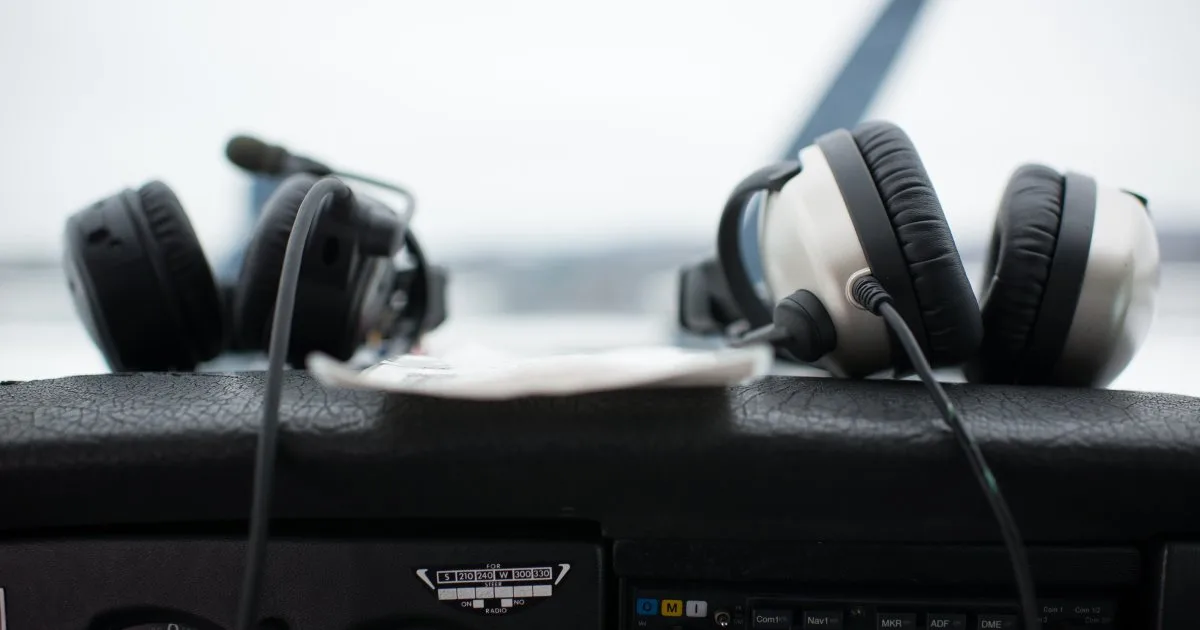
Aviation radio communication: Standard phraseology, the phonetic alphabet, typical radio calls, and the most common mistakes on frequency.
Aviation Radio Communications -- Clear Communication Saves Lives
Radio communication in aviation is not casual conversation. Every word follows a standardized system designed to eliminate misunderstandings -- because a misunderstanding on the frequency can, in the worst case, lead to a collision. ICAO has established a global standard through Doc 9432 (Manual of Radiotelephony) and Annex 10, which is supplemented by national regulations in individual countries. In the US, the FAA Aeronautical Information Manual (AIM) Chapter 4 governs pilot-controller communications. This article covers the fundamentals of radio phraseology and explains what is said, when, and why.
The ICAO Phonetic Alphabet
The foundation of all aviation radio communication is the phonetic alphabet. It is used to transmit letters unambiguously -- because "B" and "D" or "M" and "N" sound identical on a noisy frequency.
| Letter | ICAO Word | Pronunciation |
|---|---|---|
| A | Alpha | AL-FAH |
| B | Bravo | BRAH-VOH |
| C | Charlie | CHAR-LEE |
| D | Delta | DELL-TAH |
| E | Echo | ECK-OH |
| F | Foxtrot | FOKS-TROT |
| G | Golf | GOLF |
| H | Hotel | HOH-TELL |
| I | India | IN-DEE-AH |
| J | Juliet | JEW-LEE-ETT |
| K | Kilo | KEY-LOH |
| L | Lima | LEE-MAH |
| M | Mike | MIKE |
| N | November | NO-VEM-BER |
| O | Oscar | OSS-CAR |
| P | Papa | PAH-PAH |
| Q | Quebec | KEH-BECK |
| R | Romeo | ROW-ME-OH |
| S | Sierra | SEE-AIR-RAH |
| T | Tango | TANG-GO |
| U | Uniform | YOU-NEE-FORM |
| V | Victor | VIK-TAH |
| W | Whiskey | WISS-KEY |
| X | X-Ray | ECKS-RAY |
| Y | Yankee | YANG-KEY |
| Z | Zulu | ZOO-LOO |
Number Pronunciation in Aviation
Numbers in aviation are generally spoken as individual digits, with a few exceptions:
| Digit | Pronunciation | Example |
|---|---|---|
| 0 | ZERO | Runway 09: "Runway zero niner" |
| 1 | ONE (WUN) | FL 110: "Flight Level one one zero" |
| 2 | TWO (TOO) | Squawk 2345: "Squawk two tree four fife" |
| 3 | TREE | Heading 330: "Heading tree tree zero" |
| 4 | FOW-ER | 4,500 ft: "Four thousand five hundred" |
| 5 | FIFE | Altimeter 30.15: "Tree zero one fife" |
| 6 | SIX | Frequency 123.6: "One two tree point six" |
| 7 | SEV-EN | |
| 8 | AIT | |
| 9 | NIN-ER | Runway 27: "Runway two seven" |
Exceptions to digit-by-digit pronunciation: Altitude assignments in whole thousands and hundreds are spoken as compound numbers: "Two thousand five hundred" instead of "two zero zero zero fife zero zero." Flight levels are spoken as individual digits: FL090 = "Flight Level zero niner zero." Frequencies use "point" (US) or "decimal" (ICAO) for the decimal separator.
Frequency Types and Their Functions
VFR pilots encounter various frequency types:
| Frequency Type | Abbreviation | Function |
|---|---|---|
| Tower | TWR | Airport traffic control (takeoff, landing, traffic pattern) |
| Ground | GND | Taxi operations on ramps and taxiways |
| Approach/Departure | APP | Arrival and departure control within the terminal area (TMA / TRSA) |
| ATIS | ATIS | Automatic Terminal Information Service (weather, active runway, NOTAMs) |
| Flight Service / FIS | FSS / FIS | Traffic advisories and flight assistance in uncontrolled airspace (Flight Following in US) |
| CTAF / Unicom | CTAF | Self-announce operations at nontowered airports |
| Emergency frequency | 121.5 MHz | International emergency frequency, continuously monitored |
Standard Phraseology and Definitions
Aviation phraseology uses defined terms with precise meanings:
| Term | Meaning | Usage |
|---|---|---|
| AFFIRM | Yes | Affirmative response (never use "yes" on the radio) |
| NEGATIVE | No | Denial or refusal |
| ROGER | Received | Information received and understood (NOT an acknowledgment of an instruction) |
| WILCO | Will comply | Instruction understood and will be carried out |
| READBACK | Read back | Repetition of an instruction by the pilot |
| SAY AGAIN | Please repeat | When a transmission was not understood |
| STANDBY | Wait | ATC cannot respond immediately |
| CLEARED | Clearance | "Cleared for takeoff," "Cleared to land" |
| APPROVED | Approved | Request granted |
| UNABLE | Unable to comply | Instruction cannot be carried out |
| CORRECTION | Correction | When a mistake was made in a transmission |
| MAYDAY | Emergency (distress) | Immediate danger to the aircraft or its occupants |
| PAN PAN | Urgency | Serious situation, but no immediate danger (yet) |
Never use ROGER and WILCO together. ROGER means only "received," while WILCO means "received AND will comply." Saying "Roger Wilco" marks you as a beginner. And: ROGER is never a substitute for reading back a clearance.
Readback -- What Must Be Read Back?
The readback is a safety net. Certain information must always be read back:
- ATC route clearances
- Takeoff and landing clearances ("Cleared for takeoff" / "Cleared to land")
- Runway assignments
- Altitude assignments
- Heading instructions
- Speed instructions
- Squawk codes
- Frequency changes
- Altimeter settings
When reading back, repeat only the relevant information, not the entire sentence. ATC confirms a correct readback or corrects with "NEGATIVE, I SAY AGAIN..." if there are errors. An incorrect readback not caught by ATC (a hearback error) is a common contributing factor in accidents.
Typical Radio Communications in Practice
Example 1: Initial contact at a towered airport (US)
Pilot: "Oshkosh Tower, Cessna one two three alpha bravo, ten miles south, inbound for landing with information Delta"
ATC: "Cessna one two three alpha bravo, Oshkosh Tower, expect runway 18, report three-mile final"
Pilot: "Expect runway 18, will report three-mile final, Cessna three alpha bravo"
Example 2: Takeoff clearance
Pilot: "Oshkosh Tower, Cessna three alpha bravo, runway 18, ready for departure"
ATC: "Cessna three alpha bravo, runway 18, cleared for takeoff, wind one eight zero at eight"
Pilot: "Runway 18, cleared for takeoff, Cessna three alpha bravo"
Example 3: Self-announce at a nontowered airport (CTAF)
Pilot: "Ripon traffic, Cessna one two three alpha bravo, Cessna 172, five miles south, inbound, two thousand five hundred, landing runway 27, Ripon"
(No ATC response -- this is a broadcast to all traffic on the frequency for awareness)
Example 4: Emergency call (MAYDAY)
Pilot: "MAYDAY, MAYDAY, MAYDAY, Chicago Approach, Cessna one two three alpha bravo, Cessna 172, engine failure, position five miles north of Midway, altitude three thousand, two souls on board, attempting forced landing"
ATC: "Cessna one two three alpha bravo, MAYDAY acknowledged, all stations stop transmitting except Cessna three alpha bravo. Cessna three alpha bravo, squawk seven seven zero zero, say your intentions"
Radio Certificates and Language Proficiency
Requirements for radio operation vary by jurisdiction:
| Jurisdiction | Requirement | Details |
|---|---|---|
| United States (FAA) | No separate radio certificate for domestic flights | Radio proficiency is part of the pilot certificate. FCC Restricted Radiotelephone Operator Permit required for international flights |
| EASA (Europe) | Separate radio telephony certificate required | VFR certificate for national language; English-language certificate for international flights. ICAO English Language Proficiency (ELP) Level 4 minimum |
| ICAO | English Language Proficiency (ELP) | Level 4 (Operational) minimum for international operations. Levels 4 and 5 require periodic retesting |
In Europe, the radio certificate examination is administered by the national telecommunications authority and consists of a written test on procedures and regulations, plus a practical test involving simulated radio communications. In the US, radio proficiency is evaluated as part of the Private Pilot checkride.
Common Radio Communication Mistakes
Certain errors occur repeatedly among student pilots and even experienced aviators:
- Using "takeoff" outside of a clearance: The word "takeoff" is reserved exclusively for the takeoff clearance. In all other contexts, use "departure." This protocol exists because of the Tenerife disaster in 1977.
- Abbreviating callsigns on initial contact: The full callsign must be used during the first call. Only after ATC acknowledges with the abbreviated form may the pilot abbreviate to the last three characters (e.g., "three alpha bravo").
- Failing to read back the altimeter setting: The altimeter setting must always be read back, as an incorrect setting directly affects indicated altitude.
- Speaking too fast: Clarity trumps speed. Speak at a normal pace, clearly and distinctly.
- Filler words and hesitation: Release the push-to-talk button, think, then press and speak. Pauses between transmissions are normal and expected.
- Blocking the frequency: Listen briefly before transmitting to ensure the frequency is clear. Simultaneous transmissions (blocked transmissions) block the channel for everyone.
- Using "Roger" instead of a proper readback: For clearances, "Roger" is insufficient. Only a correct readback confirms that the instruction was correctly received.
Practical Tips for Everyday Radio Use
Preparation is everything: Write down key points before each transmission. In the beginning, there is no shame in writing out the entire radio call and reading it. This becomes unnecessary with experience.
Learn to listen: Listen to LiveATC.net streams or real frequencies during preflight preparation. Training your ear is at least as important as training your voice.
The structure of every call: Every radio transmission follows the pattern: Who you are calling + Who you are + What you want. In the reply: Who is being called + The instruction or information.
When in doubt, ask: "Say again" is not a weakness -- it is professional behavior. It is always better to ask once too often than to follow an incorrect instruction. ATC does not expect perfection from private pilots -- but it does expect correct readbacks and compliance with instructions.
Radio communication is a skill that comes with practice. The initial nervousness gives way to confident professionalism with experience. A pilot who has the basics mastered can focus on what truly matters: flying safely.
