
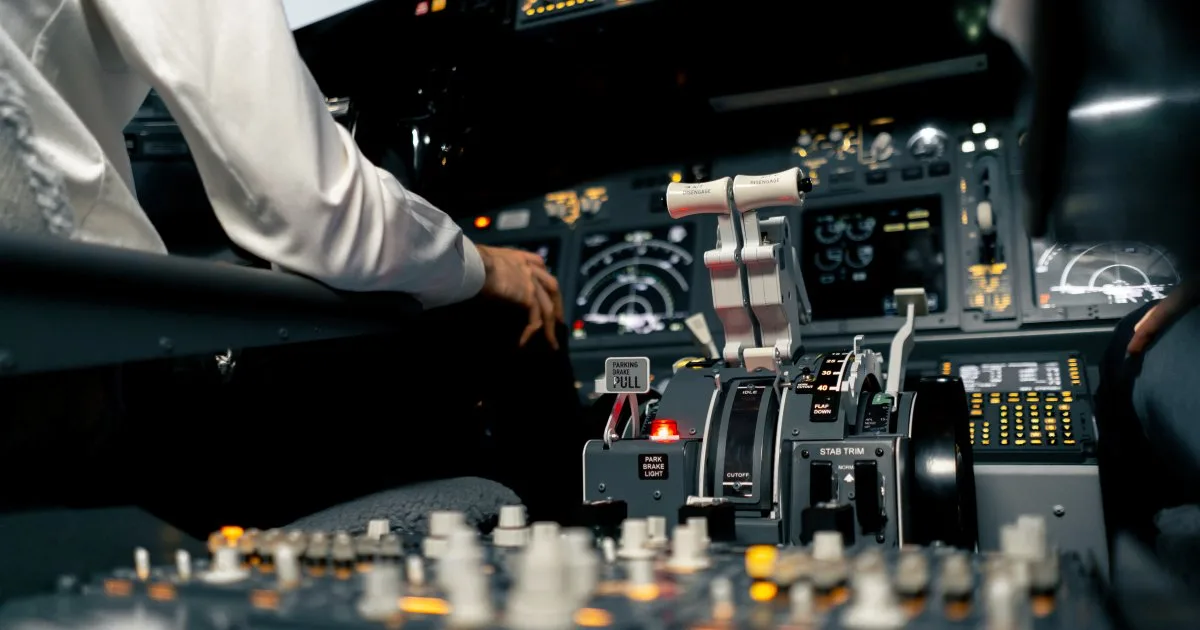
Cabin pressure in flight: How pressurization systems work, what happens during depressurization, oxygen masks, and why Helios Flight 522 crashed.
Pressurized Cabin — How It Works and What Happens When It Fails
The pressurized cabin is one of the most critical safety systems on modern aircraft. It enables flight at altitudes where humans would lose consciousness within minutes and die without technical assistance. But what happens when this system fails? How does cabin pressurization actually work? And which tragic accidents illustrate just how fatal a loss of pressure can be? This article explains the physics, the engineering, and the dramatic consequences of pressurization failure.
Why Do Aircraft Need a Pressurized Cabin?
Earth's atmosphere becomes thinner with increasing altitude. Air pressure at sea level is approximately 1,013 hPa (29.92 inHg) — at 33,000 feet (FL330), it is only about 265 hPa, roughly one-quarter of the surface pressure. The oxygen partial pressure drops accordingly, and the human body can no longer absorb sufficient oxygen.
The physiological limits are well defined:
| Altitude | Pressure (hPa) | Physiological Effect |
|---|---|---|
| Sea Level (MSL) | 1,013 | Normal — no impairment |
| 5,000 ft (1,524 m) | 843 | No noticeable effects for healthy individuals |
| 8,000 ft (2,438 m) | 753 | Typical maximum cabin altitude — mild fatigue possible |
| 10,000 ft (3,048 m) | 697 | Supplemental O2 recommended (EASA: required at night; FAA: required above 12,500 ft for crew after 30 min, above 14,000 ft continuously) |
| FL140 (14,000 ft) | 596 | Supplemental O2 required for crew (EASA OPS / FAA 14 CFR 91.211) |
| FL250 (25,000 ft) | 376 | Severe hypoxia — loss of consciousness within minutes |
| FL350 (35,000 ft) | 238 | Without O2: loss of consciousness in 30–60 seconds |
| FL410 (41,000 ft) | 179 | Without O2: loss of consciousness in 15–20 seconds |
| FL600+ (60,000 ft) | <72 | Armstrong Limit: body fluids begin to boil |
Regulatory requirements are correspondingly strict: Under EASA regulations, supplemental oxygen must be available above FL100 (10,000 ft) and is required at night. Above FL140, the flight crew must continuously use oxygen. Above FL250, all occupants must have access to oxygen. Under FAA regulations (14 CFR 91.211), requirements are structured similarly, with crew oxygen required above 12,500 ft MSL after 30 minutes and continuously above 14,000 ft MSL, and passenger oxygen required above FL250. Pressurized aircraft circumvent these limitations by maintaining cabin pressure at a tolerable level.
Cabin Altitude vs. Flight Altitude: The Basic Principle
A pressurized cabin creates a higher pressure inside the aircraft than exists outside. The goal is to maintain the cabin altitude — the pressure equivalent of a given altitude — at a physiologically tolerable level.
Typical cabin altitudes at cruise:
| Aircraft Type | Max. Flight Altitude | Cabin Altitude at Cruise |
|---|---|---|
| Boeing 737 MAX | FL410 | 6,720 ft (2,050 m) |
| Airbus A320neo | FL390 | 6,400 ft (1,950 m) |
| Boeing 787 Dreamliner | FL430 | 6,000 ft (1,829 m) |
| Airbus A350 | FL430 | 6,000 ft (1,829 m) |
| Gulfstream G700 | FL510 | 4,850 ft (1,478 m) @ FL510 |
| Bombardier Global 7500 | FL510 | 5,680 ft (1,731 m) @ FL510 |
| Cirrus Vision SF50 | FL280 | 8,000 ft (2,438 m) @ FL280 |
Modern widebody aircraft like the Boeing 787 and Airbus A350 achieve particularly low cabin altitudes of just 6,000 ft. This is made possible by CFRP (carbon fiber) fuselages that tolerate a higher pressure differential than conventional aluminum fuselages. The lower cabin altitude significantly reduces passenger fatigue, jet lag symptoms, and mucous membrane dehydration.
How Pressurization Works
Cabin pressurization works on a simple principle: air is pumped into the cabin and released in a controlled manner. The pressure difference between inside and outside is regulated by balancing air supply and air outflow.
Air Supply: Bleed Air and Electric Compressors
On most conventional aircraft, pressurized air is supplied as bleed air extracted from the engine compressors. The compressor stages of a jet engine compress air to many times the ambient pressure — a portion of this air is tapped off and routed to the cabin.
Bleed air exits the compressor at temperatures of 400 to 750 degrees Fahrenheit and must first be cooled in the air conditioning pack (Environmental Control System) to comfortable temperatures. This is accomplished through heat exchangers (ram air heat exchangers), turbines (Air Cycle Machine), and mixers that regulate the air temperature to 64 to 75 degrees Fahrenheit.
The Boeing 787 Dreamliner was the first major airliner to eliminate bleed air, using electrically driven compressors for cabin pressurization instead. This offers efficiency advantages since the engines are not burdened by air extraction, and it enables more precise regulation.
Pressure Regulation: The Outflow Valve
The central element of pressure regulation is the outflow valve. Typically located at the aft lower fuselage, it controls how much air exits the cabin. By opening and closing the valve, cabin altitude is controlled:
- Valve more closed: Less air escapes, cabin pressure rises, cabin altitude decreases.
- Valve more open: More air escapes, cabin pressure drops, cabin altitude increases.
- Valve fully open: Cabin is depressurized — cabin pressure equals ambient pressure.
Control is automatic via the Cabin Pressure Controller, which regulates cabin altitude based on current flight altitude, planned cruise altitude, and destination field elevation. The controller manages cabin altitude changes to be smooth and gradual — typically at a maximum rate of 300 to 500 ft/min during climb and 200 to 300 ft/min during descent. This gradual rate prevents uncomfortable ear pressure.
Differential Pressure: The Structural Limit
The differential pressure (Delta-P) is the difference between cabin pressure and ambient pressure. It represents the primary structural load on the fuselage — in essence, a pressurized aircraft is a flying pressure vessel.
Typical maximum pressure differentials:
| Aircraft Type | Max. Differential Pressure (PSI) | Max. Differential Pressure (hPa) |
|---|---|---|
| Cirrus Vision SF50 | 5.0 | 345 |
| Citation CJ3+ | 8.9 | 614 |
| Boeing 737 | 8.35 | 576 |
| Airbus A320 | 8.06 | 556 |
| Boeing 787 | 9.4 | 648 |
| Gulfstream G700 | 10.7 | 738 |
At 8.5 PSI differential pressure, every square foot of fuselage skin bears a load of approximately 1,224 lbs. On a Boeing 737 fuselage with a surface area of approximately 1,940 square feet, this sums to a total load exceeding 1,000 tons — a tremendous force acting on the fuselage structure during every flight. This cyclic loading (pressurization cycle) is one of the primary factors determining the structural life of an aircraft.
Safety valves (positive pressure relief valves and negative pressure relief valves) prevent the differential pressure from exceeding allowable limits. They open automatically when the differential pressure reaches structural limits — independent of the electronic control system.
Rapid Decompression vs. Slow Decompression
A loss of pressurization can occur in two fundamentally different ways:
Rapid Decompression
A rapid decompression occurs when a large opening develops in the fuselage — for example, through loss of a window, a door, or a structural failure. Cabin pressure drops to ambient pressure within seconds (typically 1 to 10 seconds).
The signs are dramatic and immediate:
- Condensation fog: The sudden pressure drop causes the air to cool rapidly and water vapor condenses — the cabin fills with dense, white fog.
- Noise: The escaping airflow produces extreme, deafening noise.
- Temperature plunge: The temperature drops within seconds to the outside air temperature — at FL400, typically minus 67 degrees Fahrenheit.
- Flying debris: Loose objects are drawn toward the opening. In the case of a window loss, occupants in the immediate vicinity of the opening can be sucked out.
- Oxygen deprivation: The oxygen partial pressure immediately drops to the level of the flight altitude — at FL400, life-threatening.
Slow Decompression
A slow decompression is considerably more insidious than a rapid decompression because it progresses gradually and often goes unnoticed. Typical causes include defective seals, a stuck outflow valve, a leak in the pressure vessel wall, or an improperly closed service panel.
Cabin altitude rises slowly over minutes or hours. The symptoms of developing hypoxia (oxygen deprivation) are subtle and frequently go unrecognized:
- Euphoria or inappropriate cheerfulness
- Impaired judgment
- Deteriorating vision (especially at night)
- Tingling or numbness in fingers and toes
- Bluish discoloration of lips and fingernails (cyanosis)
- Gradual loss of consciousness without warning
The danger of hypoxia is that the affected individual does not recognize their own impairment. A pilot suffering from hypoxia typically believes everything is fine — even as their actions become irrational. This phenomenon is known as "insidious hypoxia" and is the primary reason slow decompressions are so dangerous.
Oxygen Supply: The Last Line of Defense
Passenger Service Units (PSU) — Passenger Masks
In airliners, at a cabin altitude of 14,000 ft, oxygen masks automatically deploy from the Passenger Service Units (PSUs) above the seats. These masks are supplied by a chemical oxygen generator activated by pulling on the mask. The generator produces oxygen through an exothermic chemical reaction (typically sodium chlorate + iron powder + barium peroxide) and supplies oxygen for approximately 12 to 22 minutes — sufficient to give the pilots time for an emergency descent to a safe altitude.
Important: PSU masks do not deliver pure oxygen but rather an oxygen-air mixture via a continuous-flow regulator. They are designed for altitudes up to approximately FL400 — at higher cabin altitudes, the oxygen concentration may be insufficient to maintain consciousness.
Crew Oxygen — Quick-Donning Masks
Pilots have quick-donning masks that can be put on within a maximum of 5 seconds using one hand. These masks deliver 100 percent oxygen under pressure (diluter-demand or pressure-demand system) and are rated for the aircraft's entire altitude envelope.
Quick-donning masks are supplied from a high-pressure gaseous oxygen system (typically 1,800 PSI) and provide 60 to 120 minutes of supply. They often incorporate a built-in microphone and smoke protection (smoke goggles) for cockpit fire scenarios.
Regulatory requirement: Under EASA rules, when flying above FL250, one pilot must wear a quick-donning mask whenever the other pilot leaves the cockpit seat (e.g., for a restroom break). Above FL410, both pilots must keep their masks within immediate reach. FAA regulations (14 CFR 91.211 and 121.333) impose similar requirements.
Time of Useful Consciousness (TUC)
The Time of Useful Consciousness (TUC) — also called Effective Performance Time (EPT) — is the interval between the onset of hypoxia and the point at which the affected person can no longer take corrective action. It is one of the most critical metrics in aviation medicine:
| Cabin Altitude | TUC (At Rest) | TUC (Physical Activity) |
|---|---|---|
| FL220 (22,000 ft) | 5 – 10 minutes | 3 – 5 minutes |
| FL250 (25,000 ft) | 3 – 5 minutes | 2 – 3 minutes |
| FL300 (30,000 ft) | 1 – 2 minutes | 30 – 60 seconds |
| FL350 (35,000 ft) | 30 – 60 seconds | 15 – 30 seconds |
| FL400 (40,000 ft) | 15 – 20 seconds | 8 – 15 seconds |
| FL430 (43,000 ft) | 9 – 12 seconds | 5 – 9 seconds |
| FL500 (50,000 ft) | 5 – 9 seconds | 3 – 5 seconds |
Critical fact: During a rapid decompression at FL400, a pilot has fewer than 20 seconds to don their oxygen mask before becoming incapacitated. Every second counts. This is why the quick-donning mask is always within arm's reach of the pilot's seat.
Emergency Descent: The Immediate Response
During any decompression — whether rapid or slow — an immediate descent to a safe altitude is the top priority. The standard emergency descent procedure:
- Step 1 — Don oxygen masks: Highest priority. Pilots immediately put on their quick-donning masks and select 100% oxygen. Only then are further actions taken. The rule is: "Don your own mask first" — the same instruction cabin crew gives to passengers.
- Step 2 — Disconnect autopilot (or activate Emergency Descent Mode): Some modern aircraft feature automatic emergency descent modes that bring the aircraft to a safe altitude autonomously if the crew is incapacitated.
- Step 3 — Thrust to idle: Engines are pulled to idle to maximize descent rate and minimize fuel consumption.
- Step 4 — Deploy speed brakes: Spoilers/speed brakes are fully deployed to increase drag and steepen the descent.
- Step 5 — Accelerate to VMO/MMO: The aircraft is accelerated to its maximum operating speed to maximize the rate of descent. The resulting descent rate is typically 4,000 to 6,000 ft/min.
- Step 6 — Target: FL100 (or MEA): The descent continues to FL100 (10,000 ft) — the altitude at which most people can breathe comfortably without supplemental oxygen. In mountainous terrain, the Minimum Enroute Altitude (MEA) is used as the target altitude instead.
- Step 7 — Notify ATC: Squawk 7700 (Emergency), declare Mayday, and request immediate descent clearance. If no clearance is received, the Captain has the authority to descend unilaterally — safety takes absolute priority.
The time from FL400 to FL100 during an emergency descent is typically 4 to 7 minutes — the chemical oxygen generators in the passenger masks (12–22 minutes) are designed to comfortably cover this duration.
Case Study: Helios Airways Flight 522 (August 14, 2005)
The crash of Helios Airways Flight 522 is one of the most tragic examples of the consequences of an undetected slow decompression. The Boeing 737-300 en route from Larnaca (Cyprus) to Athens (Greece) crashed in the mountains north of Athens. All 121 people on board perished.
What Happened:
- Following an overnight pressurization leak check, the Pressurization Mode Selector was inadvertently left in the "MAN" (Manual) position instead of "AUTO."
- During takeoff and climb, the crew did not notice that automatic pressure regulation was inactive. The outflow valve remained open.
- At FL120, the cabin altitude warning horn sounded — but the crew mistook it for the takeoff configuration warning horn, which produces a similar tone.
- The crew did not respond correctly. Instead, they contacted the maintenance center and discussed supposed avionics problems.
- By FL340, both pilots were unconscious from hypoxia. The passenger oxygen masks had deployed at 14,000 ft cabin altitude, but the chemical generators were exhausted after approximately 12 minutes.
- The aircraft continued flying on autopilot, orbiting in the hold over Athens airport until fuel exhaustion.
- A flight attendant, Andreas Prodromou, who had used a portable oxygen bottle, attempted to reach the cockpit and save the aircraft. However, he had no B737 pilot training and could not prevent the crash.
Lessons from Helios 522:
- Checklist discipline: The after-takeoff checklist would have caught the incorrect pressurization mode.
- Crew awareness: The confusion of warning sounds was a fatal error in the human-machine interface.
- Outcome: EASA and the manufacturers improved the distinctiveness of warning sounds and introduced additional checklist items. The NTSB and FAA also issued related safety recommendations.
Case Study: Payne Stewart (October 25, 1999)
The crash of the Learjet 35 carrying American professional golfer Payne Stewart is another well-known example of the consequences of pressurization failure. The aircraft flew uncontrolled across several U.S. states before crashing in South Dakota. All six people on board died.
What Happened:
- Shortly after departing Orlando, Florida, bound for Dallas, Texas, the crew presumably lost consciousness due to a loss of cabin pressure.
- The exact cause could not be conclusively determined due to the destruction on impact. The NTSB investigation concluded the probable cause was incapacitation of the flight crew due to loss of cabin pressurization, for undetermined reasons.
- The aircraft flew on autopilot at FL390 for over 1,500 miles across half the continent.
- U.S. Air Force interceptor jets flew alongside the Learjet and could detect no movement inside the cabin through the windows. The windows were iced over — an indication that the cabin was no longer pressurized and the interior temperature had dropped to the outside level of minus 67 degrees Fahrenheit.
- After approximately 4 hours, fuel was exhausted and the aircraft crashed into a field in South Dakota.
Lessons from the Stewart Accident:
- Pressurization awareness: Even in business jets, crews must continuously monitor cabin altitude.
- Automatic warning systems: Modern business jets feature improved cabin altitude warning systems that provide visual and audible alerts and, on some models, initiate automatic emergency descents.
- Redundancy: The lesson underscores the importance of redundant pressurization systems and regular maintenance of all pressure-bearing components.
Modern Safety Measures
The aviation industry has learned from these tragic accidents and implemented numerous safety measures:
- Cabin Altitude Warning: Visual and audible warnings when cabin altitude exceeds 10,000 ft. On the Boeing 737, a penetrating horn sounds and the "CABIN ALTITUDE" warning light illuminates.
- Auto-Descent Systems: Some business jets (e.g., newer Gulfstream models, Bombardier Global series) feature automatic emergency descent systems that bring the aircraft to FL140 or below if the pilots are incapacitated.
- Dual Outflow Valves: Redundant outflow valves ensure that a single valve failure does not cause complete depressurization.
- Structural Inspection: Regular pressure tests and inspections of the fuselage structure for cracks and fatigue damage are part of every maintenance program, per EASA and FAA airworthiness directives.
- Enhanced Crew Training: Hypoxia awareness training in altitude chambers or using Reduced Oxygen Breathing Devices (ROBD) has become standard for many operators.
Special Considerations for Business Jets
Business jets typically cruise at FL410 to FL510 — significantly higher than most airliners. The TUC at these altitudes is only 9 to 20 seconds. This imposes special requirements:
- Quick-donning masks: In business jets with maximum operating altitudes above FL250, quick-donning masks are mandatory for pilots (per both EASA and FAA regulations).
- Crew oxygen duration: The oxygen supply must last for the entire emergency descent plus an adequate reserve — typically 60 to 120 minutes.
- Single-pilot operations: In single-pilot jets (e.g., CJ3+, Phenom 100), the risk of an undetected slow decompression is elevated since no second pilot is available to notice symptoms in the other.
- Passenger briefing: In business jet operations, a thorough passenger briefing on oxygen masks and emergency procedures is particularly important, as passengers are often infrequent flyers.
Conclusion
The pressurized cabin is one of the unsung heroes of modern aviation — it operates reliably in the background and enables flight at altitudes that would be lethal without it. Its failure ranks among the most dramatic scenarios in flying: the combination of extreme cold, oxygen deprivation, and minimal reaction time makes every decompression a potentially life-threatening event. The tragic examples of Helios 522 and Payne Stewart demonstrate that even modern technology cannot protect against human error — and that an understanding of pressurization systems, hypoxia symptoms, and emergency procedures is a matter of survival for every pilot. Consistent monitoring of cabin altitude, immediate donning of the oxygen mask at the first sign of trouble, and regular hypoxia awareness training are the three pillars on which high-altitude flight safety rests.
