
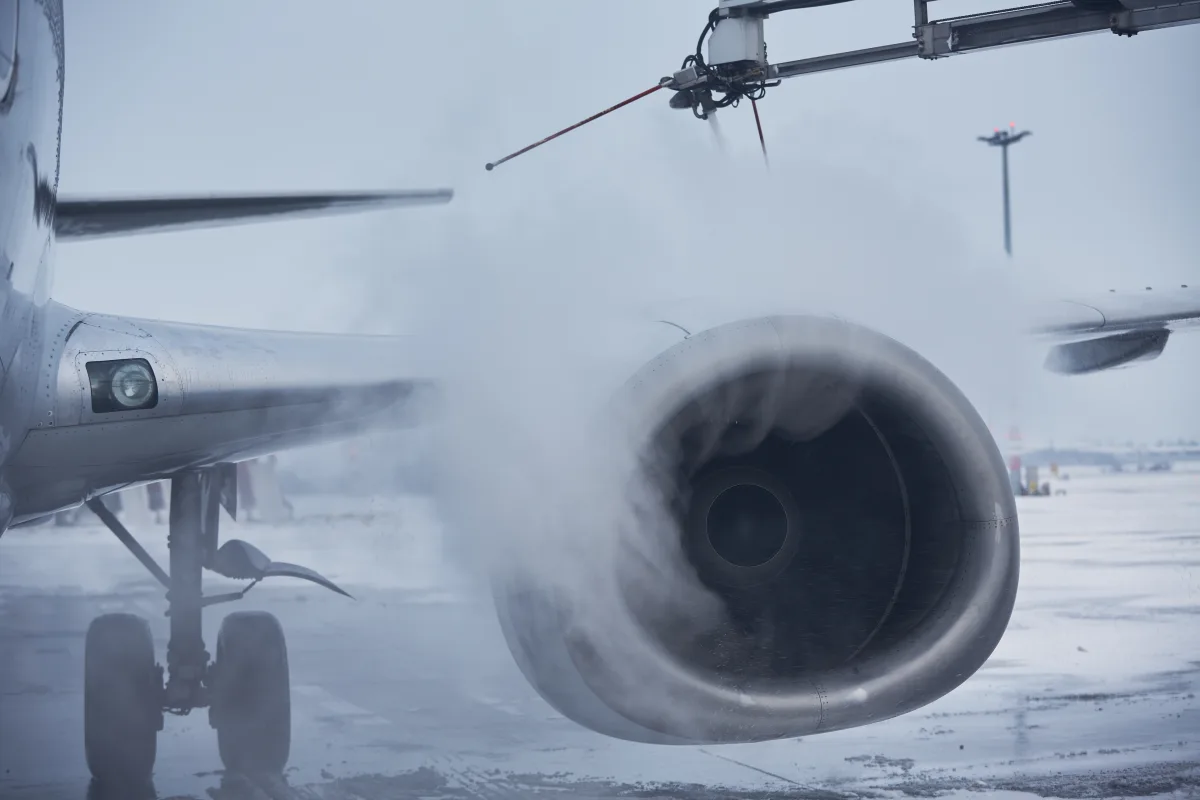
Ice formation on aircraft: Clear ice, rime ice, mixed ice — how icing changes flight characteristics, anti-icing vs. de-icing, and the deadliest icing accidents.
Icing -- Why Ice Is So Dangerous and How to Deal With It
Icing is one of the most insidious hazards in aviation. What appears harmless at first glance -- a thin layer of ice on the wing -- can dramatically degrade an aircraft's flight characteristics and, in the worst case, lead to loss of control. Icing has caused numerous accidents, from light aircraft to wide-body jets. A thorough understanding of the different types of ice, their effects, and the available countermeasures is vital for every pilot's survival.
The Physics of Icing: How Does Ice Form on an Aircraft?
Icing occurs when an aircraft flies through air masses containing supercooled water. Supercooled water droplets remain liquid despite their temperature being below the freezing point -- a metastable state. As soon as these droplets strike the aircraft's surface, they crystallize instantly and form a layer of ice. The type of ice that forms depends on the temperature, droplet size, and airspeed.
Ice Types: Clear Ice, Rime Ice, and Mixed Ice
Clear Ice (Glaze Ice)
Clear ice typically forms at temperatures between 32 degrees F and 14 degrees F (0 degrees C to -10 degrees C), when large supercooled water droplets strike the aircraft surface. The water does not freeze completely on impact but initially flows partially over the surface before solidifying. The result is a smooth, transparent, and extremely hard layer of ice.
Clear ice is the most dangerous type for several reasons:
- Difficult to detect: Due to its transparency, clear ice is often barely visible, especially at night or in clouds.
- High density and strength: Clear ice adheres extremely firmly to surfaces and is difficult to remove.
- Rapid accumulation: In severe clear icing conditions, ice can build so quickly that de-icing systems cannot keep pace.
- Profile distortion: Clear ice preferentially forms on leading edges and alters the aerodynamic profile of the wing in unpredictable ways.
Rime Ice
Rime ice forms at temperatures between 14 degrees F and -4 degrees F (-10 degrees C to -20 degrees C), when small supercooled water droplets strike the surface and freeze completely on impact. Because the water does not flow, the ice traps air bubbles, giving it its characteristic milky-white, rough surface.
Compared to clear ice, rime ice is less dangerous as it is lighter, more porous, and more easily removed by de-icing systems. Nevertheless, rime ice must never be underestimated: even a rough ice surface on the wing significantly increases drag and reduces lift.
Mixed Ice
Mixed ice forms in temperature ranges where both clear and rime ice conditions prevail, typically between 14 degrees F and 5 degrees F (-10 degrees C to -15 degrees C). It combines characteristics of both ice types and is very commonly encountered in practice. Mixed ice is irregularly shaped and can form particularly aerodynamically unfavorable surface structures.
| Property | Clear Ice | Rime Ice | Mixed Ice |
|---|---|---|---|
| Temperature Range | 32 to 14 deg F (0 to -10 deg C) | 14 to -4 deg F (-10 to -20 deg C) | 14 to 5 deg F (-10 to -15 deg C) |
| Appearance | Transparent, smooth | Milky-white, rough | Irregular |
| Density | High | Low (porous) | Medium |
| Adhesion | Extremely strong | Moderate | Strong |
| Danger Level | Very high | Medium | High |
| Removability | Difficult | Easier | Medium |
Effects of Icing on the Aircraft
Lift Loss and Drag Increase
The aerodynamic consequences of icing are dramatic and often underestimated. Even a thin layer of ice on the wing -- as thin as coarse sandpaper -- can reduce lift by up to 30% and increase drag by up to 40%. NASA wind tunnel tests have demonstrated that ice accumulation with the roughness of coarse sandpaper on a wing's leading edge can reduce the maximum lift coefficient by one-third.
Even more critically: the stall speed increases significantly. An aircraft that normally stalls at 60 knots may experience a stall at 80 or even 90 knots with ice accumulation -- and without the typical warning signs such as buffeting. The stall with ice contamination often comes abruptly and without warning.
Pitot and Static Port Icing
A particularly insidious form of icing affects the pitot tubes and static ports. When the pitot tube ices over, the airspeed indicator delivers false readings. Depending on the type of icing, the indicated airspeed may freeze, drop to zero, or even increase despite the aircraft decelerating.
When the static ports ice over, the altimeter, vertical speed indicator, and airspeed indicator all become unreliable simultaneously. The crew loses three of the most critical instruments at once. Precisely this scenario was a central factor in the crash of Air France Flight 447.
Propeller Icing
Icing does not only affect the wings. Propeller blades are equally susceptible, and ice accumulation on the propeller leads to vibration, power loss, and asymmetric thrust. In severe cases, ice chunks can break free from the propeller and be hurled against the fuselage, potentially causing structural damage. Turboprop aircraft therefore feature propeller de-icing systems, typically electric heating mats embedded in the blades.
Engine Icing
In jet engines, ice on the engine inlet can obstruct airflow or break loose and be ingested by the engine, potentially damaging compressor stages or even causing engine failure. Modern jet engines therefore use bleed air systems to heat the engine inlets.
Anti-Icing vs. De-Icing: Prevention or Removal
Aviation fundamentally distinguishes between two strategies:
- Anti-Icing: Prevents ice formation before it begins. Activated before and during flight through icing conditions.
- De-Icing: Removes ice that has already formed. Activated after a certain amount of ice has accumulated.
TKS Fluid Weeping Wing
The TKS system (named after its inventors Tecalemit, Kilfrost, and Sheepbridge Stokes) pumps a glycol-based fluid through fine pores in titanium panels on the leading edges of the wings, horizontal stabilizer, and sometimes the propeller. The fluid distributes itself across the surface and lowers the freezing point of water so that no ice adheres. The system can be used both preventively (anti-icing) and for removing existing ice (de-icing) and is particularly common in GA, for example in Mooney, Cirrus, and Piper aircraft.
Pneumatic Boots
Pneumatic de-icing boots are inflatable rubber panels on the leading edges of wings and tail surfaces. When ice has formed, the boots are inflated with compressed air, deforming the surface and breaking off the ice. The boots are then deflated. This system has been in use since the 1930s and is widely deployed in GA and turboprop aircraft. A common misconception is that you must wait until a certain amount of ice has built up before activating the boots -- modern boots can and should be used immediately upon ice accumulation.
Bleed Air Hot Wing
Large transport aircraft with jet engines typically use hot bleed air from the engine compressors to heat the leading edges of wings, tail surfaces, and engine inlets. This highly effective system is operated as an anti-icing system -- activated before the aircraft enters icing conditions to completely prevent ice formation. On modern aircraft like the Boeing 787, electric heating systems are used instead of bleed air, as the 787 does not employ a conventional bleed air architecture.
Electrical De-Icing
Electrical de-icing systems use heating wires or mats embedded in the leading edge surfaces. They are more efficient than bleed air systems and are increasingly used in modern aircraft. Electrical systems can operate in both anti-icing (continuous heating) and de-icing (cyclic heating) modes.
Carburetor Icing: The Underestimated Hazard in Piston Engines
A particularly treacherous form of icing affects carburetors in piston engines and can occur even at outside air temperatures as high as 77 degrees F (25 degrees C). This sounds paradoxical but is easily explained by physics: the Venturi effect in the carburetor causes the temperature of the inducted air to drop by as much as 36-54 degrees F (20-30 degrees C). Simultaneously, fuel evaporation extracts additional heat from the air. Combined with high humidity, ice can form in the carburetor even when outside temperatures are well above freezing.
Carburetor icing manifests as a gradual power loss in fixed-pitch propellers (RPM drop) or a manifold pressure decrease in constant-speed propellers. The countermeasure is carburetor heat, which directs hot air from the exhaust manifold to the carburetor. Important: when carburetor icing is suspected, carb heat must be applied fully -- a half-hearted application can worsen the situation, as partially heated air can promote icing in a more critical area of the carburetor.
Rule of thumb: Carburetor icing is most likely at temperatures between 41 degrees F and 68 degrees F (5 degrees C to 20 degrees C) with high humidity. Many pilots associate icing only with cold winter conditions and overlook this hazard in mild weather.
Ground De-Icing: Type I Through Type IV
Before an aircraft can depart in winter conditions, all critical surfaces must be free of ice, snow, and frost -- the so-called Clean Aircraft Concept mandated by both FAA (14 CFR 121.629 and 135.227) and EASA regulations. Ground de-icing uses specialized fluids classified into four types by their properties:
| Type | Function | Color | Holdover Time |
|---|---|---|---|
| Type I | De-Icing (ice removal) | Orange | Short (minutes) |
| Type II | Anti-Icing (ice prevention) | White/Light Yellow | Medium (20-45 min) |
| Type III | Anti-Icing (for slower aircraft) | Light Yellow | Medium |
| Type IV | Anti-Icing (long-duration protection) | Green | Long (up to 80 min) |
Typically, a two-step procedure is applied: first, heated Type I fluid removes existing ice (de-icing), then Type II or Type IV is applied as a protective layer (anti-icing). The Holdover Time indicates how long the anti-icing protection remains effective under specific weather conditions. Once the holdover time expires, the de-icing procedure must be repeated.
Air France 447: Pitot Icing with Catastrophic Consequences
On June 1, 2009, Air France Flight 447, an Airbus A330-200, crashed into the Atlantic on its way from Rio de Janeiro to Paris. All 228 people on board perished. The investigation by the Bureau d'Enquetes et d'Analyses (BEA) -- France's equivalent of the NTSB -- determined that the aircraft's pitot tubes iced over as it flew through a thunderstorm in the Intertropical Convergence Zone.
The icing of the pitot probes caused the airspeed measurement to fail, whereupon the autopilot disconnected and the flight control system transitioned from Normal Law to Alternate Law. The inexperienced crew -- the captain was on his rest break -- reacted inadequately: the pilot flying pulled back on the sidestick and put the aircraft into a steep climb. The aircraft stalled, and the crew failed to recognize the situation for over three minutes as the aircraft fell toward the ocean at a descent rate exceeding 10,000 feet per minute.
This accident led to far-reaching consequences: Airbus replaced the vulnerable Thales pitot probes with more robust Goodrich models. Airlines worldwide intensified training for unreliable airspeed indications and upset recovery. The tragedy of AF447 demonstrated how a seemingly mundane icing event can trigger a chain of events leading to the loss of a modern transport aircraft.
When NOT to Fly: The Decision Boundaries
The most important defense against icing is the decision not to fly into known icing conditions when the aircraft is not certified and equipped for it. The following situations demand particular caution:
- Visible moisture at temperatures at or below 32 degrees F (0 degrees C): Clouds, rain, or drizzle at temperatures near the freezing point are a clear indication of icing hazard.
- Freezing Rain or Freezing Drizzle (FZRA/FZDZ): These conditions produce the most severe and dangerous form of icing. No aircraft -- regardless of size or equipment -- is certified for sustained flight in freezing rain.
- Supercooled Large Droplets (SLD): Large supercooled droplets can deposit far behind the protected leading edges of the wings, where no de-icing systems operate. SLD conditions require immediate departure from the affected altitude layer.
- Sustained flight in clouds at 23 to 5 degrees F (-5 to -15 degrees C): This temperature range carries the highest icing potential, as it contains the greatest concentration of supercooled water droplets.
Icing is a hazard that affects every pilot -- from gliders to wide-body jets. The best strategy is avoidance. Anyone who does encounter icing conditions must know their aircraft's systems, activate them in time, and be prepared to exit the icing environment before the situation becomes uncontrollable. The physics of ice are unforgiving, and no de-icing system can fight indefinitely against severe icing.
