
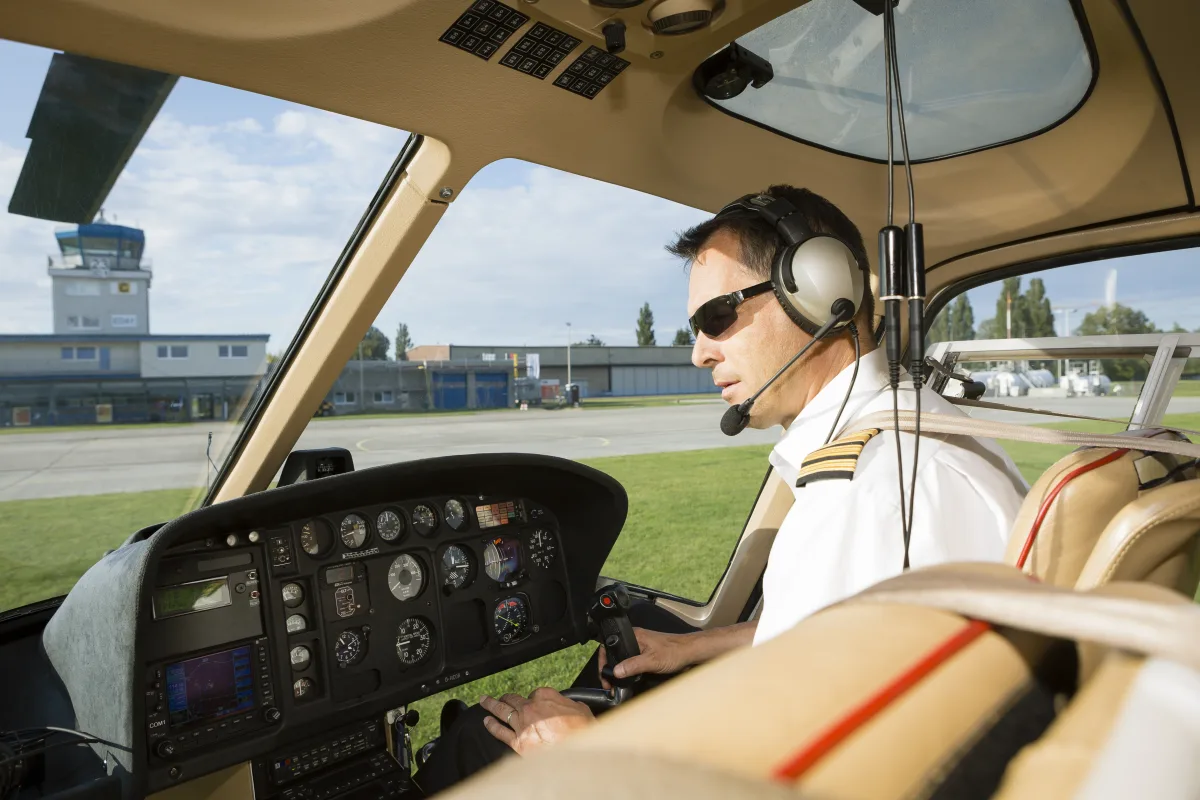
Hover control: Why hovering is the most difficult exercise, what forces are at play, and how collective, cyclic, and pedals work together.
Hovering -- Why It Is the Most Difficult Exercise in All of Aviation
It sounds paradoxical: the hardest part of helicopter flying is not the flying -- it is the standing still. The hover, as it is known in aviation, is regarded by pilots, flight instructors, and aviation experts as the most demanding exercise in all of flying. No maneuver in fixed-wing aircraft, sailplanes, or ultralight aviation comes even close to matching the complexity and coordination required to hold a helicopter in a stable hover. This article explains the physics behind the hover, why it is so extraordinarily difficult, and how aspiring helicopter pilots learn this fundamental skill.
Hover Physics -- What Happens When the Helicopter Stands Still
In forward flight, the helicopter benefits from a phenomenon called translational lift: above approximately 15 to 24 knots (ETL -- Effective Translational Lift), the rotor continuously moves through "clean" air that has not yet been accelerated by the rotor. The rotor operates more efficiently, and the helicopter receives a noticeable lift boost -- experienced pilots describe this moment as "climbing onto an air cushion."
In the hover, this forward component is entirely absent. The rotor works in its own downwash. The air that has already been accelerated downward is partially re-ingested and pushed through the rotor again -- an inefficient cycle known as recirculation. The result: the helicopter requires significantly more engine power to hover than to fly forward. In a Robinson R22, hover power demand is approximately 85 to 95 percent of maximum available power, while cruise flight at 80 knots requires only about 60 to 70 percent.
This high power demand has practical consequences: on hot days, at high elevations, or at high gross weight, the helicopter may be unable to hover -- the so-called hover ceiling has been reached. Pilots must consult the performance charts in their Rotorcraft Flight Manual before every flight to ensure that a hover is even possible under the given conditions (temperature, elevation, weight).
Ground Effect -- The Invisible Air Cushion
Another important factor in hovering is the ground effect. When the helicopter hovers at a height less than approximately one rotor diameter above the surface, the rotor downwash is reflected by the ground and creates an "air cushion" that provides additional support. This phenomenon reduces the power requirement by approximately 10 to 15 percent.
Two conditions are distinguished:
- IGE -- In Ground Effect: Hover within one rotor diameter of the surface (e.g., for an R22 with a 25.2 ft rotor diameter: below approximately 25 ft). Ground effect is active, and power demand is reduced.
- OGE -- Out of Ground Effect: Hover above one rotor diameter. No ground effect, maximum power demand. OGE hover requires significantly more engine power and is not possible in many situations (hot, high, heavy).
The transition from IGE to OGE is clearly perceptible to the pilot: when climbing out of ground effect, the helicopter suddenly settles as the supporting air cushion falls away. The pilot must pull additional collective to maintain altitude -- which in turn demands more engine power and immediately requires pedal corrections.
Pendulum Tendency -- The Helicopter Does Not Want to Stand Still
A helicopter in a hover is inherently unstable -- unlike an airplane in cruise flight, which tends to return to its original attitude when disturbed (static stability). The hovering helicopter behaves like an inverted pendulum: the center of gravity hangs below the suspension point (the rotor head), and any displacement tends to amplify rather than self-correct.
Imagine balancing a broomstick vertically on the palm of your hand. If it tips slightly to the left, you must quickly move your hand to the left to straighten it. The helicopter in a hover works exactly the same way -- except in three dimensions simultaneously. Every deviation must be corrected immediately, or it will grow. The pilot must continuously make small, precise adjustments on all controls to keep the helicopter at a single point.
This instability is further complicated by the gyroscopic precession effect. Due to precession, a force applied to the spinning rotor disk takes effect not at the point where it is applied but 90 degrees later in the direction of rotation. When the pilot pushes the cyclic forward, the rotor disk does not tilt forward immediately but at a point offset by 90 degrees. The rotor head mechanism must compensate for this effect, but the pilot still experiences the resulting lag and the non-intuitive control response.
Control Coupling -- Everything Is Connected to Everything
The central difficulty of the hover lies in the complete cross-coupling of all four control inputs. In forward flight, the controls act somewhat like those in an airplane -- relatively independently of each other. In the hover, however, every input affects every other axis:
Collective (left hand) = Altitude: The pitch lever changes the angle of attack of all rotor blades simultaneously. Collective up = more lift = helicopter climbs. Collective down = less lift = helicopter descends. But: a higher angle of attack means more rotor drag, which increases reactive torque. Result: the fuselage yaws -- the pilot must immediately apply pedal correction.
Pedals (feet) = Heading: The pedals control the thrust of the tail rotor and thereby rotation about the yaw axis. Left pedal = nose left (in Western helicopters with counterclockwise rotor rotation viewed from above). Right pedal = nose right. But: a pedal change alters the lateral thrust of the tail rotor, which displaces the helicopter sideways -- a cyclic correction becomes necessary.
Cyclic (right hand) = Position: The control stick tilts the rotor disk and therefore the thrust vector. Cyclic forward = helicopter moves forward. Cyclic left = helicopter moves left. But: tilting the rotor disk reduces the vertical lift component -- the helicopter sinks slightly -- requiring a collective correction.
Throttle/Governor = Rotor RPM: In most modern helicopters, a governor (RPM controller) automatically maintains rotor speed. In the Robinson R22, however, the pilot must fine-tune RPM via the twist grip on the collective (a correlator assists, and a governor handles coarse regulation). Any RPM change affects the torque balance and requires pedal corrections.
The result of this coupling is an endless loop of corrections: a collective change demands pedal, pedal demands cyclic, cyclic affects collective -- and the cycle repeats. An experienced pilot makes multiple corrections per second on all three active controls simultaneously, often so subtle that an observer cannot detect any movement.
Cross-Coupling -- The Student Pilot's Technical Enemy
The term cross-coupling describes the mutual interaction between control axes. In helicopters, cross-coupling is particularly pronounced:
| Input | Primary Effect | Cross-Coupling Effects |
|---|---|---|
| Collective up | Helicopter climbs | Fuselage yaws (pedal needed), rotor tilts (cyclic needed), RPM decays (throttle needed) |
| Collective down | Helicopter descends | Fuselage yaws opposite direction, RPM increases |
| Left pedal | Nose yaws left | Lateral drift to the right (cyclic correction needed) |
| Cyclic forward | Forward movement | Slight altitude loss (collective needed), RPM variation |
In fly-by-wire helicopters such as the Airbus H160, these cross-coupling effects are electronically compensated. The flight computer calculates the necessary corrections and applies them automatically -- the pilot experiences a decoupled control feel similar to an airplane. In conventional helicopters, the pilot must perform all corrections manually and simultaneously.
PIO -- Pilot Induced Oscillation: The Classic Student Mistake
Nearly every helicopter student experiences the dreaded PIO effect (Pilot Induced Oscillation) during their first hover attempts -- a phenomenon in which the pilot's own corrections create a self-amplifying oscillation.
The typical sequence: the helicopter drifts slightly to the left. The student corrects with cyclic to the right -- but too much and too late. The helicopter now moves to the right. The student corrects back to the left -- again too much. The oscillation grows with each correction until the instructor intervenes and takes control.
The cause of PIO is the delay between control input and helicopter response. The rotor does not react instantly to cyclic inputs -- there is a lag of fractions of a second. During that time, the situation has already changed, and the original correction is either too large or in the wrong direction. The human brain is wired to react to visible movement -- but in the hover, the pilot must learn to steer proactively rather than reactively.
The solution: small inputs, correct early, and wait patiently. Experienced flight instructors often tell their students: "Think the correction; don't move the stick." The subtlety of inputs required is nearly unimaginable for beginners -- a cyclic movement of just a few millimeters can produce a significant position change in the hover.
Hover Exercises in Detail
Hover training follows a structured progression that gradually builds the student toward full control authority:
Phase 1 -- Single-Axis Control: The instructor maintains all controls except one. The student controls only the pedals first (maintaining heading), then only the cyclic (maintaining position), then only the collective (maintaining altitude). Each axis is practiced individually until a basic level of proficiency is achieved.
Phase 2 -- Two-Axis Control: The student takes over two controls simultaneously (typically cyclic + pedals) while the instructor retains the third (collective). This phase is often the most frustrating -- the student feels capable of controlling one axis, but as soon as the second is added, everything falls apart.
Phase 3 -- Full Hover: The student assumes all three active controls. This is the moment of truth -- and often the moment of greatest frustration. The first attempts are typically chaotic, with large excursions in all directions. The instructor intervenes frequently to stabilize the helicopter.
Phase 4 -- Stabilization: With increasing practice, corrections become smaller, excursions decrease, and periods of stable hovering grow longer. This process typically takes 5 to 10 flight hours -- some students progress faster, others take considerably longer. There is no single "aha moment" but rather a gradual improvement, sometimes so slow that the student does not notice it themselves.
Phase 5 -- Advanced Hover Exercises:
- Spot Turns: Pedal turns about the vertical axis (360 degrees left and right) while maintaining position and altitude.
- Hover Taxi: Slow movement of the helicopter over the ground in various directions -- forward, sideways, backward.
- Crosswind Hover: Hovering in a crosswind requires an asymmetric control posture and is significantly more challenging than hovering in calm conditions or a headwind.
- OGE Hover: Hovering out of ground effect -- higher power requirement and different control characteristics.
- Confined Area Hover: Hovering in a restricted environment (between buildings, trees, or within a marked area).
How Long Until a Stable Hover?
The question every aspiring helicopter student asks: "How many hours until I can hover?" The honest answer varies significantly:
| Student Profile | Hours to Stable Hover |
|---|---|
| Natural talent, no prior aviation experience | 3-5 hours |
| Average student, no prior aviation experience | 5-10 hours |
| Student with PPL(A) / airplane experience | 4-8 hours |
| Student with difficulties | 10-15+ hours |
Interestingly, students with fixed-wing experience do not always have an advantage. Some airplane pilots must first unlearn their airplane reflexes before they can learn helicopter control. In an airplane, the rudder pedals are a secondary input; in a helicopter, the pedals are a primary control. This readjustment can actually make the first hover attempts more difficult.
A commonly observed phenomenon is the "plateau": after several hours of progress, the student suddenly stagnates and feels they are no longer improving. Experienced instructors know that this plateau is normal -- the brain is processing the new motor skills in the background. After a break of a few days, a breakthrough often follows.
Simulator Training -- A Safe Starting Point
Modern helicopter simulators have revolutionized hover training. Full Flight Simulators (FFS Level D) now provide such realistic flight behavior that they are approved by the authorities (EASA and FAA) for portions of the training curriculum and for complete proficiency checks.
The advantages of simulator training for the hover:
- No accident risk: The student can make mistakes without consequences. The inhibition threshold for attempting more aggressive corrections is lowered.
- Reproducible conditions: Wind, temperature, and weight can be set precisely. The student can repeat the same scenario as many times as needed.
- Cost savings: A simulator hour typically costs $230 to $460 -- a fraction of the real flight hour.
- No weather dependency: Training is available 365 days a year.
- Scenario training: Hovering in extreme conditions (strong crosswinds, night, urban environments) can be practiced safely.
However, the simulator has its limitations: the actual sensation of vibrations, the wind in the cockpit, and the vestibular inputs (the "seat-of-the-pants" feeling) cannot be fully replicated. Experienced instructors therefore recommend a combination of simulator and real flight: learn the basic coordination in the simulator and then refine it in the actual helicopter.
Tips from Experienced Flight Instructors
Every flight instructor has their own methods, but certain advice appears universally in hover training:
- "Look far away, not down." -- The most common student mistake is staring directly at the ground beneath the helicopter. This leads to overreactions, since small movements appear magnified at close range. The gaze should be fixed on a reference point 100 to 150 feet ahead. Peripheral vision detects drift and altitude changes more effectively than direct fixation.
- "Less is more." -- Students tend toward large, jerky corrections. The correct technique consists of minimal, continuous pressure changes on the cyclic -- no quick movements, but gentle, steady pressure.
- "Let the helicopter fly." -- Rather than trying to control every inch of position, the student should allow the helicopter to drift slightly and only correct the tendency, not the state.
- "Don't forget to breathe." -- Under intense concentration, many students literally forget to breathe, which leads to tension and degraded coordination.
- "Three good hovers a day is enough." -- Hover practice is mentally exhausting. After approximately 20 to 30 minutes of hover training, concentration declines and further practice becomes counterproductive. Quality over quantity.
Why Is There Nothing Comparable in Airplane Flying?
The legitimate question is: why is hovering so much harder than any airplane exercise? The answer lies in the combination of several factors that only converge simultaneously in the hover:
- No airspeed = no stability: An airplane gains directional stability (weathervane effect) and pitch stability (as speed changes, the tail generates corrective forces) from its airspeed. A hovering helicopter has none of these stabilizing forces.
- Complete cross-coupling: In airplane cruise flight, an aileron input barely affects the longitudinal axis. In the helicopter hover, every input affects every other axis.
- Four simultaneous inputs: An airplane pilot can apply elevator and aileron sequentially. A helicopter pilot must operate cyclic, collective, and pedals simultaneously.
- No respite: In airplane cruise flight, the pilot can release the controls for seconds at a time -- trim keeps the airplane stable. In the hover, there is no trim and no pause. The helicopter must be actively controlled at every moment.
"Anyone can learn to fly an airplane straight and level in 15 minutes. But holding a helicopter stationary at a single point for 15 seconds -- that takes some students 10 hours. That says everything about the complexity of this exercise."
The Reward
As difficult as the hover is, mastering it means acquiring the fundamental skill of helicopter flight. A stable hover is the foundation for every subsequent maneuver: takeoffs, landings, autorotation, confined area operations, hoist operations. A pilot who can hover confidently has completed the most difficult chapter of their training.
And there is a psychological dimension that no textbook can convey: the feeling of holding a helicopter motionless at a point in the air is one of the most intense and satisfying experiences a pilot can have. In that moment, hands, feet, and eyes merge into a single system that controls a complex aircraft with precision -- a skill possessed by only a few thousand people worldwide. The hover may be the hardest exercise in aviation, but it is also the most rewarding.
