
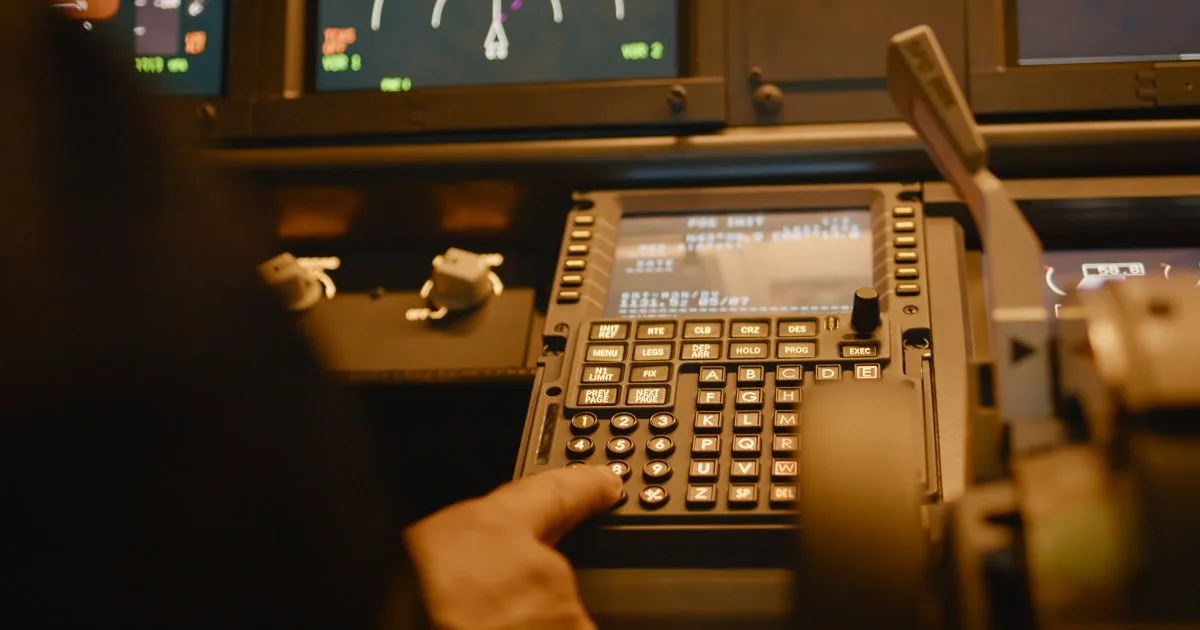
IFR contingency procedures: Flying holding patterns, executing missed approaches, and diverting to alternates when the original plan fails.
Holding, Missed Approach, Alternate — When the Plan Falls Apart
In instrument flying, a plan is only as good as the conditions under which it is executed. Weather changes, airports close, traffic backs up, and suddenly the original route no longer works. For exactly these situations, there are three fundamental IFR procedures that every instrument pilot must know cold: the holding pattern, the missed approach procedure, and alternate planning. They are Plan B, C, and D of instrument flying — and often the difference between a successful landing and an emergency.
The Holding Pattern — Waiting in the Air
A holding pattern is a defined flight maneuver in which the aircraft waits at a fixed point in the air until a clearance to continue is issued. Holdings are used when the destination airport is temporarily unavailable (weather, traffic, runway clearing), when the aircraft arrives at the approach fix too early, or when ATC needs a delay for capacity reasons.
Structure of a holding pattern:
A standard holding consists of:
- Holding fix: The fixed point around which the holding is flown (VOR, NDB, intersection, GPS waypoint).
- Inbound leg: The straight flight segment TOWARD the holding fix. This leg defines the inbound course (course to the fix).
- Outbound leg: The straight flight segment AWAY FROM the holding fix. Reciprocal of the inbound course.
- Two 180-degree turns: Standard-rate turns (Rate 1 = 3 degrees per second, or 25 degrees of bank at higher speeds) connecting the inbound and outbound legs.
Standard vs. non-standard holding:
| Feature | Standard Holding | Non-Standard Holding |
|---|---|---|
| Turn direction | Right turns | Left turns |
| Publication | "Hold right" or no direction specified | "Hold left" — must be explicitly stated |
| Frequency | Approx. 80% of all published holdings | Approx. 20%, usually obstacle-driven |
Timing in the holding:
- Below FL140 (14,000 ft): Each straight segment (inbound and outbound leg) lasts 1 minute. The pilot starts the timer when crossing the holding fix (beginning the outbound turn) and when rolling out on the outbound heading.
- At or above FL140: Leg duration increases to 1 minute 30 seconds. The reason: at higher true airspeeds, the same time duration covers more distance, enlarging the holding pattern's protected airspace.
- DME/RNAV holdings: Instead of time-based legs, they are defined by DME distances or GPS waypoints. E.g., "Hold on the 270 radial, 10 DME fix, 5 NM legs."
Entry Procedures — How to Enter the Holding
The entry procedure into a holding is one of the most discussed aspects of IFR training. There are three standard entries, depending on the direction from which the aircraft approaches the holding fix:
1. Direct Entry:
The simplest entry. The aircraft approaches the fix from a direction that allows it to fly directly into the first turn and outbound leg. Application: when the course to the fix falls within a sector of approximately 110 degrees on the non-holding side of the inbound course.
- Upon reaching the fix: immediate right turn (standard) onto the outbound heading
- 1 minute outbound leg
- Right turn onto the inbound course
- Fly to the fix — holding established
2. Teardrop Entry:
The aircraft approaches the fix from a direction that permits neither a direct nor parallel entry. The pilot flies over the fix, turns to a heading approximately 30 degrees offset toward the holding side, flies 1 minute outbound, then turns back to the fix.
- At the fix: heading 30 degrees offset from outbound course, toward the holding side
- 1 minute outbound
- Turn to the inbound course
- Fly to the fix — holding established
3. Parallel Entry:
The aircraft approaches the fix from a direction roughly reciprocal to the inbound course, from the non-holding side. The pilot flies across the fix, parallels the inbound course in the opposite direction, then turns back.
- At the fix: outbound heading parallel to inbound course (reciprocal)
- 1 minute outbound
- Left turn (for a standard right-turn holding) back to the fix
- Upon reaching the fix: right turn into the normal holding pattern
The 70-degree line as a guide:
To quickly determine which entry procedure to use, the pilot mentally draws a line 70 degrees from the inbound course through the holding fix. This line divides the space into three sectors:
- Approaching from the direct sector: direct entry
- Approaching from the teardrop sector: teardrop entry
- Approaching from the parallel sector: parallel entry
In practice, the decision must be made quickly — often under time pressure with ATC on the radio. Many pilots visualize the entry on their HSI or GPS and decide intuitively. With practice, choosing the correct entry becomes automatic.
Wind Correction in the Holding
Wind is the natural enemy of a precise holding. Without wind correction, the wind displaces the aircraft from the planned racetrack pattern, and the pilot ends up far from the holding fix. Experienced IFR pilots apply the following corrections:
- Inbound leg: Apply a wind correction angle (WCA) to track the inbound course precisely. If, for example, 10 degrees of WCA are needed, the heading is adjusted 10 degrees into the wind.
- Outbound leg: Triple correction is recommended. If 10 degrees of WCA are needed inbound, apply 30 degrees of correction in the opposite direction outbound. This compensates for the wind effect on the outbound leg and the turns.
- Timing correction: With a headwind on the inbound leg, extend the outbound leg (e.g., with a 20-knot headwind inbound: extend outbound to 1:20). With a tailwind inbound, shorten the outbound leg.
Missed Approach — When the Runway Does Not Come Into Sight
The missed approach procedure is one of the most important safety nets in IFR flight. It defines precisely what the pilot does when they reach the decision point without visual contact with the runway and cannot land.
When is a missed approach initiated?
- At the DH/DA (Decision Height/Decision Altitude): On precision approaches (ILS, LPV), the pilot descends to the Decision Height. If the required visual references are not visible at that point (approach lights, runway, threshold markings), the pilot must go around. There is no "let me go a little lower" — at DH, the decision is made, period.
- At the MDA (Minimum Descent Altitude): On non-precision approaches (VOR, NDB, LNAV), the pilot descends to the MDA and flies level until reaching the MAP (Missed Approach Point). If the MAP is reached without the runway in sight, a go-around is executed.
- At any time during the approach: If safety is jeopardized (unstabilized approach, wind shear, traffic on the runway, technical problems), a go-around can and must be initiated at any time.
- On ATC instruction: "Go around!" — when ATC aborts the approach (e.g., due to an aircraft on the runway).
Missed approach sequence:
- Power: Full power (full throttle in GA, TOGA at airlines). Establish an immediate positive rate of climb.
- Pitch: Raise the nose to the initial climb attitude. Retract flaps to the recommended position (typically: retract first notch).
- Configuration: Retract landing gear (if extended), retract flaps incrementally, adjust trim.
- Fly the published missed approach: Follow the procedure published on the approach plate. Typical: "Climb to 3,000 ft, right turn direct to VOR, hold." Each procedure is unique and must be briefed beforehand.
- Notify ATC: "Approach, November 123 Alpha Bravo, going around, missed approach." ATC may issue alternative instructions.
The Missed Approach Point (MAP):
The MAP is the point at which the go-around must be initiated at the latest. On ILS approaches, the MAP is defined as the point where DH is reached (on the glide slope). On non-precision approaches, the MAP is defined either by timing (timer from FAF), distance (DME), or fix (GPS waypoint). The MAP must be briefed before the approach — there is no time to search for the approach plate in the stress of the approach.
Published vs. ATC-instructed missed approach:
The published missed approach procedure is the default. ATC may, however, issue different instructions: "After go-around, climb heading 090, climb to 6,000, contact approach on 119.9." In this case, the ATC instruction takes precedence over the published procedure — provided it can be safely followed.
The Psychology of the Missed Approach
A missed approach is not a failure — it is a safety procedure. Nevertheless, it has a psychological dimension that must not be underestimated:
"There is no shame in a missed approach. There is only shame — and often tragedy — in an approach that is pushed below minimums."
- Continuation bias: The tendency to continue a commenced approach even though conditions require a missed approach. "I have come this far, it will work out." This bias is one of the most common factors in CFIT (Controlled Flight Into Terrain) accidents.
- Passenger pressure: With passengers aboard, pilots often feel pressure to land. "They want to arrive." Professional pilots must learn to ignore this pressure.
- Fuel anxiety: After a missed approach, sufficient fuel must remain for another attempt or for the flight to the alternate. Fear of fuel shortage can tempt pilots to "push through" the approach. Proper alternate and fuel planning eliminates this concern.
Alternate Planning — Plan B on the Ground
Alternate planning is a central component of every IFR flight preparation. An alternate is an airport that can be flown to if the destination airport is unreachable or cannot be approached.
When is an alternate required?
Under EASA rules (Part-NCO, Part-NCC) and FAA regulations (14 CFR 91.169), an alternate must be listed in the flight plan if weather conditions at the destination airport do not meet specific planning criteria at the estimated time of arrival.
- No alternate needed if (FAA 1-2-3 Rule): The weather forecast for the destination, from 1 hour before to 1 hour after estimated arrival, shows a ceiling of at least 2,000 ft and visibility of at least 3 SM (statute miles). EASA uses a similar 1-hour window with comparable thresholds.
- Alternate required if: Weather conditions fall below these planning minima or the forecast is uncertain.
Alternate minima:
The selected alternate airport must have weather conditions at the estimated arrival time that exceed the standard approach minima. Typical alternate minima are:
| Approach Procedure at Alternate | Alternate Minimum Ceiling | Alternate Minimum Visibility |
|---|---|---|
| Precision Approach (ILS CAT I, LPV) | DH + 200 ft (at least 600 ft FAA / 400 ft EASA) | Visibility + 1 SM (at least 2 SM) |
| Non-Precision Approach (VOR, NDB, LNAV) | MDA + 400 ft (at least 800 ft FAA / 600 ft EASA) | Visibility + 1 SM (at least 2 SM) |
| No instrument procedure available | Ceiling sufficient for VFR approach | Visibility sufficient for VFR approach |
The logic: if you need to divert to the alternate, something at the destination did not work out. It would be disastrous if the alternate were also weather-below-minimums. Hence the elevated minima as a safety buffer.
Fuel Planning — Fuel as Life Insurance
IFR fuel planning is more conservative than VFR and accounts for multiple contingencies:
Required reserves under EASA (Part-NCO) and FAA (14 CFR 91.167):
- Trip fuel: Fuel for the planned flight from departure to destination, including climb, cruise, and descent.
- Alternate fuel: Fuel for the flight from the destination to the alternate (when an alternate is planned).
- Final reserve: 45 minutes of fuel at normal cruise power (FAA and EASA for piston aircraft). This reserve must NOT be used — if fuel drops to final reserve, a fuel emergency must be declared ("Minimum Fuel" advisory or "Mayday Fuel").
- Contingency fuel: 5% of trip fuel or at least 5 minutes — as a buffer for deviations (detours, holdings, worse wind than planned).
Worked example:
Flight from Airport A to Airport B, alternate Airport C, Cessna 182 at 11 USG/h:
| Item | Time | Fuel (USG) |
|---|---|---|
| Taxi + Takeoff | 10 min | 2.0 |
| Trip Fuel (A to B) | 2 h 30 min | 27.5 |
| Contingency (5%) | 7.5 min | 1.4 |
| Alternate Fuel (B to C) | 25 min | 4.6 |
| Final Reserve (45 min) | 45 min | 8.3 |
| Minimum Block Fuel | 3 h 58 min | 43.8 USG |
With a fuel capacity of 88 USG in the Cessna 182, this flight is comfortably achievable. But the calculation shows: nearly 16 USG (37% above trip fuel) are reserves — that is the price of safety in IFR operations.
Decision Height vs. Decision Altitude
A subtle but important distinction in IFR terminology:
- Decision Height (DH): Height above the runway threshold. Measured with a radio altimeter. Applicable only in aircraft equipped with a radio altimeter. Typical for CAT II/III operations.
- Decision Altitude (DA): Altitude above mean sea level (MSL). Measured with the barometric altimeter. Standard for CAT I in GA. Published on the approach plate as "DA" or "DA(H)" with the height equivalent in parentheses.
- MDA (Minimum Descent Altitude): The lowest altitude above MSL to which a pilot may descend on a non-precision approach without the required visual references. Unlike DA/DH, the MDA is not "flown through" — the pilot may not descend below MDA until they see the runway environment.
When the Commander Decides
At the end of every IFR approach, there is a decision: land or go around. That decision belongs to the PIC (Pilot in Command). No other person — not ATC, not the copilot, not the passengers — can override this decision.
Decision criteria at DH/DA:
- Visual references acquired? The pilot must identify at least one of the following: approach lights, threshold lighting, runway edge lights, centerline, threshold markings, touchdown zone, or the runway surface itself.
- Aircraft in stable approach configuration? Airspeed, descent rate, track, and glide path must be within prescribed tolerances. An unstabilized approach requires a go-around — regardless of visibility.
- Is a safe landing possible? Even with visual references: if the pilot is not convinced a safe landing is achievable (wind shear, hydroplaning, obstruction on the runway), a go-around is mandatory.
The golden rule:
"When in doubt: missed approach. A go-around can be repeated as many times as needed. A landing below minimums can be fatal and only happens once."
How It All Fits Together: Holding — Missed Approach — Alternate
In practice, these three procedures often interlock. A typical scenario:
- The pilot flies an ILS approach to the destination airport. At the DA, the runway is not in sight. Missed approach is initiated.
- ATC sends the pilot into a holding: "Hold at MIKE, expect further approach in 15 minutes."
- The pilot flies the holding and calculates remaining fuel. Is there enough for another approach AND the flight to the alternate?
- After 15 minutes, a second approach attempt is made. This time conditions are better, and the lights come into view. Landing.
- Had the second approach also resulted in a missed approach, the pilot would have proceeded directly to the alternate — no third attempt, because fuel only suffices for the alternate plus final reserve.
This interplay demands forward thinking, continuous fuel monitoring, and the willingness to change the plan when circumstances require it. It is the essence of professional IFR flying and distinguishes the safe pilot from the reckless one.
Conclusion: Plan B Is the Real Plan
In instrument flying, the ability to deal with the unexpected is just as important as the ability to fly a precise ILS approach. Holdings, missed approaches, and alternate planning are not peripheral topics of IFR training — they are its core. A pilot who can fly a perfect approach but does not know what to do when the runway does not appear is only half trained. And in aviation, "half" is not enough.
The finest quality of an IFR pilot is not precision — it is flexibility. The willingness to change the plan at any moment, to initiate the missed approach without hesitation, and to head for the alternate when necessary. That requires knowledge, training, and — perhaps most importantly — the right mindset: that a go-around is not failure, but the most professional decision a pilot can make.
