
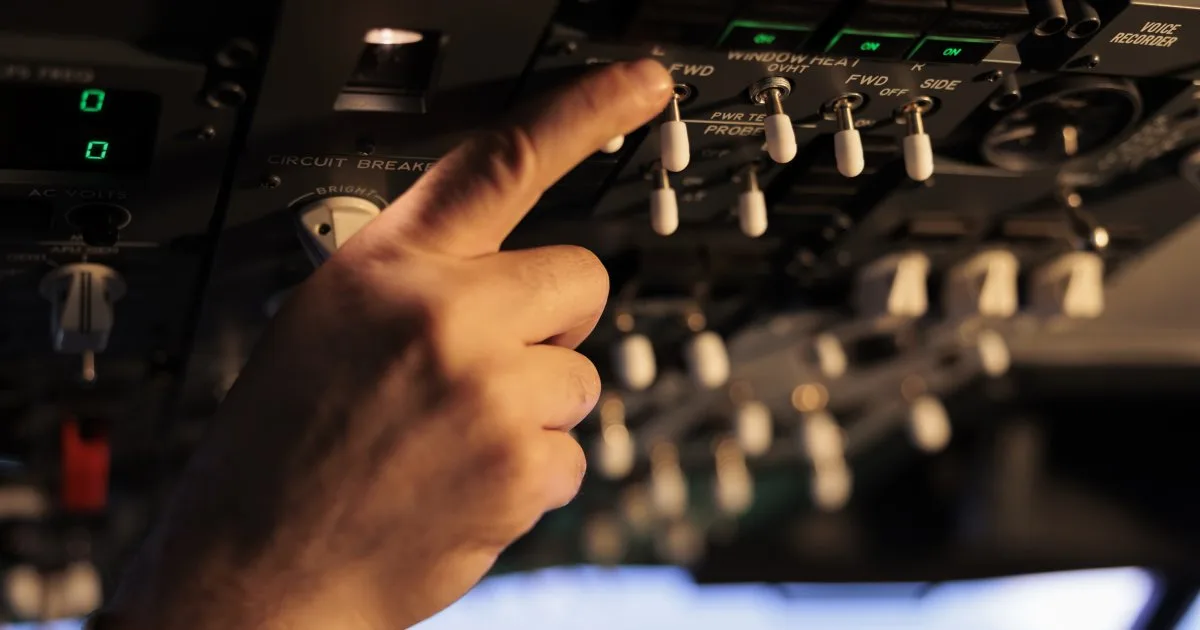
The go-around as a lifesaver: When a missed approach is necessary, why pilots resist it, and which accidents could have been prevented by a timely abort.
Go-Around -- Why the Bravest Decision Is Sometimes to Abort
The go-around -- the missed approach maneuver -- is one of the most fundamental procedures in aviation and simultaneously one of the most misunderstood. Many pilots regard a go-around as a sign of failure, an admission that they could not manage the landing. In truth, the opposite is the case: a go-around is a sign of professional decision-making. It rescues situations that might otherwise end in catastrophe. And yet statistics show that go-arounds are performed far less frequently than they should be.
The Go-Around Procedure: TOGA, Pitch, Climb
A go-around is a standardized maneuver that must be available as an option during every approach. The procedure follows a clearly defined sequence specified in every aircraft flight manual and airline SOP (Standard Operating Procedure). Although the details vary by aircraft type, the basic principle always follows the same pattern:
Step 1: TOGA -- Set Thrust
The first and most critical step is setting engine power to Take-Off/Go-Around (TOGA) thrust. In modern transport aircraft, this is initiated by pressing the TOGA button on the thrust lever, after which the autothrust system sets the required thrust. In piston-engine GA aircraft, this means: full throttle, carburetor heat cold, propeller to full RPM.
This step has absolute priority, because without adequate engine power, no climb is possible. The power must be applied decisively and fully -- a common error is hesitant or incomplete thrust application.
Step 2: Pitch Up -- Establish Climb Attitude
Simultaneously with the thrust increase, the aircraft nose is raised to the climb attitude. In most transport aircraft, the go-around pitch attitude is 12.5 to 15 degrees nose up, depending on configuration and weight. The flight director displays the required attitude when available. In light single-engine aircraft, the attitude is typically set for the Best Rate of Climb speed (Vy).
Step 3: Positive Rate -- Confirm Climb
As soon as the vertical speed indicator (VSI) shows a positive climb and the radar altimeter shows increasing values, "Positive Rate" is called. Only when the climb is confirmed may further configuration changes be made.
Step 4: Gear Up -- Retract Landing Gear
After climb confirmation, the landing gear is retracted to reduce drag. In retractable-gear GA aircraft, the same principle applies: retract the gear only when positive climb and adequate altitude above the ground are assured.
Step 5: Flap Schedule -- Stepwise Flap Retraction
The landing flaps are not retracted suddenly but in stages according to the schedule specified in the flight manual. Retracting flaps too quickly reduces lift and can be dangerous near the ground. The typical sequence in a Boeing 737, for example, is: Flaps 15 at Positive Rate, then Flaps 5 at a certain altitude, then Flaps 1, and finally Flaps 0 (Up) at a safe altitude and sufficient airspeed.
Step 6: Cleanup and Acceleration
At a safe altitude, the aircraft is brought into climb configuration: flaps fully retracted, airspeed accelerated to normal climb speed, and thrust reduced to climb power. The autopilot can be re-engaged, and the crew contacts ATC for further instructions.
When Is a Go-Around Necessary?
The situations that require a go-around are varied. Some are obvious, others require rapid assessment and decision-making. The key scenarios:
Unstabilized Approach
The most common and most frequently ignored reason for a go-around is an unstabilized approach. International safety organizations and airlines define clear criteria that an approach must meet by a certain altitude. If these criteria are not met, a go-around is mandatory -- without exception, without discussion.
Windshear
Windshear -- a sudden change in wind direction and/or wind speed -- is one of the most dangerous situations on approach. Modern transport aircraft are equipped with windshear warning systems that automatically issue a "WINDSHEAR, WINDSHEAR" warning when windshear is detected and initiate the go-around. The windshear procedure is distinctive: TOGA thrust, 15 degrees pitch-up, and hold that attitude even if airspeed initially decreases and the stick shaker activates. Under no circumstances lower the nose!
Runway Occupied
When the runway is blocked by another aircraft, a vehicle, an animal, or an obstacle, an immediate go-around is required. ATC will typically issue a go-around instruction, but the crew must also go around independently, without an ATC instruction, if the runway is not clear.
Below Minima -- Below Minimum Visibility Requirements
During an instrument approach, a Decision Height (DH) or Minimum Descent Altitude (MDA) is defined. If the aircraft reaches this altitude and the required visual reference to the runway or approach lighting is not established, a go-around must be initiated. Continuing below Decision Height without visual contact with the runway is prohibited and extremely dangerous.
Additional Reasons
- Extreme crosswind component: When the crosswind component exceeds the aircraft's limits or the pilot can no longer safely align the aircraft with the runway.
- Technical problems: Warnings or system failures that call into question a safe landing.
- Unsecured landing configuration: Missing gear lock indication, incorrectly set flaps.
- Gut feeling: When something does not feel right and the pilot has an uneasy feeling, a go-around is always the safe option. In professional aviation, the principle applies: "When in doubt, go around."
Stabilized Approach Criteria: The Threshold Values
The Flight Safety Foundation and most airlines worldwide define an approach as stabilized when, by no later than 1,000 feet above airport elevation in an instrument approach (or 500 feet in a visual approach), the following criteria are simultaneously met:
| Criterion | Threshold |
|---|---|
| Configuration | Gear extended, flaps in landing position, checklist complete |
| Airspeed | Vref to Vref +10 kt (max +20 kt in gusty wind) |
| Descent rate | Maximum 1,000 ft/min (750 ft/min at some airlines) |
| Engine power | Stable and appropriate for the approach |
| Track guidance | On correct course and glidepath (max 1 dot deviation) |
| Runway in sight | The runway or approach lighting must be visible |
| Briefing | Go-around procedure briefed |
If even one of these criteria is not met at 500 feet above airport elevation, the SOPs of most airlines mandate a go-around. The 500-foot mark serves as the last checkpoint -- the so-called "Final Approach Gate." Below 500 feet, a go-around is still possible and often necessary, but the time windows become extremely tight.
Psychological Barriers: Why Pilots Do Not Go Around
Although the procedures are clear and the criteria unambiguously defined, go-arounds are performed in practice far less frequently than necessary. Studies show that the reasons are primarily psychological in nature.
Plan Continuation Bias
Plan continuation bias -- also known as "press-on-itis" or "get-there-itis" -- is the strongest psychological barrier against the go-around. It is the human tendency to continue with an established plan even when circumstances have changed and the plan is no longer sensible or safe. The pilot has committed to the landing, the passengers expect it, the airport is in sight -- and then they are supposed to raise the nose and start over? This psychological resistance is enormous and one of the best-documented human factors phenomena in aviation.
Sunk Cost Fallacy
Closely related to plan continuation bias is the sunk cost fallacy: "We have flown this far, consumed this much fuel, the passengers are waiting -- we cannot just go around now." This thinking ignores that the resources already invested are irrecoverable and that the decision should be made solely on the basis of the current situation.
Social Pressure
Pilots face multifaceted social pressure. There is pressure from the employer to be punctual and avoid delays. There are passengers who want to reach their destination. There is the pilot's pride, not wanting to appear before the first officer or colleagues as someone who "could not handle it." And in GA, pressure from passengers who are growing impatient or urging the pilot to continue is a frequent factor.
Insufficient Training
Although go-arounds are trained in theory, they occur so rarely in practice that many pilots are uncertain when they actually need to perform one. Studies have shown that go-arounds in simulator training are often performed under idealized conditions -- with adequate altitude, stable conditions, and without the psychological pressure of the real situation. The discrepancy between training and real-world conditions can cause pilots to hesitate at the critical moment.
Go-Around Accidents: When the Missed Approach Fails
Asiana Airlines Flight 214 -- San Francisco (2013)
On July 6, 2013, a Boeing 777 of Asiana Airlines touched down far short of the runway at San Francisco Airport. The aircraft struck the seawall in front of Runway 28L with the main gear, the tail section broke off, and the aircraft slid across the runway. Three passengers were killed and 187 were injured.
The NTSB investigation found that the crew had continued an unstabilized approach. The aircraft was significantly below the glidepath and below target airspeed. The crew recognized the situation but initiated the go-around too late. When the captain finally set TOGA, the aircraft was already so low and slow that the engines could not spool up in time.
The accident highlighted several core problems: excessive dependence on automation (the crew had not noticed that the autothrottle was not correctly engaged), inadequate monitoring discipline, and -- critically -- the delayed initiation of the go-around. An earlier go-around would have very likely prevented the accident.
FlyDubai Flight 981 -- Rostov-on-Don (2016)
On March 19, 2016, a Boeing 737-800 of FlyDubai crashed during the second approach to Rostov-on-Don Airport in Russia. All 62 occupants were killed. After a first go-around due to poor weather conditions, the crew flew a second approach. This too was unstabilized. When initiating the second go-around, the aircraft entered an extreme nose-down attitude and impacted nearly vertically.
The investigation pointed to a so-called "somatogravic illusion": during the strong acceleration from TOGA thrust, the crew experienced the physical sensation of extreme pitch-up, whereupon the pilot intuitively pushed the nose down -- with catastrophic consequences. The accident demonstrated the dangers of a go-around under stress conditions and the necessity of safely executing the go-around maneuver even under adverse circumstances.
Turkish Airlines Flight 1951 -- Amsterdam (2009)
On February 25, 2009, a Boeing 737-800 of Turkish Airlines crashed on approach to Amsterdam Schiphol Airport. Nine of the 135 occupants were killed. The left radar altimeter had delivered an erroneous value of -8 feet even though the aircraft was still above 1,000 feet. The autothrottle system interpreted this value as "on the ground" and reduced thrust to idle.
The crew noticed the airspeed loss too late. When they recognized the error and initiated the go-around, the aircraft was already below the stall speed. The aircraft crashed into a field just short of the runway. Here too, the decisive factor was the delayed recognition of the problem and the too-late initiation of the go-around. The investigation was conducted by the Dutch Safety Board.
The Alarming Statistic: 97% Continue
One of the most alarming statistics in aviation safety comes from the Flight Safety Foundation: only approximately 3% of all unstabilized approaches actually result in a go-around. This means: in 97% of cases where a go-around would actually be required, the crew continues the approach.
This figure is concerning for several reasons:
- Unstabilized approaches are a proven risk factor for Approach and Landing Accidents (ALA), the most common accident category in commercial aviation.
- The 97% rate shows that while SOPs exist, they are not consistently followed in practice.
- Each of these 97% "successful" landings from an unstabilized approach reinforces the pilot's assumption that "it will be fine" -- a dangerous normalization process that sociologist Diane Vaughan has described as "Normalization of Deviance."
"A go-around is not a sign of failure -- it is a sign of good airmanship. Every safe go-around is a successful outcome." -- Flight Safety Foundation
How Airlines Foster a Go-Around Culture
The most progressive airlines in the world have recognized that the problem lies not in the procedures but in the culture. They have therefore taken systematic measures to de-stigmatize the go-around and create a culture in which going around is seen as a professional strength.
No-Blame Go-Around Policy
Many airlines have introduced an explicit "no-blame" policy for go-arounds. No pilot is reprimanded for a go-around -- on the contrary, go-arounds are positively highlighted in safety reports. Some airlines go so far as to sanction pilots who continued an obviously unstabilized approach instead of going around.
Proactive Go-Around Training
Modern simulator training integrates realistic go-around scenarios that replicate the psychological pressure of real situations. These include scenarios with time pressure, low fuel, poor weather, and passengers who will miss their connections. The goal is to give pilots the experience that a go-around can be the right decision under all circumstances.
Data Monitoring and Feedback
Flight Data Monitoring (FDM) programs -- known as FOQA (Flight Operational Quality Assurance) in the US -- automatically analyze the approach parameters of all flights. If an approach failed to meet the stabilization criteria yet resulted in a landing, this is identified and discussed with the crew -- not for punishment but for learning. Conversely, go-arounds from unstabilized approaches are included as positive examples in safety communications.
Improved Cockpit Automation
Some aircraft manufacturers are working on automated go-around support systems. Airbus has investigated the concept of an "Automatic Go-Around" in which the aircraft could independently initiate a go-around maneuver when certain parameters are breached. Boeing and other manufacturers are developing enhanced cockpit displays that alert pilots more clearly and earlier to the need for a go-around.
Go-Around in General Aviation
In General Aviation, the go-around issue is at least as relevant as in commercial aviation, but the conditions are different. GA pilots typically fly alone, without SOPs and without Flight Data Monitoring. The go-around decision rests entirely with the individual pilot -- and with it the psychological barriers.
For GA pilots, several specific recommendations apply:
- Include the go-around in the briefing: Before every approach, the pilot should mentally review the go-around procedure for the specific runway: What obstacles exist? In which direction is the go-around flown? What is the traffic pattern?
- Define personal stabilization criteria: Even without airline SOPs, every GA pilot should establish personal criteria: "If at 500 feet AGL I am not at landing speed, on the correct course, and stabilized, I will go around."
- Practice the go-around regularly: Not only during flight training or check rides, but plan a go-around on every practice flight.
- Never allow yourself to be pressured: Neither by passengers, radio traffic, other aircraft in the pattern, nor your own ego.
The Future of the Go-Around
The aviation industry is working on multiple levels to increase the go-around rate on unstabilized approaches. Technological solutions such as enhanced situational awareness systems, automatic approach monitoring, and better cockpit warnings are complemented by cultural measures: go-around campaigns, safety communications, and the continuous effort to build a culture in which going around is recognized for what it is -- the most professional decision a pilot can make in an unsafe situation.
The go-around is not a defeat. It is not an admission of failure. It is the deliberate decision to place safety above pride. Every go-around safely executed is a success -- even if it never appears in a statistic. Because that statistic might otherwise list an accident.
The words of an experienced airline captain say it best: "I have flown more than a dozen go-arounds in my career. Every single one was the right decision. And not once did anyone complain afterward." A culture that celebrates the go-around for what it is -- a courageous and professional decision -- is a culture that saves lives.
