
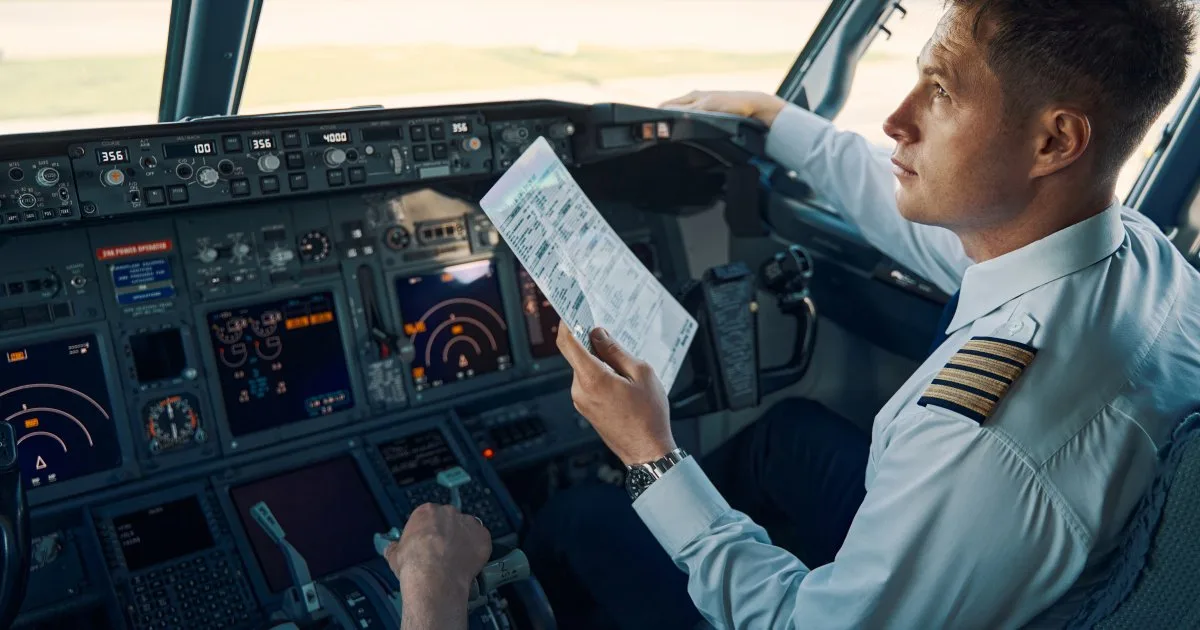
CRM in aviation: From Tenerife 1977 to today — how standardized communication, flat hierarchies, and error management revolutionized flight safety.
Crew Resource Management -- How Communication in the Cockpit Saves Lives
Crew Resource Management, or CRM, is one of the most significant safety concepts aviation has ever produced. It is based on a simple but long-ignored insight: most aviation accidents are not caused by technical failure but by human errors in communication, decision-making, and teamwork in the cockpit. CRM has fundamentally changed the way crews work together -- and in doing so has saved thousands of lives.
The Disasters That Made CRM Necessary
Tenerife 1977: The Worst Disaster in Aviation History
On March 27, 1977, at Los Rodeos Airport on Tenerife, the deadliest disaster in civil aviation history occurred. A KLM Boeing 747 collided during takeoff with a Pan American Boeing 747 still on the runway. 583 people lost their lives.
The investigation revealed a disturbing picture of human failure on multiple levels. The experienced KLM captain, Jacob Veldhuyzen van Zanten -- ironically the chief flight instructor of KLM and the face of the airline's advertising -- initiated the takeoff without having received an unambiguous takeoff clearance. The first officer and flight engineer expressed concerns but did not dare to correct the captain forcefully enough. The hierarchical cockpit culture of the era made it virtually impossible for subordinate crew members to openly challenge an experienced captain.
United Airlines Flight 173: Portland 1978
On December 28, 1978, a DC-8 of United Airlines circled over Portland, Oregon. The aircraft had a landing gear issue -- the indicator did not confirm that the gear was extended and locked. Captain Malburn McBroom focused so intently on the gear problem that he lost track of the fuel state. Although the flight engineer repeatedly pointed out the declining fuel level, the captain did not respond decisively.
After over an hour of holding, all four engines flamed out in succession. The aircraft crashed into a residential area; 10 of the 189 occupants and one person on the ground were killed. Ironically, the landing gear had been properly extended the entire time -- only the indicator was faulty.
This accident became the direct catalyst for the development of CRM. The accident investigation made unmistakably clear: it was not the technical problem that had caused the crash, but the inadequate communication and teamwork in the cockpit.
The Birth of CRM: NASA Workshop 1979
Inspired by the findings from the accidents of the 1970s, NASA organized a workshop in 1979 titled "Resource Management on the Flightdeck." Psychologist John Lauber coined the term "Cockpit Resource Management" -- the utilization of all available resources (human, technical, informational) for the safe conduct of a flight.
The central thesis was revolutionary for the cockpit culture of the era: a captain who makes all decisions alone and ignores the contributions of his crew is not the strongest commander but the greatest safety risk. United Airlines was the first major airline to introduce formal CRM training in 1981. Other airlines followed, initially hesitantly, but with increasing urgency after further accidents.
The CRM Generations: An Evolution of Thinking
1st Generation: Cockpit Resource Management (1980s)
The first generation focused primarily on the cockpit and the interaction between captain and first officer. The emphasis was on leadership style, authority gradient, and the ability of crew members to voice concerns. The training sessions were often confrontational and psychologically oriented -- which met fierce resistance from some experienced captains. Many saw CRM as a personal attack on their authority.
2nd Generation: Crew Resource Management (1990s)
In the second generation, the concept expanded from "Cockpit" to "Crew." Now flight attendants, dispatchers, and ground personnel were included. Training became less confrontational and more focused on practical scenarios. Core topics included situational awareness, decision-making, and workload management. The renaming from "Cockpit" to "Crew" was not merely semantic -- it reflected the recognition that safety is a team effort extending beyond the cockpit door.
3rd Generation: Company Resource Management (2000s)
The third generation extended CRM to the entire organization. It was recognized that corporate culture, management decisions, and organizational structures also have a direct impact on cockpit safety. Topics like Safety Culture, Just Culture, and organizational errors were integrated. CRM was no longer merely a cockpit training program but a company-wide safety philosophy.
4th Generation: Threat and Error Management (TEM)
The current generation of CRM thinking is based on the Threat and Error Management model. TEM assumes that threats and errors in flight operations are inevitable. The goal is not to eliminate errors -- which is impossible -- but to detect them early, manage them, and limit their consequences. TEM distinguishes between external threats (weather, ATC, system failures) and internal threats (fatigue, distraction, time pressure).
The Core Elements of CRM
Communication
Effective communication is the foundation of CRM. It encompasses not only speaking but also active listening, confirmation of information, and the use of standardized phraseology. Communication in the cockpit must be clear, concise, unambiguous, and timely. Ambiguity is the enemy of safety.
A key concept is the closed-loop communication: the sender provides information or an instruction, the receiver confirms by repeating (readback), and the sender verifies correctness (hearback). This three-step process ensures that both parties have the same understanding.
Situational Awareness (SA)
Situational awareness describes the ability to correctly perceive the current situation (Level 1: Perception), understand it in context (Level 2: Comprehension), and predict its future development (Level 3: Projection). The loss of SA is a recurring theme in aviation accidents. CRM trains crews to continuously monitor and maintain their SA through regular briefings, cross-checks, and actively questioning assumptions.
Decision Making
CRM promotes structured decision-making processes in the cockpit. Models like FORDEC (Facts, Options, Risks & Benefits, Decision, Execution, Check) provide the crew with a framework for systematic decision-making under time pressure. Importantly, decisions are made as a team -- the captain retains final decision authority, but should actively solicit and consider the inputs of all crew members.
Workload Management
The distribution of workload in the cockpit is a central CRM topic. The principle "Aviate, Navigate, Communicate" defines the priorities: first fly the aircraft, then navigate, then communicate. During high-workload phases -- such as an engine failure after takeoff -- the crew must clearly divide tasks and consciously defer less urgent items.
Assertiveness
Assertiveness is the ability and willingness to voice concerns clearly and unambiguously, even when this means correcting a hierarchically superior colleague. CRM has established the expectation that first officers, flight engineers, and flight attendants have not only the right but the duty to raise safety concerns. The challenge lies in doing so respectfully but unmistakably.
A proven model is the PACE method (Probe, Alert, Challenge, Emergency):
- Probe: "Captain, have you noticed that we are below the minimum altitude?"
- Alert: "Captain, we are below the minimum altitude. This is a safety concern."
- Challenge: "Captain, we need to climb immediately. We are in an unsafe situation."
- Emergency: Taking control if immediate danger exists and the captain is not responding.
Standard Calls and Callouts
Standard calls are predefined announcements made at specific points during the flight. They serve to keep the crew on the same page and monitor critical parameters. Examples include:
- "V1" -- Decision speed during takeoff (from this point the takeoff is continued)
- "Rotate" -- Speed for rotation
- "Positive Rate" -- Positive climb confirmed
- "Gear Up" -- Retract landing gear
- "1000 feet" -- 1,000 feet above airport elevation on approach (Stabilized Approach Check)
- "500 feet" -- Final stabilization check
- "100 above" -- 100 feet above Decision Height
- "Minimums" -- Decision Height reached
- "Go Around" -- Initiate missed approach procedure
These standardized callouts ensure that no critical flight phases are conducted without mutual monitoring.
The Sterile Cockpit Rule
The Sterile Cockpit Rule, introduced by the FAA in 1981 as FAR 121.542 (and adopted under equivalent EASA regulations), prohibits non-flight-related activities and conversations in the cockpit during critical flight phases, defined as all operations below 10,000 feet. This includes:
- No personal conversations
- No non-essential cabin crew contacts
- No reading of non-flight-related material
- No use of personal electronic devices
- No eating during critical flight phases
The rule was introduced after several accidents were attributed to distractions in the cockpit during critical flight phases. It is a fundamental component of the CRM concept and ensures that the crew's full attention is dedicated to flying when the risk is highest.
The Swiss Cheese Model: James Reason's Error Chain
Professor James Reason of the University of Manchester developed the Swiss Cheese Model, which became one of the most influential safety models in aviation. The model represents safety barriers as slices of Swiss cheese. Each slice represents a layer of defense (design, training, procedures, technology, oversight), and each slice has holes (weaknesses). An accident occurs when the holes in all slices randomly align, allowing a threat to penetrate all layers of defense.
The model distinguishes between:
- Active Failures: Immediate errors by the crew at the "sharp end" -- incorrect inputs, missed indications, poor decisions.
- Latent Conditions: Systemic weaknesses that originated long before the accident -- inadequate training, flawed procedures, deficient maintenance, organizational culture.
CRM addresses both active failures (through better communication and teamwork) and latent conditions (through safety culture and organizational learning).
CRM Failures: When the System Does Not Work
Korean Air Flight 801 -- Guam (1997)
On August 6, 1997, a Korean Air Boeing 747 crashed into a hill on approach to Guam. 228 of the 254 occupants were killed. The investigation found that the captain flew a faulty non-precision approach and assumed an incorrect glidepath. The first officer and the flight engineer recognized the errors but only expressed vague concerns that the captain ignored. The strongly hierarchical cockpit culture at Korean Air at that time -- where a first officer barely dared to openly correct the captain -- was identified as a significant contributing factor. The NTSB investigation highlighted the critical role of cockpit culture in accident causation.
Korean Air drew profound consequences: the airline reformed its entire cockpit culture, introduced intensive CRM training, hired foreign training captains, and made English the standard cockpit language. The transformation was so successful that Korean Air later became a model example of cultural change in aviation.
Helios Airways Flight 522 -- Greece (2005)
On August 14, 2005, a Boeing 737 of Helios Airways crashed into a hill near Marathon, Greece. All 121 occupants were killed. The cause: after maintenance, the pressurization switch had been left in the manual position. The crew did not correctly identify the warning and confused the pressurization warning with a different alert. Due to the gradual cabin pressure loss, the crew lost consciousness. The aircraft continued flying on autopilot as a "ghost flight" until the fuel was exhausted.
The accident revealed fatal CRM deficiencies: the crew did not communicate effectively about the warning, did not conduct a systematic checklist, and lost situational awareness of the cabin pressure. It was a classic example of organizational latent conditions (inadequate training, insufficient procedures) combined with active failures by the crew.
Single-Pilot CRM: CRM Without a Copilot
A particular challenge is CRM in single-pilot operations, as is the norm in General Aviation. Without a second pilot, the principles of cross-checking, mutual monitoring, and task sharing are absent. Single-pilot CRM therefore requires specific strategies:
- Self-discipline: The single pilot must honestly assess their own performance capability. Fatigue, stress, medications, or emotional burden must be openly acknowledged. The IMSAFE checklist (Illness, Medication, Stress, Alcohol, Fatigue, Emotion/Eating) is a useful tool.
- Passengers as a resource: A brief briefing for passengers explaining how they can alert the pilot (e.g., "Tell me if you think we are getting too close to the ground") utilizes additional eyes.
- Automation as copilot: Autopilot, GPS moving map, terrain warning, and other systems can reduce workload and catch errors.
- Verbalization: Speaking decisions and checklist items aloud, even when alone, improves error detection.
- ATC as partner: Using flight following and ATC services -- every controller who has the aircraft on radar is an additional layer of safety.
"CRM does not change the captain's authority or responsibility. It does change the way we get there. The captain is still the final authority, but CRM ensures that the best possible information is available before decisions are made." -- John Lauber, NASA
CRM Today and in the Future
CRM is today a mandatory component of pilot training worldwide. EASA mandates annual CRM training for all crew members (under Part-ORO.FC), and the FAA addresses CRM principles through Advisory Circulars and crew training requirements under Part 121 and Part 135. Modern CRM training programs use realistic simulator scenarios that place crews under pressure and test their communication, decision-making, and teamwork under realistic conditions.
The future of CRM faces new challenges: increasing automation is transforming the crew's role from active pilots to system monitors, bringing new forms of skill erosion and situational awareness loss. The discussion around single-pilot operations even at the airline level raises the question of how CRM principles can be implemented in a radically changed cockpit environment.
One thing, however, remains unchanged: the recognition that no technical system in the world can replace the power of effective human collaboration. CRM has made aviation safer than ever before -- and its principles have long since been adopted by other safety-critical domains, from medicine to nuclear energy to maritime operations.
