
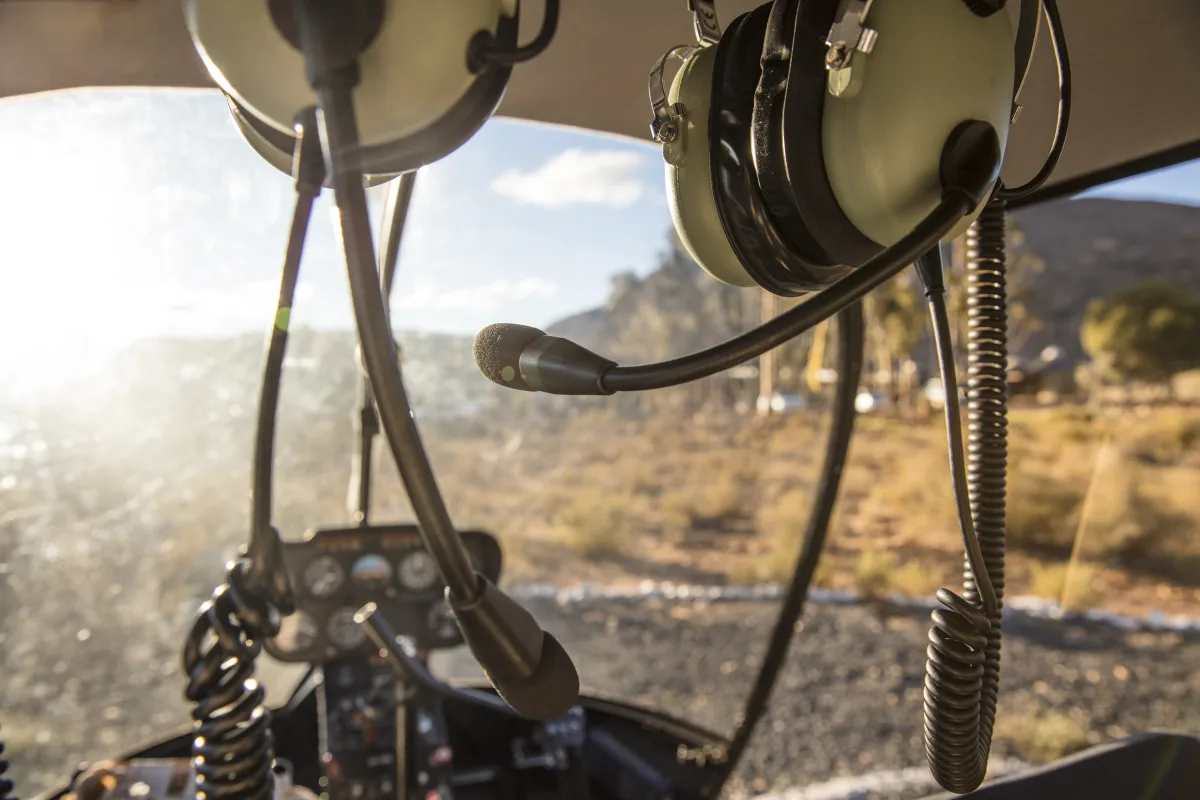
Autorotation in detail: The physics behind it, why the rotor keeps spinning without power, how the landing works, and why every helicopter pilot must master it.
Autorotation -- How a Helicopter Lands Without Engine Power
It is one of the most persistent myths in aviation: "If a helicopter's engine fails, it drops like a stone." The reality is the exact opposite. A helicopter can land safely without any engine power -- thanks to a phenomenon called autorotation. This aerodynamic principle allows the rotor to continue spinning solely from the upward flow of air, generating enough lift for a controlled landing. Autorotation is not merely an emergency procedure but a mandatory exercise in every helicopter training program and a fascinating piece of flight physics. This article explains the physics behind it, the precise sequence of actions, and why every helicopter pilot must master this technique instinctively.
The Basic Principle -- The Rotor as a Windmill
In normal powered flight, the engine drives the main rotor through the transmission. The rotor blades generate lift through their pitch angle and rotation -- energy flows from the engine to the rotor to the air. During an engine failure, this energy source is lost. However, the rotor does not stop spinning immediately. Due to its enormous moment of inertia -- a Robinson R22 rotor system weighs approximately 175 lbs (80 kg) including blades and hub, spinning at about 510 RPM -- it stores considerable kinetic energy.
The critical step is to reverse the direction of energy flow. Instead of the engine driving the rotor, the upward-flowing air must drive the rotor -- exactly as wind turns a windmill. To achieve this, the pilot must immediately lower the collective fully down to minimize blade pitch, and push the nose down to build forward airspeed and establish a controlled rate of descent. The air flowing upward through the rotor disk due to the descent now drives the rotor and maintains its RPM.
From a physics standpoint, the helicopter's potential energy (altitude) is converted through the airflow into kinetic energy (rotor rotation), which in turn generates lift. The helicopter descends in a controlled manner, but it does not fall. The typical rate of descent in a stable autorotation is 1,500 to 2,000 feet per minute -- comparable to a parachutist under an open canopy.
The Three Regions of the Rotor Blade in Autorotation
Understanding autorotation requires examining the aerodynamic forces acting on different portions of each rotor blade. In autorotation, every blade can be divided into three regions:
1. The Stall Region (blade root, approximately inner 25%): Near the rotor hub, rotational velocity is lowest (because the circumference is smaller), while the upward airflow from the descent is uniform across the disk. The resulting angle of attack is so steep in this region that the airfoil operates in stall. This area produces high drag and virtually no useful lift -- it decelerates the rotor.
2. The Driving Region (mid-span, approximately 25-70%): This is the critical section. Here, the ratio of rotational velocity to upward airflow produces an angle of attack that creates a forward-tilted lift component. This forward component of the total aerodynamic force vector drives the rotor -- acting like a sail harnessing the wind. The driving region is the heart of autorotation: without it, the rotor would quickly decelerate and stop.
3. The Driven Region (blade tip, approximately outer 30%): At the blade tip, rotational velocity is highest, and the upward airflow has comparatively little influence on the angle of attack. The blade operates here similarly to normal powered flight -- it produces lift but slightly decelerates the rotor, as aerodynamic drag reduces the rotational speed.
In a stable autorotation, the system is in equilibrium: the driving force from the driving region exactly balances the decelerating forces from the stall region and the driven region. Rotor RPM remains constant, and the helicopter descends at a steady rate.
Entry -- The Critical First Seconds
Entering autorotation after an engine failure is the most time-critical maneuver in all of aviation. The reaction window is only 1 to 3 seconds, depending on helicopter type. If the pilot delays too long, rotor RPM decays below a critical value and autorotation can no longer be established.
The sequence following an engine failure in forward flight:
- Step 1 -- Lower the collective immediately: This is the most important and most urgent action. Lowering the collective reduces blade pitch, which decreases the aerodynamic drag on the blades and allows the upward airflow to drive the rotor. In most helicopters, the collective must be moved fully down. If the pilot hesitates, rotor RPM (Nr) drops below the green arc -- in an R22, Nr must not fall below 97% (approximately 495 RPM).
- Step 2 -- Apply right pedal: Since no engine torque is acting on the fuselage, the previous left pedal position (in helicopters with counterclockwise rotor rotation when viewed from above) is no longer required. Right pedal compensates for the changed torque requirement and keeps the fuselage straight.
- Step 3 -- Lower the nose, build airspeed: The pilot pushes the cyclic slightly forward to achieve the optimal autorotation airspeed, which typically lies between 60 and 80 knots, depending on type.
- Step 4 -- Select a landing site: Once the autorotation is stable, the pilot selects a suitable landing area. Flat surfaces, fields, or meadows are ideal. The available range depends on altitude -- the glide ratio is approximately 4:1.
An engine failure during a hover is even more critical. The pilot has no forward airspeed and no airflow to drive the rotor. The collective must be lowered immediately, and the landing occurs nearly vertically -- the kinetic energy stored in the rotor must be sufficient for the cushion (flare) just before touchdown. At very low heights above ground (below 10 feet), the pilot can use the available rotor energy to cushion directly. At heights between 10 and approximately 300 feet AGL, the helicopter is within the dangerous zone of the Height-Velocity Diagram.
Optimum Autorotation Airspeed
Every helicopter type has an optimum autorotation airspeed published in the Rotorcraft Flight Manual (RFM). This speed provides the best ratio of rate of descent to forward speed and therefore the greatest range:
| Helicopter | Best Glide Speed | Min. Rate of Descent Speed | Rate of Descent (approx.) |
|---|---|---|---|
| Robinson R22 | 65 kt | 53 kt | 1,500 ft/min |
| Robinson R44 | 70 kt | 55 kt | 1,500 ft/min |
| Guimbal Cabri G2 | 60 kt | 50 kt | 1,400 ft/min |
| Airbus EC/H135 | 80 kt | 65 kt | 1,700 ft/min |
| Bell 206 | 70 kt | 56 kt | 1,600 ft/min |
There is an important distinction between the best glide speed (maximum range, higher airspeed) and the minimum rate of descent speed (lowest sink rate, lower airspeed). In a real emergency, the pilot chooses based on the available landing site: if the nearest suitable area is farther away, they fly at best glide speed. If a site is directly below, they reduce to minimum rate of descent speed for more time to prepare.
Steady-State Autorotation -- The Stabilized Descent
Once autorotation is stably established, the helicopter is in a steady descent. In this condition, the pilot must monitor the following parameters:
- Rotor RPM (Nr): Must remain in the green arc. Too-low Nr means insufficient energy for the flare. Too-high Nr can cause structural damage. The pilot regulates Nr primarily through the collective: raising the collective slightly = Nr decreases (more drag). Lowering the collective = Nr increases (less drag).
- Indicated Airspeed (IAS): Maintain the optimal autorotation airspeed.
- Heading: Use the pedals to point the fuselage in the desired direction. In autorotation, the fuselage tends to rotate opposite to the rotor direction, since no engine torque is acting.
- Landing site assessment: Continuously evaluate wind, obstacles, surface conditions, and approach direction.
The rate of descent cannot be significantly reduced in this state -- the helicopter descends at a physically determined rate governed by its weight, rotor disk area, and air density. Only during the flare is the stored energy used to drastically reduce the sink rate.
Flare and Cushion -- The Decisive Final Seconds
The landing from autorotation consists of two closely sequenced phases that demand the utmost precision:
The Flare: At approximately 40 to 100 feet AGL (depending on type and airspeed), the pilot pulls the cyclic aft, raising the nose of the helicopter. This has two effects: first, forward airspeed is reduced (aerodynamic braking). Second, the nose-up attitude increases the angle of attack on the rotor, causing rotor RPM to rise significantly -- typically 10 to 20 percent above the normal operating value. This overspeed is intentional: it stores additional kinetic energy in the rotor, needed for the cushion.
The Cushion: At approximately 5 to 15 feet AGL, the pilot levels the nose (cyclic neutral or slightly forward) and simultaneously pulls the collective up firmly. This abruptly increases blade pitch, converting the entire angular momentum stored in the rotor into a massive lift impulse. The rate of descent is reduced to near zero, and the helicopter touches down -- ideally -- with minimal sink rate and low forward speed.
The timing of the cushion is absolutely critical. Pulled too early, the rotor energy is expended while still airborne, and the helicopter falls the remaining distance uncontrolled. Pulled too late, the helicopter impacts with excessive sink rate. The collective can only be pulled once in autorotation -- there is no second chance, as rotor RPM decays rapidly after the collective pull.
The Height-Velocity Diagram -- The Deadman's Curve
Every helicopter has a Height-Velocity Diagram (H-V Diagram), colloquially known as the Deadman's Curve. This diagram shows the combinations of altitude and airspeed at which a safe autorotation landing cannot be guaranteed.
The H-V Diagram typically has two avoidance zones:
- Zone 1 -- high altitude, low airspeed: Typically the region from approximately 10 to 300 feet AGL at airspeeds below 40 knots. In this zone, the pilot lacks sufficient time and airspeed to establish a stable autorotation and execute the flare properly. Hovering above 10 feet AGL falls directly within this zone -- an engine failure in a high hover is among the most dangerous situations in helicopter flying.
- Zone 2 -- low altitude, high airspeed: The region below approximately 10 feet AGL at airspeeds above 50 knots. Insufficient altitude exists to execute the flare, and the forward speed is too high for a safe touchdown.
Experienced pilots know the avoid areas of their helicopter type and consciously stay clear of these combinations. During takeoff, they accelerate briskly through the hazardous zone; during landing, they remain outside the H-V envelope as long as possible. In the real world, however, these zones cannot always be avoided -- confined landing sites or mountain operations sometimes require flight within the critical zone.
Training -- Power Recovery vs. Full-Down Autorotation
In helicopter flight training (PPL(H) under EASA / Private Pilot -- Helicopter under FAA), autorotations are practiced in two variants:
Power Recovery Autorotation: This is the most common and safest training variant. The instructor simulates the engine failure (typically by rolling the throttle to idle), the student initiates autorotation and flies the stabilized descent. At approximately 100 to 200 feet AGL, engine power is restored (power recovery) and the helicopter resumes normal flight. This exercise trains the entry and the stabilized autorotation descent without the risk of an actual powerless landing.
The power recovery autorotation is typically introduced around hour 10 to 15 of training and then practiced regularly. A typical training flight includes 5 to 10 autorotation exercises, since repetition is essential for building the required reflexes.
Full-Down Autorotation (Touchdown Autorotation): In this variant, the autorotation is carried through to an actual landing without engine power -- including flare and cushion. This is the most realistic and most demanding exercise. In many training programs, the full-down autorotation is practiced only toward the end of training, once the student has mastered the power recovery version. Some schools and examiners require at least 3 to 5 full-down autorotations before the checkride.
During the checkride, a power recovery autorotation is typically required. However, some examiners may request a full-down autorotation, particularly when the applicant is tested on a type known for its forgiving autorotation characteristics (e.g., Robinson R44).
Autorotation Characteristics by Helicopter Type
Not all helicopters autorotate equally. Rotor inertia -- determined by blade weight, blade length, and RPM -- is the decisive factor:
- Robinson R22: With its lightweight 2-blade rotor, the R22 has relatively low rotor inertia. This means rotor RPM decays faster after an engine failure, giving the pilot less time to react. The reaction window is only about 1 to 1.5 seconds. This makes the R22 demanding but simultaneously trains fast reflexes.
- Airbus H125/H135: With their heavy, multi-blade rotor systems, these turbine helicopters have high rotor inertia. Rotor RPM decays more slowly, giving the pilot 2 to 4 seconds of reaction time. The stored energy provides a powerful cushion.
- Bell 206: The JetRanger is known for its forgiving autorotation characteristics. Its 2-blade underslung rotor with moderate inertia provides a good balance between reaction time and energy reserve.
Real-World Engine Failures -- Statistics and Experience
Engine failures in helicopters are rare, but they do occur. EASA statistics indicate that for single-engine piston helicopters, the rate is approximately one engine failure per 15,000 to 20,000 flight hours. For turbine helicopters, the rate is significantly lower: approximately one failure per 50,000 to 100,000 hours. The FAA/NTSB data shows comparable figures for U.S.-registered rotorcraft.
The survival rate for properly executed autorotation landings is remarkably high. Studies show that with well-trained pilots, the success rate exceeds 90 percent -- provided the failure occurs outside the critical H-V zone and a suitable landing site is available. Most fatal accidents following engine failure result not from the physical failure of autorotation but from delayed reaction, inadequate training, or unsuitable terrain.
Twin-engine helicopters (e.g., H135, H145, AW139) can continue flying on the remaining engine following a single engine failure -- albeit with reduced power. Pilots must know the OEI performance data (One Engine Inoperative) for their type and, if necessary, jettison weight or land immediately.
Comparison with Fixed-Wing Emergency Landings
Autorotation differs fundamentally from the powerless glide of an airplane:
| Aspect | Airplane (Glide) | Helicopter (Autorotation) |
|---|---|---|
| Reaction time | Minutes (establish best glide) | 1-3 seconds (critical) |
| Glide ratio | 8:1 to 15:1 | Approximately 4:1 |
| Rate of descent | 500-800 ft/min | 1,500-2,000 ft/min |
| Landing distance required | 1,000-2,000 ft needed | Near-vertical possible |
| Energy source | Potential energy (altitude) | Altitude + rotor inertia |
| Complexity | Moderate | Very high |
| Advantage | Long range, ample time | Can land in confined spaces |
The great advantage of autorotation over the airplane glide: the helicopter requires no runway. While an airplane without power needs at least 1,000 to 2,000 feet of flat surface for a safe forced landing, a helicopter in autorotation can touch down on an area of just a few square yards. In built-up or wooded terrain, this is a decisive advantage.
Proficiency and Currency
Autorotation is a perishable skill -- it must be practiced regularly to remain reliable. EASA requires helicopter pilots to demonstrate an autorotation during the annual Proficiency Check. The FAA mandates a flight review every 24 calendar months. Many operators and insurers additionally require quarterly autorotation training.
Modern flight simulators provide a safe environment to train autorotations under a wide variety of conditions: engine failure in different flight regimes, at night, in low visibility, with crosswinds, or in mountainous terrain. Simulators can replicate scenarios too dangerous for real-world practice -- such as an engine failure within the H-V zone or an autorotation onto a rooftop.
"Autorotation is proof that a helicopter does not fly against the laws of physics but with them. The rotor wants to spin -- you just need to feed it the right air."
The ability to autorotate makes the helicopter a remarkably safe aircraft -- provided the pilot is well trained. Every helicopter ever certified must demonstrate that it can be safely landed in autorotation. This emergency procedure is not a theoretical construct but a proven, reliable, and daily-practiced maneuver that has saved countless lives around the world.
