
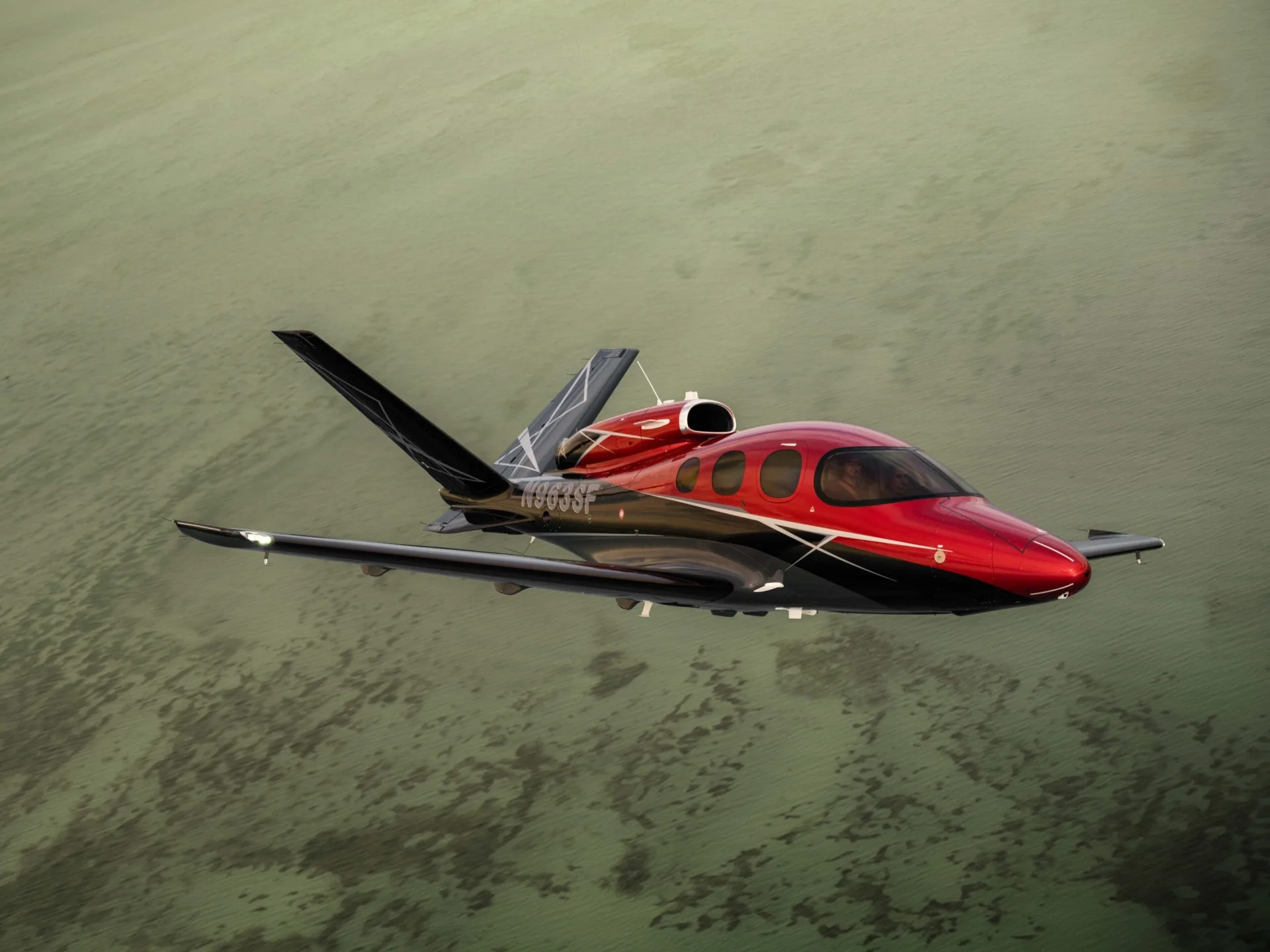
Overview
The Cirrus Vision Jet SF50 G2+ is the world's first single-engine personal jet equipped with a whole-aircraft parachute system. Powered by a Williams International FJ33-5A turbofan engine producing 1,846 lbs of thrust, the Vision Jet carries up to five passengers plus two children in the rear at speeds up to 311 knots and altitudes up to FL310.
Conceived as the natural step-up from Cirrus's SR-series piston aircraft, the Vision Jet brings jet performance and pressurized comfort within reach of owner-pilots. Its V-tail design, single-engine simplicity, and CAPS parachute system make it uniquely approachable for pilots transitioning from piston aircraft to jet operations.
History & Context
Cirrus Aircraft first revealed the Vision Jet concept in 2006, with the prototype making its maiden flight in 2008. After a lengthy development and certification process, the SF50 received FAA type certification in October 2016 and first deliveries began in late 2016. It was the first certified single-engine civilian jet to feature a whole-aircraft parachute system.
The G2 upgrade arrived in 2019, adding auto-throttle, Flight Stream connectivity, and performance improvements. The G2+ variant introduced Safe Return, an emergency autoland system developed with Garmin that allows even a passenger to land the aircraft safely in the event of pilot incapacitation.
Development & Updates
The SF50 G2+ features the Garmin Perspective Touch+ avionics suite with dual touchscreen displays, Autothrottle, and the revolutionary Safe Return emergency autoland system. Safe Return enables a single button press to automatically navigate to the nearest suitable airport, execute an approach, and land the aircraft without pilot input.
Additional G2+ enhancements include improved cabin pressurization, updated interior design options, and enhanced systems monitoring. The Williams FJ33-5A engine benefits from the manufacturer's extensive experience in small turbofan design, offering reliable performance with manageable maintenance costs for the personal jet segment.
Flight Characteristics
The Vision Jet is designed to feel familiar to SR-series pilots. The side-stick controller, cockpit layout, and general handling philosophy carry over from the SR22, making the transition to jet flying less intimidating than a conventional multi-engine jet would be. Controls are well-harmonized and responsive, with the V-tail providing distinctive but effective pitch and yaw authority.
In cruise at FL280-FL310, the Vision Jet provides a smooth, quiet cabin experience with pressurization maintaining a cabin altitude of approximately 8,000 feet at maximum operating altitude. The single-engine configuration eliminates the complexity of multi-engine procedures while the CAPS parachute provides an additional safety layer.
Landing the Vision Jet requires careful speed management due to its relatively clean aerodynamic profile, but pilots generally report predictable and pleasant handling in the pattern. The auto-throttle significantly reduces workload during all phases of flight.
Use Cases & Target Group
The Vision Jet SF50 G2+ targets a specific niche of safety-conscious, owner-operator pilots:
- Cirrus SR22 owners seeking a natural step-up to jet performance
- Owner-pilots who want single-pilot jet operations without multi-engine complexity
- Business professionals needing 800-1,200 nm range at jet speeds
- Families who value the CAPS and Safe Return safety systems
- Pilots entering the jet market who prefer a simplified operational profile
Strengths & Weaknesses
Strengths
- Only certified personal jet with CAPS whole-aircraft parachute system
- Safe Return emergency autoland system for unmatched safety in its class
- Single-engine simplicity reduces training requirements and operating complexity
- Natural transition path from Cirrus SR-series piston aircraft
- Garmin Perspective Touch+ avionics with auto-throttle and synthetic vision
- Pressurized cabin with jet speeds up to 311 knots
Weaknesses
- Limited range of approximately 1,200 nm compared to light twin-engine jets
- Rear seats are designed for children, limiting full adult passenger capacity
- Single engine means no redundancy in the event of engine failure at altitude
- Baggage space is constrained for a jet-class aircraft
Summary & Conclusion
The Cirrus Vision Jet SF50 G2+ has created an entirely new category in aviation: the personal jet. By combining single-engine simplicity with CAPS, Safe Return autoland, and a pilot-friendly cockpit, Cirrus has made jet ownership accessible to a wider audience than ever before. It is not a replacement for a light twin-engine jet but rather a step-up from high-performance piston aircraft.
For pilots who value safety technology, operational simplicity, and the ability to fly faster and higher without the complexity of multi-engine operations, the Vision Jet stands alone in the market.
