
Overview
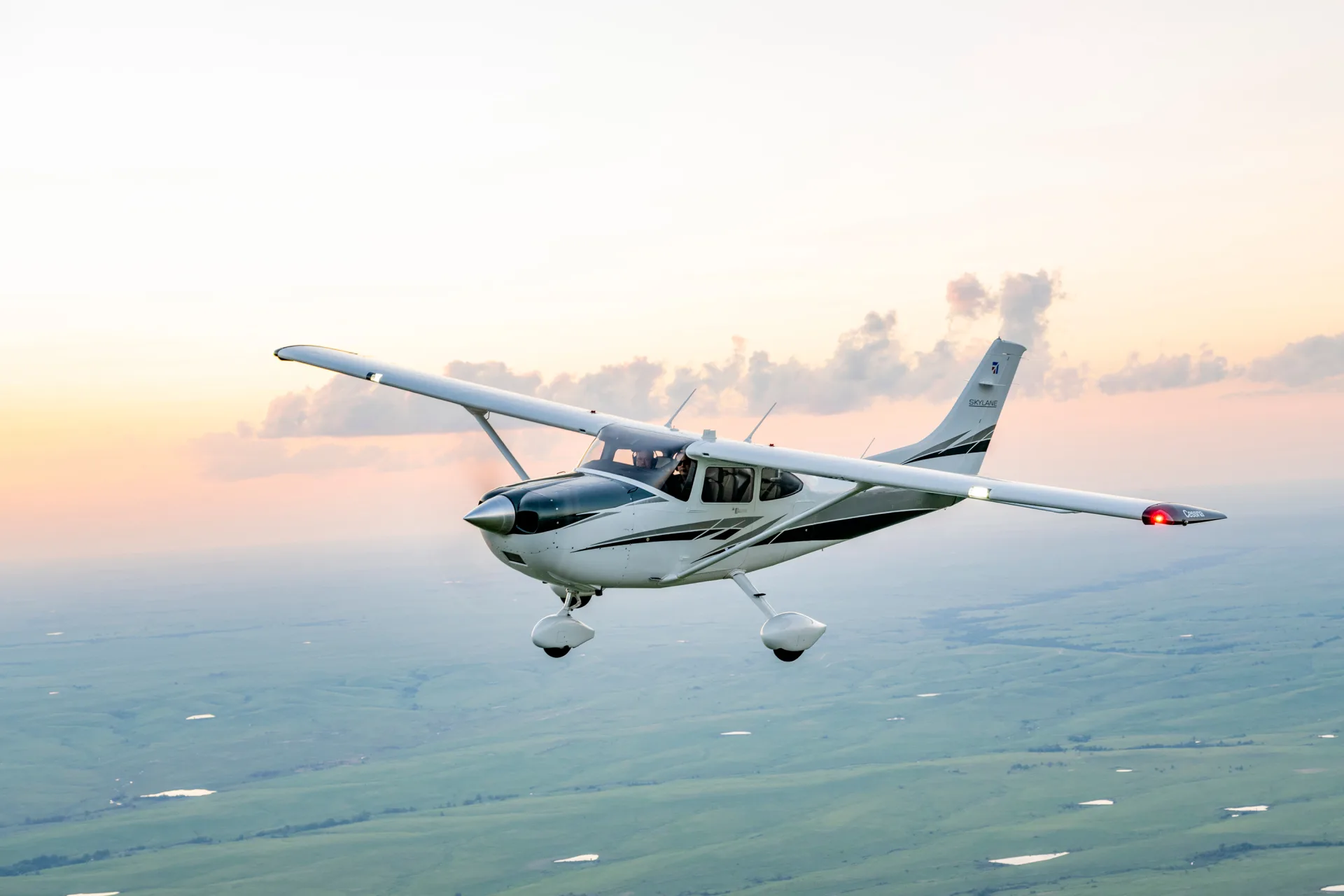
The Cessna 182 Skylane is the high-performance step-up from the legendary 172 Skyhawk, featuring a 235 HP Lycoming IO-540-AB1A5 engine and a constant-speed propeller. First introduced in 1956, the Skylane offers significantly greater payload capacity, faster cruise speeds, and improved climb performance while retaining the Skyhawk's proven high-wing configuration.
With a useful load often exceeding 1,100 pounds and a cruise speed of approximately 145 knots, the 182 bridges the gap between basic training aircraft and more complex high-performance singles. Its fixed landing gear keeps maintenance simple while the constant-speed propeller provides the efficiency needed for serious cross-country flying.
History & Context
The Cessna 182 was introduced in 1956, the same year as the 172, as a more powerful derivative of the Cessna 180 with tricycle landing gear. Over 23,000 units have been built, making it one of the most successful four-seat aircraft in general aviation. Like the 172, production halted in 1986 and resumed in 1996.
The Skylane has undergone continuous evolution, transitioning from carbureted Continental engines to fuel-injected Lycoming powerplants, and from analog instruments to the Garmin G1000 NXi glass cockpit. Throughout these changes, the fundamental airframe has remained remarkably consistent, a testament to its sound original design.
Development & Updates
The current Cessna 182T Skylane is powered by a 235 HP Lycoming IO-540-AB1A5 engine driving a McCauley constant-speed propeller. Standard avionics include the Garmin G1000 NXi integrated flight deck with GFC 700 autopilot, providing a highly capable IFR platform right from the factory.
Recent improvements focus on cabin comfort, with redesigned interiors, USB power, and improved soundproofing. The aircraft continues to be manufactured at Textron Aviation's Independence, Kansas facility, maintaining the type's long tradition of quality and consistency.
Flight Characteristics
The Skylane retains the Cessna high-wing stability that 172 pilots know well, but with noticeably more power and authority. The 235 HP engine provides strong climb rates, particularly at higher density altitudes where the 172 struggles. The constant-speed propeller requires an additional layer of engine management but delivers superior efficiency across the flight envelope.
In cruise, the 182 is notably faster and more stable than its smaller sibling, with the additional weight contributing to a smoother ride in turbulence. Landing the Skylane requires attention to speed management, as the heavier aircraft carries more energy on approach.
Pilots transitioning from the 172 generally find the Skylane intuitive to fly, with the main adjustment being propeller management and the higher approach speeds. The aircraft handles crosswinds well and offers excellent short-field performance when operated correctly.
Use Cases & Target Group
The Cessna 182 Skylane is aimed at pilots who have outgrown the 172 and need more capability:
- Private pilots seeking greater payload and range for family travel
- Pilots transitioning from fixed-pitch to constant-speed propeller aircraft
- Backcountry and off-airport operators (especially on aftermarket STOL kits)
- IFR pilots wanting a stable, well-equipped instrument platform
- Aircraft owners prioritizing simplicity of fixed-gear with higher performance
Strengths & Weaknesses
Strengths
- Significantly greater useful load than the Cessna 172, enabling full-fuel four-seat operations
- 235 HP engine with constant-speed propeller for efficient cross-country performance
- Proven high-wing design with excellent visibility and stability
- Fixed landing gear keeps maintenance costs lower than retractable-gear alternatives
- Garmin G1000 NXi glass cockpit with GFC 700 autopilot as standard
- Strong aftermarket support with STOL kits, engine upgrades, and avionics modifications
Weaknesses
- Higher fuel consumption than the 172, averaging 13-14 GPH at cruise
- Higher acquisition and insurance costs compared to the Skyhawk
- Constant-speed propeller adds operational complexity for newer pilots
- Cabin width remains relatively modest for a four-seat aircraft
Summary & Conclusion
The Cessna 182 Skylane occupies a sweet spot in general aviation as the logical step up from the 172 Skyhawk. It delivers meaningfully more performance and payload without the complexity and cost of retractable gear or turbocharged engines. For pilots who want to carry four people and baggage over reasonable distances, the Skylane is one of the most practical choices available.
Its combination of simplicity, capability, and the enormous Cessna support network makes it a perennial favorite among private pilots and a solid long-term investment in personal aviation.
