
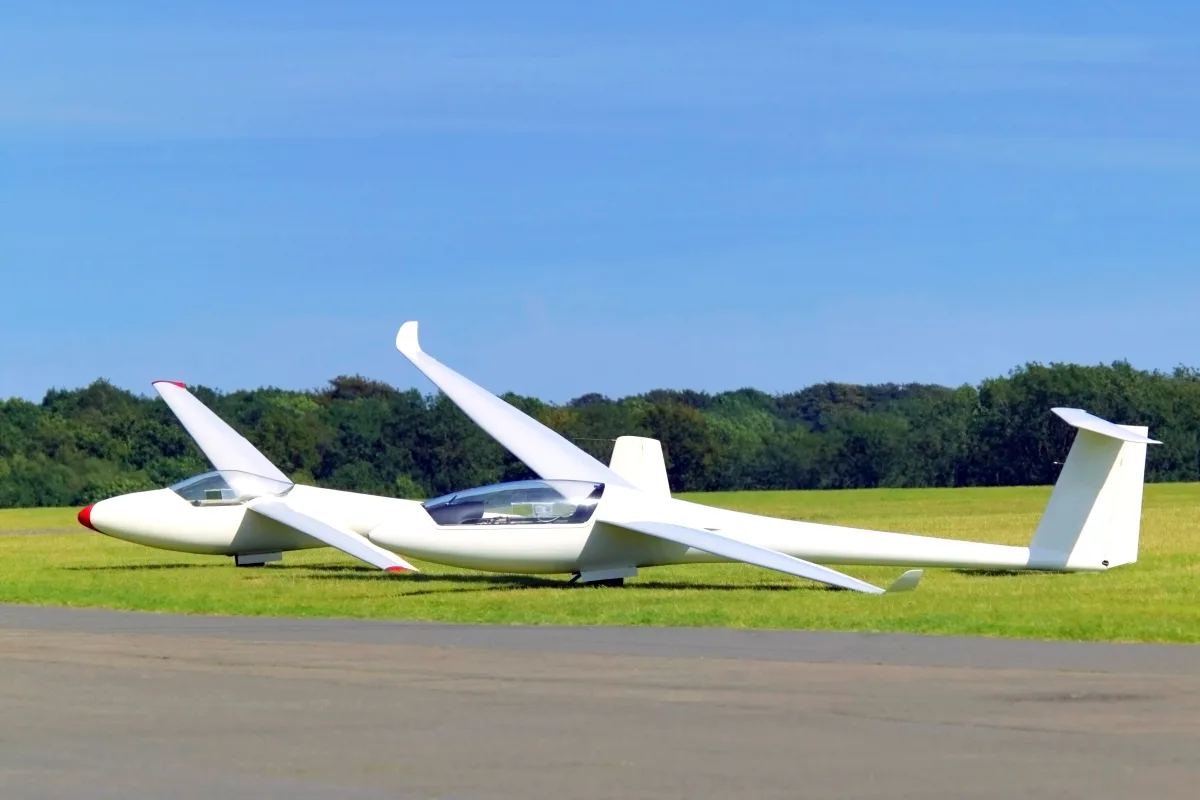
From training gliders to high-performance sailplanes: Glide ratios, construction methods, manufacturers, and what a good glider costs.
Modern Gliders Compared — From ASK 21 to Quintus
The world of gliders is more diverse than outsiders might expect. From the rugged training two-seater to the ultralight open-class sailplane with over 85 feet of wingspan, a fascinating spectrum unfolds. In this comparison we introduce the most important modern gliders organized by class, and explain the technological differences, performance data, and pricing. A guide for anyone planning to start soaring or thinking about their next aircraft purchase.
Fundamentals — what makes a glider good?
The central performance metric of a glider is the glide ratio (L/D): the ratio of horizontal distance covered to altitude lost. A glide ratio of 40 means the glider can cover 40 miles from an altitude of roughly 5,280 feet in still air. Modern high-performance gliders achieve glide ratios above 60, while training gliders range from about 28 to 35.
But the glide ratio alone does not tell the whole story. Equally important are:
- Minimum sink rate: How slowly does the glider descend at optimal speed? Critical for weak thermals.
- High-speed performance: How does the glide ratio hold up at higher speeds (70-100 knots)? Decisive for cross-country soaring.
- Handling qualities: Docility at low speed, agility in thermals, stability at high speed.
- Payload and water ballast: Higher wing loading improves high-speed glide performance at the expense of low-speed performance.
- Ground handling: Assembly and disassembly, transportability, ease of maintenance.
Training gliders — the entry point
Training gliders must be docile, robust, and two-seated. They forgive mistakes and give the instructor in the rear seat good visibility and full control.
ASK 21 (Alexander Schleicher)
The ASK 21 is the world's most widely used glider training two-seater and the standard aircraft in soaring clubs worldwide. In production since 1979, over 1,000 units have been built. The aircraft excels through its extraordinary docility, benign spin behavior, and rugged fiberglass construction.
| Specification | ASK 21 |
|---|---|
| Wingspan | 55.8 ft (17.0 m) |
| Glide ratio | 34 |
| Min. sink | 1.3 kt (0.65 m/s) |
| VNE | 151 kt (280 km/h) |
| Empty weight | 794 lb (360 kg) |
| Construction | Fiberglass (GFK) |
| Used price | $30,000-$60,000 |
The ASK 21 is also available in a Mi version (with retractable self-launch engine) and a B version (modernized cockpit, slightly improved performance). For training it is nearly unmatched — its only drawback is somewhat lower performance compared to more modern types.
DG-1001 (DG Flugzeugbau)
The DG-1001 is the most modern training two-seater on the market. With a 66-foot wingspan and a glide ratio of 46, it delivers performance approaching that of a Standard Class single-seater. It is available as a pure glider, with a retractable engine (DG-1001M), or with a sustainer turbine (DG-1001T).
| Specification | DG-1001 |
|---|---|
| Wingspan | 65.6 ft (20.0 m) |
| Glide ratio | 46 |
| Min. sink | 1.0 kt (0.51 m/s) |
| Construction | Carbon/Fiberglass (CFK/GFK) |
| New price (approx.) | from $140,000 |
Grob Twin Astir / Twin III Acro
The Grob Twin Astir and its successor the Twin III Acro are also widely used training two-seaters. The Twin Astir (glide ratio 28) is an older but robust design that serves as the workhorse in many clubs. Available used from $12,000-$18,000, it offers a cost-effective entry point. The Twin III Acro provides improved performance (glide ratio 36) and is cleared for aerobatics.
Standard Class — 15 meters without flaps
The Standard Class is the most traditional competition class: maximum 49-foot (15m) wingspan, no flaps, water ballast permitted. Aircraft in this class are the "pure" gliders — performance through aerodynamics, not technology.
LS8 (DG Flugzeugbau)
The LS8 is widely regarded as the finest Standard Class glider of the past decades. Docile handling paired with excellent thermal and high-speed performance make it the favorite of many cross-country pilots. The newer LS8-neo features an updated cockpit and modernized construction.
| Specification | LS8-18 | Discus 2 | ASW 28 |
|---|---|---|---|
| Wingspan | 49 ft / 59 ft | 49 ft (15 m) | 49 ft / 59 ft |
| Glide ratio (15m) | 43 | 43 | 43 |
| Min. sink | 1.1 kt | 1.15 kt | 1.07 kt |
| Empty weight | 525 lb | 540 lb | 529 lb |
| Water ballast | 48 gal (180 l) | 48 gal (180 l) | 50 gal (190 l) |
| Construction | GFK/CFK | CFK | CFK/GFK |
| Used price | $40,000-$65,000 | $48,000-$72,000 | $48,000-$65,000 |
Discus 2 (Schempp-Hirth)
The Discus 2 is Schempp-Hirth's counterpart to the LS8. It offers comparable performance with a somewhat different flight character — many pilots describe it as "sportier" and more direct in its control response. The Discus 2c (carbon fiber wing) is the high-performance version.
ASW 28 (Alexander Schleicher)
The ASW 28 is Schleicher's answer to the LS8 and Discus. It offers excellent minimum sink and therefore outstanding thermal performance. Also available as an 18-meter version (ASW 28-18) with extended wingtips.
15-Meter Class — flaps for more performance
In the 15-Meter Class, flaps are permitted. These optimize the wing profile for different flight phases: positive camber for slow flight and thermalling, neutral for cruise, negative camber for high-speed flight. This technology delivers a significant performance leap over the Standard Class.
ASG 29 (Alexander Schleicher)
The ASG 29 is one of the most successful competition gliders in the 15/18-meter class. With flaps and an optionally extendable 18-meter wingspan, it achieves glide ratios of 48 (15m) to 52 (18m). The ASG 29 is available as a pure glider, turbo (29T), and self-launcher (29E).
Ventus 3 (Schempp-Hirth)
The Ventus 3 is Schempp-Hirth's current flagship for the 15/18-meter class. It represents the latest in technology with an optimized carbon fiber structure, improved flaps, and excellent handling. The Ventus 3T (Turbo) features a retractable sustainer engine as a get-home aid.
| Specification | ASG 29 (18m) | Ventus 3 (18m) |
|---|---|---|
| Wingspan | 49 ft / 59 ft | 49 ft / 59 ft |
| Glide ratio (18m) | 52 | 55 |
| Min. sink | 0.9 kt | 0.84 kt |
| Water ballast | 53 gal (200 l) | 53 gal (200 l) |
| Construction | CFK (carbon fiber) | CFK (carbon fiber) |
| New price (approx.) | from $120,000 | from $140,000 |
18-Meter Class — the sweet spot of performance and handling
The 18-Meter Class offers an excellent compromise: significantly higher performance than the 15-meter class, yet still manageable wingspans for club operations and transport. Many pilots buy a 15/18-meter glider (such as the ASG 29 or Ventus 3) and fly it with short or long wingtips depending on the intended use.
ASH 31 (Alexander Schleicher)
The ASH 31 Mi is an 18/21-meter two-seater with self-launch capability, used for training, cross-country touring, and competition alike. With a glide ratio of up to 56 (21m) and the ability to fly solo or dual, it is one of the most versatile gliders on the market. New price is over $240,000.
Open Class — where the limits of physics are explored
In the Open Class there is no wingspan restriction. Here the most extreme gliders in the world are built — with wingspans of 75 to over 100 feet and glide ratios beyond 60.
Quintus (Schempp-Hirth)
The Quintus is a 75-foot single-seater from Schempp-Hirth with an impressive glide ratio of over 60. It is based on the proven Ventus wing, extended by massive outer wing panels. The Quintus is the flagship for ambitious cross-country pilots who seek maximum performance with still-acceptable handling.
ASH 30 Mi (Alexander Schleicher)
The ASH 30 Mi is an 87-foot two-seater in the Open Class with a self-launch engine. With a glide ratio of up to 66, it ranks among the highest-performing production gliders in the world. It can be flown solo or with a copilot and is intended for pilots who want to extract the maximum from cross-country soaring. New price: well over $240,000.
Eta (Eta Aircraft)
The Eta, with a wingspan of 101.4 feet (30.9 m), is the largest glider ever built and achieves a glide ratio above 70 — a figure unmatched in aviation. The Eta is a two-seater developed in Germany in the 2000s. Only a handful of examples were built, each a handcrafted carbon fiber masterpiece. Virtually unavailable on the used market, the new price was in the high six-figure dollar range.
Glide ratios compared — from trainer to record holder
| Aircraft | Class | Wingspan | Glide Ratio | Used Price |
|---|---|---|---|---|
| Twin Astir | Training | 57.4 ft (17.5 m) | 28 | $12,000-$18,000 |
| ASK 21 | Training | 55.8 ft (17.0 m) | 34 | $30,000-$60,000 |
| LS4 | Standard (older gen.) | 49.2 ft (15.0 m) | 38 | $22,000-$36,000 |
| LS8 | Standard | 49.2 ft (15.0 m) | 43 | $40,000-$65,000 |
| Discus 2 | Standard | 49.2 ft (15.0 m) | 43 | $48,000-$72,000 |
| DG-1001 | Training/Competition | 65.6 ft (20.0 m) | 46 | $96,000-$144,000 |
| ASG 29 (15m) | 15-Meter | 49.2 ft (15.0 m) | 48 | $84,000-$120,000 |
| ASG 29 (18m) | 18-Meter | 59.1 ft (18.0 m) | 52 | $96,000-$132,000 |
| Ventus 3 (18m) | 18-Meter | 59.1 ft (18.0 m) | 55 | $108,000-$156,000 |
| Quintus | Open Class | 75.5 ft (23.0 m) | 60+ | $156,000-$216,000 |
| ASH 30 Mi | Open Class | 86.9 ft (26.5 m) | 66 | $216,000-$300,000 |
| Eta | Open Class | 101.4 ft (30.9 m) | 72 | rarely available |
Construction methods — fiberglass, carbon fiber, and the evolution of materials
Construction methods in glider manufacturing have changed dramatically over the decades:
Wood construction (through 1960s): Classic wooden gliders like the Ka 6 or Bergfalke consisted of a wood frame with fabric or plywood skin. Robust and repairable, but heavy and aerodynamically limited. Used wooden gliders can be found for $2,000-$6,000 and serve as inexpensive entry-level aircraft.
Fiberglass (GFK) construction (from 1960s): The fiberglass revolution enabled smooth surfaces, laminar flow profiles, and significantly higher glide ratios. The Libelle (1964) was one of the first fiberglass gliders. Today fiberglass gliders are the standard for training and recreational soaring. Examples: ASK 21, Astir, Std. Cirrus.
Carbon fiber (CFK) construction (from 1980s): Carbon fiber is lighter and stiffer than fiberglass, enabling even slimmer profiles and greater wingspans at reduced weight. All modern high-performance gliders use carbon fiber for wings and primary structure. The downside: carbon fiber is more expensive to manufacture and more sensitive to point loads (stone strikes, hard landings).
Hybrid construction: Many current gliders combine carbon fiber (wings, tail) with fiberglass (fuselage, less-stressed areas) to optimize the cost-performance balance.
The manufacturers — who builds the best gliders?
Glider manufacturing is a niche in which a handful of manufacturers — predominantly from Germany — dominate the world market:
Schempp-Hirth (Kirchheim/Teck, Germany): Founded in 1935, one of the most storied manufacturers. Products: Discus 2, Ventus 3, Quintus, Duo Discus, Arcus. Known for excellent build quality and innovative engineering. The company is one of the world's leading producers of high-performance gliders.
DG Flugzeugbau (Bruchsal, Germany): Formed from the merger of DG (Glaser-Dirks) and LS (Rolladen-Schneider). Products: DG-1001, LS8-neo, LS4. DG unites two of the most important brands in soaring history under one roof and offers a broad portfolio from training two-seaters to competition gliders.
Alexander Schleicher (Poppenhausen, Germany): The world's oldest still-operating glider manufacturer, founded in 1927. Products: ASK 21, ASG 29, ASH 31, ASH 30, ASW 28. Schleicher gliders are known for their solid construction, long service life, and high resale value.
Jonker Sailplanes (Potchefstroom, South Africa): A younger manufacturer that has challenged the established European makers with the JS1 Revelation and the JS3 Rapture. Jonker gliders stand out through innovative aerodynamics (jet flaps) and excellent performance in the 18-meter class. The JS3 is considered one of the highest-performing 18-meter gliders in existence.
Buyer's guide — which glider is right for you?
The choice of the right glider depends on experience, budget, and intended use:
- Beginners (0-100 hours): Use club gliders (ASK 21, LS4, Astir). No purchase necessary — club membership is sufficient.
- Progressing pilots (100-300 hours): A used Standard Class single-seater. LS4 ($22,000-$36,000), Std. Cirrus ($14,000-$24,000), or ASW 19 ($18,000-$30,000) are ideal first gliders.
- Ambitious cross-country pilots: A used LS8 or Discus 2 ($40,000-$72,000) offers competition-capable performance at reasonable cost.
- Competition pilots: ASG 29 or Ventus 3 in 15/18m configuration ($84,000-$156,000) — the optimum combination of performance and versatility.
- Maximum performance: Open Class with Quintus, ASH 30, or comparable ($156,000-$300,000+) — for pilots who want to extract the last ounce of performance from every soaring day.
"The best glider is the one you fly regularly. An older single-seater that is in the air every weekend brings more progress than a high-tech machine that sits in the trailer because of cost." — A timeless truth from the soaring community
In addition to the aircraft itself, costs arise for a trailer (used $3,500-$10,000), insurance ($600-$1,800/year), maintenance and annual inspection ($600-$2,400/year), and hangar space ($350-$1,800/year). Many pilots share an aircraft in a partnership of two or three owners to reduce costs.
The used glider market is well-supplied: platforms like the SSA classifieds, WingsAndWheels, and international portals offer a wide selection. The value stability of quality gliders is remarkable — a well-maintained LS8 hardly depreciates at all, and some types like the Ka 6 have actually appreciated as collector's items.
Whether as a training aircraft in a club, a personal cross-country machine, or a top-tier competition sailplane — the diversity of modern gliders offers the right aircraft for every need and budget. The decision should be well considered, because for many pilots a glider is more than a piece of sports equipment — it is a faithful companion for decades.
