
Loops, rolls, and spins without an engine: Which figures are possible in gliders, training requirements, and which aircraft are approved.
Aerobatics in Gliders — What Is Allowed, What Is Possible
Aerobatics in gliders is a discipline that demands the highest precision, deep aerodynamic knowledge, and absolute mastery of the aircraft. Unlike powered aerobatics, the glider aerobatic pilot has only a finite energy budget — every maneuver costs altitude, and there is no engine to recover it. This article explains the permitted maneuvers, the approved aircraft types, the training pathway, and the fascinating world of glider aerobatic competition.
Fundamentals — energy management without an engine
The fundamental difference from powered aerobatics lies in energy management. A glider aerobatic pilot begins the sequence at a specific altitude and must complete all maneuvers within the available altitude band. Each maneuver converts potential energy (altitude) into kinetic energy (speed) while consuming total energy through drag. A typical competition program requires 2,600 to 4,000 feet of altitude.
This means: the pilot must climb to sufficient altitude before the sequence — either in thermals or by aerotow to 5,000-6,500 feet AGL. Then the program begins, and with each maneuver the available altitude decreases. The art lies in flying the maneuvers so efficiently that enough altitude remains at the end for a safe return and landing.
Permitted maneuvers in glider aerobatics
Maneuvers in glider aerobatics are standardized in the Aresti catalog (named after Spanish pilot Jose Luis Aresti). Each maneuver has a defined K-factor that indicates the difficulty level and factors into the scoring. Maneuvers are divided into several difficulty tiers:
Basic maneuvers (Sportsman/Intermediate level)
Loop: The classic aerobatic maneuver — a complete vertical circle. The pilot accelerates to approximately 95-110 knots, pulls up smoothly, passes through inverted flight at the top with about 55 knots, and returns to upright flight. The G-loading during the pull-up is typically 3.5 to 4.5 g. A clean loop requires constant G-loading and a perfectly round shape.
Hammerhead (Stall Turn): The pilot pulls to the vertical, lets the speed decay to near zero, and pivots the aircraft 180 degrees using the rudder before diving vertically. The hammerhead requires precise timing and delicate rudder coordination. It is the most altitude-efficient maneuver since the entry and exit altitudes are nearly identical.
Roll: A complete 360-degree rotation about the longitudinal axis in straight flight. In a glider, the roll is typically flown at a roll rate of 90-120 degrees per second. Variations include slow rolls (constant rotation), point rolls (hesitation rolls with defined stops at 90, 180, 270 degrees), and snap rolls. The challenge: throughout the entire roll, the flight path must remain straight — no altitude loss, no heading change.
Spin: A controlled departure beyond the critical angle of attack with autorotative rotation. In gliders, typically 1 to 3 turns are executed. Recovery is initiated with opposite rudder and forward stick. The spin is one of the oldest aerobatic maneuvers and demonstrates safe mastery of flight at the stall boundary.
Advanced maneuvers (Advanced/Unlimited level)
Immelmann: A half loop upward followed by a half roll to upright. The pilot gains altitude and reverses heading by 180 degrees.
Split-S: The reverse of the Immelmann — a half roll to inverted followed by a half loop downward. The pilot loses significant altitude but gains speed for the next maneuver.
Cuban Eight: Two half loops connected by 45-degree down lines with half rolls. An elegant, flowing figure that demands good energy management.
Rolling maneuvers: Rolls on ascending, descending, or horizontal lines, often combined with hesitation points (2-point, 4-point, 8-point). Point rolls require extreme precision — in a 4-point roll the pilot must stop at exactly 90, 180, 270, and 360 degrees.
Inverted flight: Sustained straight-and-level flight in the inverted position. Particularly challenging in gliders because the wing profile is optimized for upright flight and produces considerably more drag when inverted. The pilot must push continuously (negative G) to maintain altitude.
Knife-edge flight: Level flight at 90 degrees of bank — the aircraft flies "on its edge." Lift is generated solely by the rudder and fuselage cross-section. Knife-edge flight in a glider is extremely difficult and only possible in types specifically designed for it.
Approved aircraft for glider aerobatics
Not every glider is cleared for aerobatics. Aircraft must be certified for the corresponding load limits and possess aerobatic approval per the manufacturer's specifications. The most important aerobatic gliders are:
| Aircraft | Manufacturer | Seats | G-Limits | Category |
|---|---|---|---|---|
| Swift S-1 | Marganski (Poland) | 1 | +7/-5 g | Unlimited Class |
| MDM-1 Fox | MDM (Poland) | 2 | +7/-5 g | Training & Competition |
| SZD-59 Acro | PZL Bielsko (Poland) | 1 | +6/-4 g | Advanced Class |
| Pilatus B4 | Pilatus (Switzerland) | 1 | +5.3/-2.65 g | Sportsman/Intermediate |
| ASK 21 (Aerobatic version) | Schleicher (Germany) | 2 | +6.5/-4 g | Training |
| Salto | Start+Flug (Germany) | 1 | +6.5/-4 g | Intermediate/Advanced |
The Swift S-1 is the dominant aircraft in the Unlimited Class. With its symmetrical airfoils, high structural strength, and excellent roll rate, it was purpose-built for aerobatics. The MDM-1 Fox is the standard two-seater for aerobatic training and is also used in the two-seat class at competitions.
Training — the path to an aerobatic rating
In the United States, no specific FAA rating or endorsement is required for glider aerobatics, though proficiency training with an experienced instructor is strongly recommended and considered essential by the soaring community. In EASA countries, a formal aerobatic rating is required as an extension of the SPL/LAPL(S). The training typically includes:
Prerequisites:
- Valid Private Pilot - Glider certificate (FAA) or SPL/LAPL(S) (EASA)
- At least 40 hours PIC time in gliders (recommended)
- Current medical (FAA: driver's license; EASA: LAPL Medical or higher)
- Proficiency in slow flight and spin recovery
Practical training:
- At least 20 aerobatic training flights in a two-seater (typically Fox or ASK 21)
- Basic maneuvers: loop, hammerhead, roll, spin, inverted flight
- Energy management and altitude planning
- Emergency procedures for failed maneuvers
- Solo aerobatic flights under instructor supervision
- Proficiency check with an aerobatic examiner (EASA) or endorsement from instructor (FAA)
Ground instruction:
- Aerodynamics of aerobatic flight (load factors, stalls in unusual attitudes)
- Aircraft knowledge (G-limits, VNE, maneuvering speed VA)
- Human performance under G-loading (greyout, blackout, redout)
- Emergency procedures and parachute use
G-forces — what the body must endure
Aerobatics means significant physical stress. G-forces act on the entire body and can lead to dangerous conditions without proper preparation:
| G-Loading | Physical Effect | Typical Maneuver |
|---|---|---|
| +1 g | Normal flight, no special stress | Straight and level |
| +2 to +3 g | Increased body weight, slight visual restriction | Steep turn, gentle loop |
| +3.5 to +4.5 g | Greyout possible (loss of peripheral vision) | Loop, tight pull-up |
| +5 to +6 g | Blackout possible (complete loss of vision) | Sharp pull-ups |
| -1 to -2 g | Blood rushes to the head, redout risk | Inverted maneuvers |
Countermeasures against G-forces include the anti-G straining maneuver (AGSM) — tensing the abdominal and leg muscles while breathing in short, forceful bursts — as well as good physical fitness, adequate hydration, and avoiding abrupt G-onset rates. Unlike in powered aerobatics or military flying, G-suits are not used in glider aerobatics.
Safety equipment
Safety is the top priority in aerobatics. The following equipment is required or strongly recommended:
Parachute: Wearing a bailout parachute during aerobatics is mandatory in most countries. The parachute is worn as a seat-pack and must be repacked regularly (every 6-12 months). The minimum safe bailout altitude is approximately 1,000-1,600 feet AGL — below this height there may not be enough time for full deployment.
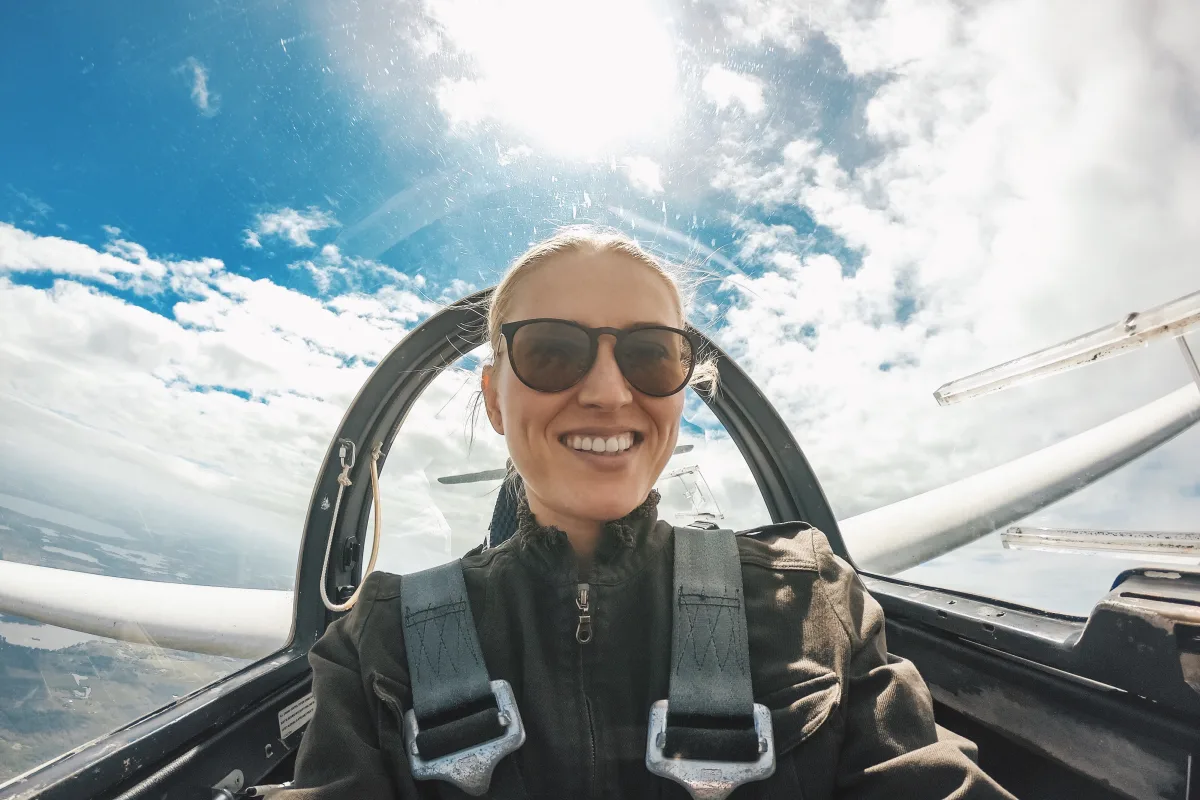
Harness: Aerobatic gliders use 5-point harnesses (two shoulder straps, two lap belts, and a crotch strap) that secure the pilot firmly in the seat. The harness must be tightened enough that the pilot is not lifted out of the seat during negative G maneuvers. Loose harnesses are a common and dangerous error.
Helmet: Although not required everywhere, a helmet is strongly recommended for glider aerobatics. It protects during turbulence, hard landings, and in the unlikely event of a crash.
Aerobatic boxes — the framework for safe training
Aerobatics may only be performed in designated aerobatic boxes (aerobatic practice areas) in most countries. An aerobatic box defines:
- Horizontal boundaries: Typically an area of roughly 0.5 x 0.5 miles (competition) to larger practice areas
- Vertical boundaries: Minimum altitude (typically 1,500 ft AGL) and maximum altitude
- Authorization: The box must be approved by the relevant aviation authority (FAA or local CAA)
- NOTAM: During aerobatic operations, a NOTAM (Notice to Air Missions) must be active to inform other air traffic
At competitions, the box is monitored by judges on the ground who evaluate the precision of the maneuvers. Maneuvers flown outside the box boundaries result in significant scoring penalties.
Competitions — CIVA and national championships
Glider aerobatic competitions are held at various levels:
CIVA (Commission Internationale de Vol Acrobatique): The aerobatic commission of the FAI organizes the World Glider Aerobatic Championships, held every two years. The categories are:
- Sportsman: Entry level with basic maneuvers
- Intermediate: Extended maneuvers, moderate difficulty
- Advanced: Demanding programs with combined maneuvers
- Unlimited: The top tier — all maneuvers permitted, highest difficulty
The US National Glider Aerobatic Championships are held annually and attract top American aerobatic pilots. The US, along with European nations like Germany, France, and Poland, has a strong tradition in glider aerobatics and regularly produces world-class competitors.
At competitions, several programs are flown:
- Known Program: A mandatory program known in advance and practiced by the pilots
- Free Program: A freestyle sequence composed by the pilot within defined rules
- Unknown Program: A program revealed only shortly before the flight, testing improvisational ability
Prerequisites and getting started
Those interested in getting into glider aerobatics should consider the following steps:
- Solid foundation: A Private Pilot - Glider certificate with at least 40-50 hours of experience provides the base
- Find the right club: Locate a soaring club with an aerobatic tradition and suitable aircraft (Fox, ASK 21)
- Experienced instructor: Seek an instructor with aerobatic experience and the appropriate teaching credentials
- Physical fitness: Good baseline fitness, no cardiovascular issues, no tendency toward motion sickness
- Gradual progression: Start with basic maneuvers (spins, loops, hammerheads) and build up incrementally
- Attend competitions: Watch aerobatic contests as a spectator to get a feel for the atmosphere
"Aerobatics in a glider is the most honest form of aerobatics — you get only one chance, every maneuver must be perfect, and gravity is merciless. But that is exactly what makes it so compelling." — Jerzy Makula, multiple World Glider Aerobatic Champion
Glider aerobatics combines the elegance of silent flight with the dynamics of acrobatic maneuvers. It is a sport that challenges the complete pilot — physically, mentally, and technically. Anyone who has experienced the thrill of a clean loop in a glider, the silence at the apex, the view upward to the earth below, will understand why this discipline captivates its devotees so deeply.
