
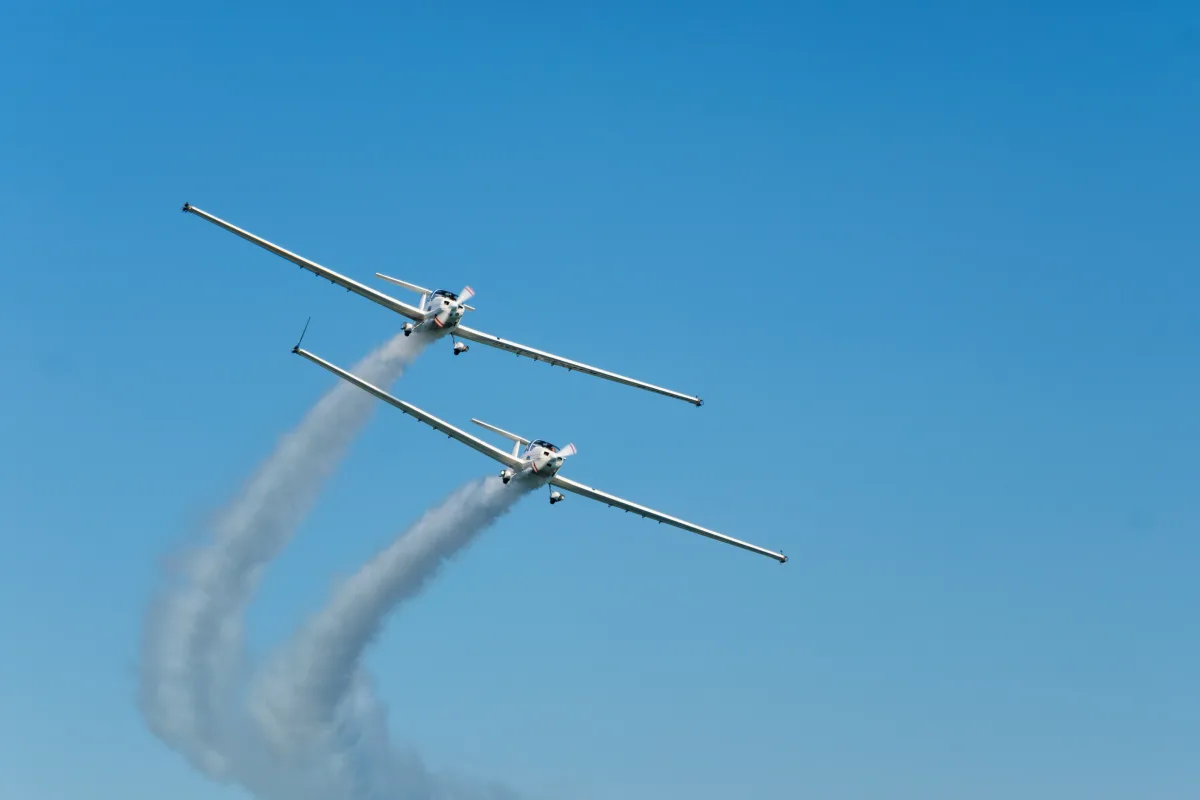
From loops to knife-edge flight: Which figures exist, how training works, competition requirements, and what g-forces the body can handle.
Aerobatics — Basic Figures, Licensing, Competitions, and Hazards
Aerobatics is the pinnacle of aviation. No other branch of flying combines airmanship, physical endurance, and pure aesthetics as uncompromisingly as maneuvering an aircraft through three-dimensional figures in the sky. Those who practice aerobatics strive for complete mastery of their aircraft — in every attitude, at every speed, under every load. This article explains the key figures, the path to an aerobatic rating, the competitive landscape, and the real dangers of this captivating discipline.
What Are Aerobatics? A Definition
Aerobatics encompasses all flight maneuvers that go beyond normal flight operations. EASA defines aerobatics as intentionally performed maneuvers in which the aircraft assumes an attitude not required for normal flight — specifically, a bank angle exceeding 60 degrees or an unusual pitch attitude. In the United States, the FAA (14 CFR 91.303) similarly defines aerobatic flight as an intentional maneuver involving an abrupt change in an aircraft's attitude, an abnormal attitude, or abnormal acceleration not necessary for normal flight. This clearly distinguishes aerobatics from regular VFR flight and requires special ratings, approved aircraft, and designated airspace.
Basic Aerobatic Figures
The basic figures form the foundation of every aerobatic program. They are the first maneuvers taught during training and remain the building blocks for more complex combinations even for experienced pilots.
Loop (Inside Loop)
The loop is the most iconic aerobatic figure. The aircraft describes a complete vertical circle — nose up, inverted at the top, nose down, and back to normal flight. The pilot begins with increased airspeed (typically 110-135 kt in an Extra 300), applies steady back pressure on the stick, and flies through the circle at approximately +3.5 to +4.5 g at the bottom. At the top of the arc, the G-load is around +1 g. A clean loop has a perfectly circular shape and ends at the same altitude and heading at which it began. A typical loop spans 1,000 to 1,600 ft vertically.
Aileron Roll
During an aileron roll, the aircraft rotates around its longitudinal axis while flying straight ahead. The pilot initiates the roll with full aileron deflection and corrects with rudder and elevator to keep the nose tracking along the horizon. A complete 360-degree roll takes 1 to 3 seconds depending on the aircraft type. Variations include the Half Roll (180 degrees, ending in inverted flight), the Four-Point Roll (four stops at 90-degree increments), and the Slow Roll (flown slowly and precisely, extremely demanding).
Hammerhead (Stall Turn)
The hammerhead is one of the most elegant figures in aerobatics. The aircraft is pulled vertically upward until the airspeed decays to near zero. At that precise moment, the pilot applies full rudder, and the aircraft pivots around its vertical axis — the nose travels from pointing straight up to pointing straight down, like a hammer toppling over. The aircraft then descends vertically before being pulled back to level flight. A perfect hammerhead shows an exactly vertical up-line, a clean pivot point, and an exactly vertical down-line. The difficulty lies in timing: too early on the rudder means the aircraft still has too much energy and won't yaw cleanly; too late means an uncontrolled departure.
Spin
The spin is an autorotative motion around all three axes simultaneously. One wing is stalled while the other continues to produce lift, creating a rotation combined with a descent. In aerobatics, the spin is deliberately entered and precisely recovered after a defined number of turns (typically 1 to 3). Recovery is achieved by applying opposite rudder (against the direction of rotation) and relaxing back pressure on the elevator. Spin training is also of enormous importance in primary flight training, as it simulates behavior during an unintentional stall.
Immelmann Turn
Named after the German World War I fighter pilot Max Immelmann, this figure consists of a half loop upward followed by a half roll at the apex. The result: the aircraft has reversed its heading by 180 degrees while gaining altitude. In aerial combat, this was a brilliant maneuver for shaking off a pursuer while simultaneously gaining a superior position. In modern aerobatic competition, the Immelmann must be flown with precision — the half loop must end exactly at the apex, and the half roll must be centered and on point.
Split-S
The Split-S is the exact opposite of the Immelmann: first a half roll (transitioning to inverted flight), then a half loop downward. The aircraft reverses heading by 180 degrees while losing altitude. The G-load during the pull-out can be substantial (+4 to +5 g), which is why sufficient altitude must be available. A Split-S initiated too low is a fatal maneuver.
Advanced Aerobatic Figures
Knife Edge
In knife-edge flight, the aircraft is banked 90 degrees and maintains altitude solely through rudder input. The fuselage effectively becomes the lifting surface. Knife-edge flight requires considerable rudder force and is physically extremely demanding. It is typically sustained only for short distances, as the aircraft generates significant drag in this attitude and rapidly loses airspeed. A clean knife-edge pass with constant altitude and heading over several hundred feet is a mark of the highest pilot precision.
Lomcevak
The Lomcevak (Czech for "headache" or "stumbler") is one of the most spectacular figures in aerobatics. The aircraft is pitched into a tumbling gyration — rotating simultaneously around its lateral and longitudinal axes, appearing to somersault end-over-end through the air. The figure was developed by Czech pilots in the 1950s and requires specific aerodynamic characteristics in the aircraft. The Lomcevak belongs to the category of tumbling maneuvers and is flown only in the highest competition categories. The G-loads during this figure are unpredictable and can momentarily reach extreme values.
Torque Roll
The torque roll is a relatively modern figure that became possible only with high-performance aerobatic aircraft. The aircraft is pulled vertically upward until it comes to a complete stop — and then hangs on the propeller, held aloft solely by engine thrust. In this position, the aircraft slowly rotates around its vertical axis, driven by propeller torque. The pilot controls the rotation using control surfaces and throttle management. A sustained torque roll through multiple rotations requires an aircraft with an outstanding thrust-to-weight ratio of at least 1:1.
Training and Aerobatic Rating
In Europe, aerobatics is not simply permitted — it requires a special rating. Under EASA regulations (Part-FCL), a pilot needs an aerobatic rating to perform aerobatic maneuvers. In the United States, while the FAA does not require a specific aerobatic rating, aerobatic flight instruction from a qualified CFI is strongly recommended, and specific airspace and altitude restrictions apply under 14 CFR 91.303. The prerequisites and training pathway under EASA are clearly defined.
Prerequisites (EASA)
- Valid pilot license (at least PPL(A) or LAPL(A))
- At least 40 hours of flight experience as pilot-in-command on aeroplanes after license issue
- Class 2 medical certificate or higher (FAA equivalent: at least a 3rd Class medical)
- Minimum age of 16 to begin aerobatic training
Training Syllabus
The aerobatic training course comprises at least 10 hours of aerobatic instruction with a qualified flight instructor. Training is typically divided into the following phases:
- Phase 1 (approx. 3 hours): Unusual attitudes, stalls, spin entry and recovery
- Phase 2 (approx. 4 hours): Basic figures — loop, roll, hammerhead, inverted flight, Immelmann, Split-S
- Phase 3 (approx. 3 hours): Figure combinations, freestyle sequences, check ride preparation
The examination consists of a practical check ride in which the candidate must demonstrate a defined program of basic figures. Theoretical examinations are typically integrated into the PPL training or completed as a supplementary module.
Costs
| Item | Cost (approx.) |
|---|---|
| 10h aerobatic training (dual seat) | 3,000 - 5,000 EUR (~$3,300 - 5,500) |
| Flight instructor fees | 500 - 1,000 EUR (~$550 - 1,100) |
| Check ride / examination | 300 - 500 EUR (~$330 - 550) |
| Total | 3,800 - 6,500 EUR (~$4,200 - 7,150) |
Aerobatic Competitions
Aerobatic competitions represent the pinnacle of the sport. They are organized under the auspices of CIVA (Commission Internationale de Voltige Aerienne), a sub-commission of the FAI (Federation Aeronautique Internationale). In the United States, the International Aerobatic Club (IAC), a division of EAA, governs competitive aerobatics.
Competition Categories
Competitions are divided into ascending difficulty categories:
| Category | Description | Typical Figures |
|---|---|---|
| Sportsman | Entry-level category | Loop, roll, hammerhead, spin |
| Intermediate | Advanced basic figures | Four-point roll, half Cuban eight |
| Advanced | Complex combinations | Snap rolls, push maneuvers |
| Unlimited | Highest level, all figures permitted | Lomcevak, torque roll, outside loop |
A competition program consists of three sequences: the Known Program (pre-published), the Unknown Program (revealed only the evening before), and the Freestyle Program. Judges on the ground score each individual figure from 0 to 10, with deductions for form errors, heading deviations, and imprecise lines.
National and International Competitions
National aerobatic championships are held annually in many countries — for example, by the IAC in the United States, the British Aerobatics Association in the UK, and the DAeC in Germany. Beyond national events, European Championships and World Aerobatic Championships bring together the world's best pilots competing in the Unlimited category. The sport has a strong international following, with top competitors from Europe, the Americas, and beyond.
The Aerobatic Box
All competition figures must be flown within a defined aerobatic box. Its dimensions typically measure 3,300 ft x 3,300 ft (1,000 m x 1,000 m) horizontally and extend vertically from the ground to the approved upper limit. The lower floor varies by category — in the Unlimited category, it is set at 328 ft (100 m) AGL. If the pilot leaves the box or descends below the minimum altitude, penalty points are assessed or disqualification results.
Aerobatic Aircraft
Not every aircraft is approved for aerobatics. Aerobatic-capable machines must have elevated structural load limits and be certified for flight maneuvers in all attitudes.
Popular Aerobatic Aircraft
| Aircraft | Manufacturer | G-Limits | Notable Feature |
|---|---|---|---|
| Extra 330SC | Extra Aircraft (Germany) | +10g / -10g | Carbon construction, Unlimited standard |
| Extra 330LX | Extra Aircraft (Germany) | +8g / -6g | Two-seat trainer |
| Pitts Special S-2C | Aviat Aircraft (US) | +6g / -3g | Classic biplane |
| CAP 232 | Mudry (France) | +10g / -8g | French competition monoplane |
| Sbach 342 | XtremeAir (Germany) | +10g / -10g | Single-seat, full carbon structure |
The Extra 330SC is widely regarded as the most-flown Unlimited competition aircraft in the world. Built by Extra Aircraft in Dinslaken, Germany, it has a power-to-weight ratio that enables vertical climbs and sustained torque rolls. The Pitts Special, by contrast, is the classic among aerobatic aircraft — as a biplane it offers outstanding roll performance but is increasingly being displaced by modern monoplanes in higher competition categories.
G-Forces and Their Effects
Aerobatics subjects the human body to extreme loads. G-force describes acceleration as a multiple of gravitational acceleration. At +1 g, a person feels normal — their weight corresponds to standing on the ground. At +6 g, a 176 lb (80 kg) pilot effectively weighs 1,058 lb (480 kg), and blood is forced from the brain down into the lower extremities.
Positive G-Loading (+Gz)
- +3 to +4 g: Peripheral vision begins to narrow (greyout)
- +4 to +5 g: Tunnel vision develops, visual field constricts significantly
- +5 to +6 g: Blackout possible (loss of vision with consciousness retained)
- +6 to +9 g: G-LOC (G-induced Loss of Consciousness) without protective measures
Negative G-Loading (-Gz)
Negative G-loads are considerably more uncomfortable than positive ones. At just -2 to -3 g, a redout occurs — blood rushes to the head, eyes become congested, and headache and disorientation threaten. The human tolerance for negative G-forces is significantly lower than for positive ones.
G-Protection Measures
Aerobatic pilots employ various techniques to increase G-tolerance: the Anti-G Straining Maneuver (AGSM), in which the leg and abdominal muscles are tensed and breathing is controlled. Anti-G suits, common in military aviation, are rarely used in civilian aerobatics. Regular strength training and cardiovascular fitness significantly improve natural G-tolerance.
Hazards in Aerobatics
Aerobatics is not a risk-free sport. Accident causes can be categorized into several areas:
G-LOC (G-induced Loss of Consciousness)
G-induced loss of consciousness is one of the most insidious hazards. Under high G-loading, the pilot loses consciousness and is unable to control the aircraft for 10 to 30 seconds. At low altitude — particularly during competitions — recovery time is often insufficient. G-LOC has caused numerous fatal accidents throughout the history of aerobatics.
Structural Failure
Even though aerobatic aircraft are designed for high G-loads, material fatigue, improper maintenance, or exceeding approved limits can lead to structural failure. Wing failure, empennage failure, or flight control failure under load are rare but potentially fatal. Regular special inspections (100-hour checks, annual inspections, life limits on critical components) are therefore particularly important in aerobatic operations.
Spatial Disorientation
During rapid sequences of figures, the pilot can lose orientation — unable to distinguish up from down. Inside the aerobatic box at low altitude, this disorientation can be fatal. Experienced pilots rely on horizon reference and train rapid visual orientation in every flight attitude.
Insufficient Altitude
Many aerobatic accidents occur during air shows and demonstration flights at low altitude. A loop started too low, a Split-S without adequate altitude reserve, or a botched hammerhead too close to the ground — safety margins shrink dramatically during show maneuvers. Accident statistics show that incidents during air shows are disproportionately frequent compared to routine aerobatic training.
Getting Started — Practical Tips for Aspiring Aerobatic Pilots
Those wishing to begin aerobatic flying should consider the following recommendations:
- Book an introductory flight: Many aerobatic schools offer familiarization rides where you can experience G-loads firsthand.
- Find a suitable club or school: Numerous flying clubs and aerobatic schools worldwide have dedicated aerobatic sections with their own aircraft and instructors.
- Take fitness seriously: Regular exercise, particularly strength and cardiovascular training, markedly improves G-tolerance.
- Progress gradually: From basic figures through Intermediate to Advanced — skipping levels creates dangerous situations.
- Train regularly: Aerobatic skills deteriorate rapidly. At least 2 to 4 practice sessions per month are recommended.
"Aerobatics teaches you not only to master an aircraft — it teaches you to master yourself. The ability to remain calm, precise, and forward-thinking under extreme physical stress is the true essence of this discipline."
Summary
Aerobatics is one of the most demanding and captivating disciplines in aviation. From basic figures like the loop and aileron roll to extreme maneuvers like the Lomcevak and torque roll, it demands the highest precision, physical fitness, and mental resilience. Training is clearly regulated, requiring at least 40 hours of flight experience and 10 hours of dedicated aerobatic instruction under EASA; in the US, formal aerobatic instruction with an experienced CFI is strongly recommended. Those looking to enter competition flying will find a clear development path from Sportsman through Unlimited categories. The hazards — G-LOC, structural failure, disorientation, and insufficient altitude — are real but manageable through professional training, regular practice, and strict adherence to safety protocols. With aircraft like the Extra 330, Pitts Special, and Sbach 342, world-class machines are available that combine engineering excellence with a passion for flight.
