
Paragliding between mountain sport and aviation: Training, airspace rules for paraglider pilots, and interaction with powered aircraft and gliders.
Paragliding — Where Does It Meet Regulated Aviation?
A paraglider fits into a backpack, weighs under 33 lb (15 kg), and enables its pilot to stay aloft for hours and cover hundreds of miles. Paragliding is the most accessible form of free flight. Yet despite the paraglider seeming worlds apart from an Airbus or a Cessna, its pilot operates in the same airspace as powered aircraft, gliders, and helicopters. Where exactly is the boundary between casual ridge soaring and regulated aviation? This article covers training, licensing, airspace rules, powered paragliding, and the interaction with "mainstream" aviation.
Paraglider vs. Hang Glider — the Basics
The paraglider and the hang glider are the two classic forms of motorless soaring. Both use the same physical principles — lift and glide — but differ fundamentally in construction and flight characteristics.
Paraglider
A paraglider consists of a canopy (a profiled fabric wing made of nylon or polyester), lines (several hundred thin cords connecting the canopy to the harness), and the harness (a seat harness with back protector). The canopy has an upper and lower surface connected by internal ribs. Air enters through open cells at the leading edge and inflates the canopy into an aerodynamic profile — turning the paraglider into a wing.
- Weight: 9 to 33 lb (4 to 15 kg) — wing plus harness
- Glide ratio: 7:1 to 12:1 (high-performance wings up to 13:1)
- Speed: 14 to 30 kt (25 to 55 km/h); trim speed approximately 19 kt (35 km/h)
- Launch: On foot from a hillside (hill launch) or by winch (winch launch)
Hang Glider
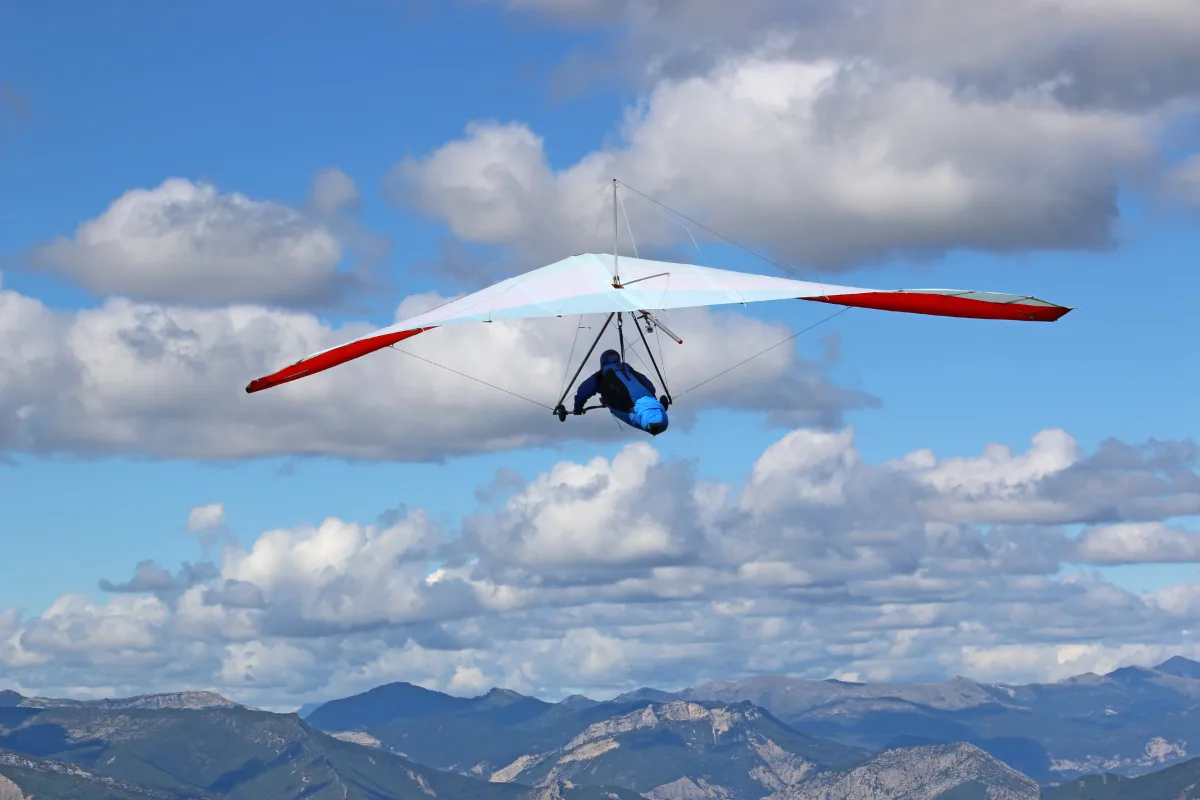
A hang glider has a rigid or semi-rigid frame made of aluminum or carbon tubing, over which a sail is stretched. The pilot hangs in a harness beneath the wing and steers by weight shift. The hang glider has significantly better glide performance than a paraglider but is bulkier, heavier, and more complex to transport and assemble.
- Weight: 55 to 88 lb (25 to 40 kg)
- Glide ratio: 12:1 to 20:1 (rigid wings up to 25:1)
- Speed: 16 to 65 kt (30 to 120 km/h)
- Launch: Hill launch on foot, requires steeper terrain than a paraglider
Training and Certification Systems
Paraglider pilot training and certification varies by country. In the United States, the United States Hang Gliding and Paragliding Association (USHPA) administers a proficiency-based rating system. In Europe, national aero clubs manage certification under frameworks aligned with EASA or national regulations. The specifics differ by country, but the progression from beginner to advanced pilot follows similar principles worldwide.
USHPA Rating System (United States)
| Rating | Designation | Privileges | Requirements |
|---|---|---|---|
| P1 | Beginner | Flying at training hills under direct instructor supervision | Basic ground school and initial flights |
| P2 | Novice | Flying at designated sites, basic soaring | 25+ flights, demonstrated skills |
| P3 | Intermediate | Thermal flying, cross-country, wider site access | Proficiency verification, 90+ flights |
| P4 | Advanced | All sites, competition, tandem (with endorsement) | Extensive experience, demonstrated mastery |
In Europe, the German DHV (Deutscher Hangegleiterverband) uses an A/B/C/D certificate system, with the A-Schein (restricted license) for beginners and the B-Schein (unrestricted license) for independent flying at all approved sites. The Austrian OAeC and Swiss SHV operate similar systems.
Training Costs
| Item | Cost |
|---|---|
| Basic course (P1-P2 / A-certificate) | 1,000 - 1,500 EUR (~$1,100 - 1,650) |
| Advanced course to P3 / B-certificate | 500 - 1,000 EUR (~$550 - 1,100) |
| Personal equipment (wing, harness, reserve) | 3,000 - 6,000 EUR new (~$3,300 - 6,600); 1,500 - 3,000 EUR used (~$1,650 - 3,300) |
| Total to independent flying | 4,500 - 8,500 EUR (~$4,950 - 9,350) |
Training typically takes place in mountainous regions, hill country, or at coastal sites. The basic course lasts 5 to 10 days and covers theory (aerodynamics, meteorology, air law, equipment technology) as well as practical work (ground handling, hill glides, first high flights). Many flight schools offer package programs where the basic and advanced courses are completed in two blocks.
Airspace Rules for Paraglider Pilots
This is where the title question gets its answer. Paraglider pilots operate in the regulated airspace system and are subject to Visual Flight Rules (VFR). They are full participants in the air traffic system and must know and respect the airspace structure.
Fundamental Rules
- Maximum altitude: In the US, paragliders generally operate in Class G and E airspace and must comply with VFR weather minimums and cloud clearance requirements. In Europe, the typical ceiling is FL 100 (approximately 10,000 ft MSL) in uncontrolled airspace (Class G).
- Visual conditions: Paragliders may only fly in VMC (Visual Meteorological Conditions) — minimum visibility and cloud clearance requirements apply.
- Controlled airspace: Paragliders may only enter controlled airspace (Class B, C, D, E) with ATC clearance. In practice, this rarely occurs since paragliders typically carry no transponder and often no radio.
- Prohibited areas: Restricted and prohibited airspace is off-limits.
- Right of way: Under ICAO rules and FAA regulations (14 CFR 91.113), the least maneuverable aircraft generally has right of way. Paragliders, as the slowest aircraft, are therefore given priority over faster aircraft. In practice, however, paraglider pilots must remain extremely vigilant because they are difficult for powered aircraft to spot.
Thermal Flying and Cross-Country (XC)
Thermal flying transforms the paraglider from a pure glider into an aircraft that can stay aloft for hours and cover great distances. Thermals form when the sun heats the ground and rising warm-air bubbles or columns develop. A paraglider pilot circles in these updrafts to gain altitude — typically climbing at 400 to 1,000 ft/min (2 to 5 m/s) in good thermal conditions.
Cross-country flying (XC) is the ultimate discipline in paragliding. The pilot uses thermals to gain altitude, glides to the next thermal source, climbs again, and covers distance in this way. Experienced pilots regularly fly 60 to 120 NM (100 to 200 km) in a single day. The current world record for free-distance flight exceeds 325 NM (600 km).
In addition to thermals, paraglider pilots also utilize ridge lift (air forced upward along a slope) and, in rare cases, wave lift (lee waves, similar to those used in sailplane soaring) to achieve great altitudes and distances.
Powered Paragliding (Paramotor) — When the Paraglider Gets an Engine
A paramotor combines a paraglider with a back-mounted engine and propeller. It enables launch from flat ground — no hill, no winch required — opening up paragliding to pilots in flat terrain.
Variants
- Foot-launch: The pilot launches on foot with the paramotor on their back. Motor weight: 44 to 66 lb (20 to 30 kg). Launch requires a short run of 30 to 100 ft.
- Trike: The motor is mounted on a three-wheeled cart. The pilot sits in the trike and launches rolling. Trike weight: 88 to 176 lb (40 to 80 kg). More comfortable but less portable.
Regulatory Classification
In the United States, foot-launched powered paragliders operating under FAA Part 103 as ultralight vehicles require no pilot license, no registration, and no airworthiness certification — provided they meet Part 103 weight and speed limitations (empty weight under 254 lb, speed under 55 kt, single seat only). Two-seat and heavier paramotors fall under different regulations and require appropriate licensing. In Europe, powered paragliders are classified as ultralights and require an ultralight pilot license with the appropriate class rating.
| Feature | Paraglider | Paramotor (Foot-Launch) | Paramotor (Trike) |
|---|---|---|---|
| License (US) | USHPA P2+ rating | None (Part 103) / Sport Pilot | Sport Pilot or higher |
| Launch site | Hill or winch | Any open area | Field, path, airstrip |
| Total weight | 9-33 lb (4-15 kg) | 44-66 lb motor (20-30 kg) | 88-176 lb trike (40-80 kg) |
| Flight duration | Dependent on thermals | 2-4 hours (fuel capacity) | 3-5 hours (larger tank) |
| Equipment cost | 3,000-6,000 EUR (~$3,300-6,600) | 5,000-12,000 EUR (~$5,500-13,200) | 8,000-20,000 EUR (~$8,800-22,000) |
Sharing Airspace with Powered Aircraft and Gliders
In the same airspace, paragliders encounter sailplanes, powered aircraft, helicopters, and other air traffic. This coexistence demands heightened awareness from all parties.
Paragliders and Sailplanes
Paragliders and sailplanes frequently share the same thermals. Both circle in rising air, but at very different speeds: a paraglider circles at 16 to 19 kt (30 to 35 km/h), a sailplane at 43 to 54 kt (80 to 100 km/h). The turn radius of the sailplane is correspondingly larger. The rules dictate that an aircraft entering an already occupied thermal must circle in the same direction as the aircraft already established in the thermal. In practice, sailplane pilots must spot the paraglider early — which can be challenging given its small size.
Paragliders and Powered Aircraft
Powered aircraft are easily heard and usually spotted early by paraglider pilots. Conversely, a paraglider is nearly invisible to a powered aircraft pilot — especially against dark backgrounds (forest, mountains). Closing speeds are enormous: a powered aircraft at 110 kt approaching a paraglider at 19 kt produces a relative speed of up to 130 kt. At that speed, fewer than 10 seconds remain for detection and avoidance.
FLARM and Transponders
Increasingly, paragliders are equipped with FLARM devices — compact collision-warning systems that broadcast position and flight path to other FLARM users. FLARM is widely deployed in the glider community and allows sailplane pilots to see paragliders on their display. In the US, ADS-B has become the standard traffic awareness tool, and lightweight ADS-B Out transmitters are becoming available for paragliders. Traditional transponders are not required for paragliders and are rarely installed due to weight and power constraints.
Accident Statistics and Safety
Paragliding ranks among the safer air sports when accident numbers are set in relation to the number of active pilots. National organizations publish annual accident reports. The most common accident causes are:
- Collapses (tucks): Part of the canopy folds due to turbulence. On modern wings, collapses usually reinflate spontaneously but can lead to crashes during low-level flight or in unfavorable attitudes.
- Launch errors: Faulty canopy inflation, insufficient speed, or poor launch decisions.
- Landing errors: Landing into obstacles (trees, power lines, buildings) or in excessive wind.
- Overconfidence: Pilots flying in conditions beyond their skill level — too strong wind, too turbulent thermals, unsuitable terrain.
Reserve Parachute
Every paraglider pilot carries a reserve parachute in their harness. In an uncontrollable flight event (tangled lines, full stall, spiral dive), the reserve is deployed manually. The reserve parachute slows the descent to approximately 15 to 23 ft/s (5 to 7 m/s) — a hard but survivable landing. Reserve parachutes must be regularly repacked and inspected. Reserve deployments save the lives of dozens of pilots every year.
Insurance
In many European countries, third-party liability insurance is legally required for paraglider pilots and is often included with association membership. In the United States, USHPA membership includes liability insurance. Additional accident and mountain rescue insurance (particularly relevant for Alpine flying) is recommended.
"The paraglider is the most democratic flying machine in the world. It fits in your trunk, requires no airfield and no tower. But it operates in the same airspace as an Airbus. This tension between simplicity and responsibility is what makes paragliding so extraordinary."
Where Does Paragliding Meet Regulated Aviation?
The answer to the title question is straightforward: There is no boundary — paragliding IS aviation. A paraglider is an aircraft under aviation law. The pilot needs a license or rating. Air traffic rules apply. Airspace must be respected. Insurance is required. The only distinction is that paragliders are classified as ultralights or sport aircraft, affording certain simplifications — such as no requirement for registration (in some jurisdictions), no requirement for an airfield, and no transponder mandate. But the moment the pilot's feet leave the ground, they are a full participant in the air traffic system and must conduct themselves accordingly.
Summary
Paragliding is a full-fledged form of aviation that integrates into the broader air traffic system with a minimum of equipment. Training through structured rating systems (USHPA in the US, DHV in Germany, and equivalents elsewhere) provides a clear and quality-oriented path from beginner to advanced pilot. With entry costs starting at approximately 1,000 EUR (~$1,100) for the basic course and 3,000 EUR (~$3,300) for equipment, the barrier to entry is comparatively low. Thermal flying and cross-country open up virtually limitless potential for aerial adventure. Powered paragliding extends the possibilities to flat-terrain launches and independence from thermals. Coexistence with powered aircraft and sailplanes in the same airspace demands knowledge, awareness, and consistent compliance with air traffic rules. Modern safety equipment — from reserve parachutes to FLARM and ADS-B — makes paragliding safer than ever, but personal responsibility and continuous skill development remain indispensable.
