
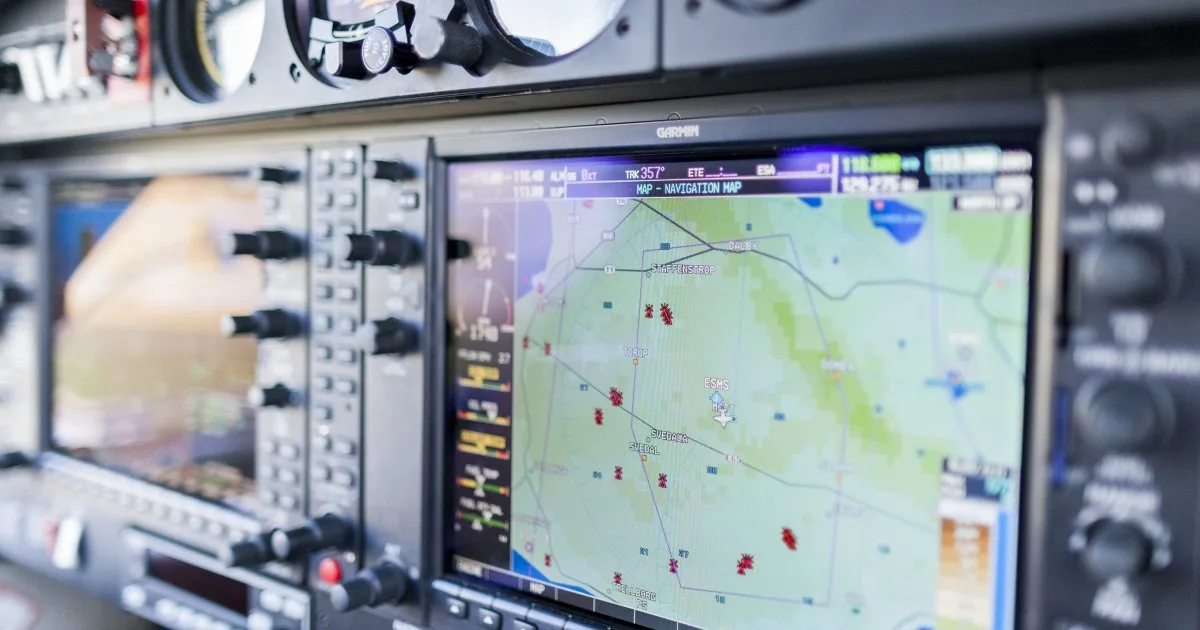
Garmin G1000 versus round dials: Situational awareness, costs, redundancy, and why training on both systems matters.
Glass Cockpit vs. Analog Instruments — pros and cons for pilots
Aircraft instrumentation has changed fundamentally over the past two decades. Where once six mechanical round gauges — affectionately called "steam gauges" — served as the pilot's sole source of information, today high-resolution LCD screens with integrated moving maps, traffic displays, and weather overlays dominate the panel. But does modern necessarily mean better? This article analyzes both systems in detail, examines the advantages and disadvantages for different pilot profiles, and explains why the debate is more nuanced than it first appears.
The Six-Pack — the classic round gauges
The traditional instrument layout in a VFR- or IFR-capable aircraft follows a standardized arrangement known as the "Six-Pack" or "Basic T." The six primary flight instruments are arranged in two rows of three:
Top row (left to right)
- ASI (Airspeed Indicator): Displays indicated airspeed (IAS) in knots (or km/h in some international aircraft). Color-coded arcs denote operating ranges: white arc (flap operating range), green arc (normal operating range), yellow arc (caution range), red line (Vne — Never Exceed Speed). Operates purely on pitot-static pressure — no electronics, no electrical power required.
- AI (Attitude Indicator / Artificial Horizon): The most important instrument for instrument flight. Displays the aircraft's orientation relative to the horizon — pitch and bank. Traditionally gyroscope-driven (mechanical gyro powered by vacuum or electric motor). The AI is the primary reference when flying in clouds or at night.
- ALT (Altimeter): Displays barometric altitude in feet. Operates purely on static pressure. The Kollsman window setting allows adjustment to current altimeter setting (QNH internationally, or local altimeter setting in the US). A correctly set altimeter is essential for altitude separation under IFR per FAR 91.121 and ICAO standards.
Bottom row (left to right)
- TC (Turn Coordinator): Displays the aircraft's turn rate and whether flight is coordinated (ball centered in the inclinometer). Standard rate turn (2 minutes for 360 degrees) is indicated by the reference marks. Important for precise instrument approaches and standard-rate turns.
- HI (Heading Indicator / Directional Gyro): Displays magnetic heading. Unlike the magnetic compass, the HI is not subject to acceleration and turning errors and provides a stable heading reference. However, mechanical gyro-driven HIs precess and must be realigned with the magnetic compass periodically (typically every 15 minutes).
- VSI (Vertical Speed Indicator): Displays the rate of climb or descent in feet per minute (fpm). Operates on the rate of change of static pressure. The indication typically lags the actual vertical speed by 6 to 9 seconds — a well-known characteristic that IVSI (Instantaneous VSI) instruments compensate for with an accelerometer pump.
In addition to the Six-Pack, a typical analog cockpit includes: magnetic compass (as the primary, independent heading reference — required by FAR 91.205), VOR/ILS receiver with CDI, ADF (Automatic Direction Finder), DME (Distance Measuring Equipment), transponder, and the engine instruments (RPM, manifold pressure, oil pressure, oil temperature, fuel quantity, EGT/CHT).
The glass cockpit — the digital revolution
A glass cockpit replaces mechanical round gauges with large LCD screens on which all flight information is displayed digitally. The industry standard in General Aviation is the Garmin G1000 system (and its successor, the G1000 NXi) as well as the Garmin G3X Touch for lighter aircraft.
PFD — Primary Flight Display
The PFD (Primary Flight Display) is the left screen and replaces all six instruments of the Six-Pack on a single display. It shows:
- Attitude indicator: Large-format in the center of the screen, with Synthetic Vision Technology (SVT) on newer systems. SVT displays a 3D representation of the terrain, including topography, airports, and obstacles — even in IMC.
- Speed tape: Vertical band on the left, showing IAS with color-coded V-speed markings. A trend vector shows projected airspeed in the coming seconds.
- Altitude tape: Vertical band on the right, showing barometric altitude with trend vector.
- VSI: Digital vertical speed display adjacent to the altitude tape.
- HSI (Horizontal Situation Indicator): At the bottom of the screen, combining heading display, navigation course (VOR/GPS), glideslope indication, and course deviation in a single instrument.
- Wind data: Wind direction and velocity, headwind/tailwind component.
- Autopilot status: Active modes of the autopilot.
MFD — Multi Function Display
The MFD (Multi Function Display) is the right screen and provides information that was either unavailable or required separate equipment in an analog cockpit:
- Moving map: GPS-based chart display showing own position, airports, airspace, waypoints, and the planned route. The map can be zoomed, panned, and displayed in various modes (Track Up, North Up, Arc).
- Engine instruments (EIS): Digital display of all engine parameters with automatic color coding (green = normal, yellow = caution, red = warning).
- Traffic (TIS/ADS-B): Display of surrounding traffic on the moving map. ADS-B In receives position data from other aircraft and shows them relative to own position — including altitude and vertical trend.
- Terrain (TAWS): Terrain display with color coding (red = dangerously close, yellow = caution, green = safe). Audible and visual alerts when approaching terrain.
- Weather (datalink weather): Weather data received via ADS-B In or SiriusXM — NEXRAD radar imagery, METARs, TAFs, PIREPs, lightning — displayed directly on the moving map.
- Checklists: Digital checklists for all flight phases.
- Nearest: Nearest airports, VORs, intersections, NDBs — invaluable in an emergency.
Situational awareness — the decisive advantage
The greatest advantage of the glass cockpit lies in dramatically improved situational awareness. Four areas stand out in particular:
Moving map and navigation accuracy
With a GPS-based moving map, the pilot knows exactly where they are at all times. The risk of getting lost or inadvertently entering controlled airspace drops dramatically. In complex airspace environments — such as the Class B and C airspace around major metropolitan airports, or the congested corridors in Europe — this is a significant safety improvement.
In an analog cockpit, the pilot had to determine position via VOR radials, DME distances, and dead reckoning — an error-prone and time-consuming method that is now considered outdated, though it should still be mastered as a backup skill.
Traffic awareness
The display of surrounding traffic on the MFD has revolutionized safety in uncontrolled airspace. Instead of relying solely on visual scanning for other aircraft (see and avoid), the pilot sees on screen where traffic is, at what altitude it is flying, and whether it is climbing or descending. ADS-B In — mandated by the FAA since January 2020 in certain airspace (per FAR 91.225) — has significantly improved the coverage and accuracy of this display.
Terrain awareness
The TAWS (Terrain Awareness and Warning System) in a glass cockpit provides visual and audible alerts for potential terrain conflicts. This is especially critical when flying in mountainous terrain — the Rockies, Cascades, Appalachians, or the European Alps. The accident statistics for CFIT (Controlled Flight Into Terrain) accidents have declined significantly since the introduction of TAWS in GA.
Weather awareness
The integration of weather data directly on the moving map enables proactive weather avoidance that was simply not possible with analog instruments. The pilot can see thunderstorms, precipitation areas, and IFR weather on screen and adjust the route accordingly — often before the weather becomes visually apparent.
Failure scenarios — the Achilles heel of the glass cockpit
The greatest disadvantage of the glass cockpit lies in its dependence on electrical power and electronics. What happens when one or both screens fail?
Partial panel with analog instruments
In an analog cockpit, a partial panel scenario — typically the failure of the vacuum system that powers the attitude indicator and heading indicator — is a well-known and intensively practiced procedure. The pilot covers the failed instruments and navigates with the remaining ones: airspeed indicator, altimeter, turn coordinator, and magnetic compass. This is challenging but feasible, since the remaining instruments function independently of each other and share no common point of failure.
Screen failure in a glass cockpit
In a glass cockpit, a screen failure is potentially more critical. If the PFD fails, the pilot loses all primary flight instruments simultaneously. Modern glass cockpits address this risk with several measures:
- Reversionary mode: If one screen fails, the remaining screen can take over the functions of the failed unit — PFD and MFD information is then displayed on a single screen.
- Backup instruments: Both EASA and the FAA (per 14 CFR 23.2600 and Advisory Circulars) require backup instruments for certified glass cockpits. Typically a standby attitude indicator, a standby altimeter, and a standby airspeed indicator, operating independently of the primary screens with their own power supply.
- Separate electrical buses: PFD and MFD are powered from separate electrical buses. A generator failure or circuit breaker trip typically affects only one screen.
- Garmin GI 275: A modern electronic standby instrument that can function as a standalone PFD with an internal battery providing at least 60 minutes of operation.
In practice, complete screen failures in modern glass cockpits are extremely rare. The MTBF (Mean Time Between Failure) of a Garmin G1000 display exceeds 10,000 hours. Nevertheless, the scenario is regularly practiced during training and proficiency checks.
Cost of retrofitting
Upgrading an older analog-equipped aircraft to a glass cockpit requires substantial investment. The range is wide:
| System / Scope | Approximate Cost (installed) | Typical Aircraft |
|---|---|---|
| Garmin G5 (single digital instrument as AI/DG replacement) | $3,500–$5,800 | All certified SEL aircraft |
| Garmin GI 275 (2 units as PFD/MFD replacement) | $9,200–$17,500 | C172, PA-28, Bonanza, etc. |
| Garmin G500 TXi (PFD + MFD touchscreen) | $29,000–$46,000 | C182, PA-32, Mooney |
| Garmin G3X Touch (experimental / LSA) | $11,500–$23,000 | Experimental, Light Sport Aircraft |
| Full G1000 NXi retrofit | $92,000–$140,000 | C172SP, C182T, DA40, SR22 |
| Avidyne IFD series + PFD | $35,000–$58,000 | Various SEL/MEL aircraft |
The cost of a retrofit often does not make economic sense relative to the aircraft's value. Upgrading a 1980 Cessna 172 with a market value of $70,000 to a G1000 NXi is hard to justify financially. A more sensible approach is a phased modernization: start with a Garmin GI 275 as a standby/PFD replacement, then add a GPS navigator like the GTN 750Xi, and if needed, an ADS-B transponder.
Training on both systems
The question of which system to begin flight training on is debated within the training community. Both approaches have their merits:
Training on analog instruments
Proponents argue that training on analog instruments builds a deeper understanding of flight instrumentation. The pilot learns to interpret individual instruments and mentally assemble their information into a situational picture — a skill known as the "instrument scan" that forms the cognitive foundation of instrument flight.
Pilots trained on analog instruments can transition to a glass cockpit without difficulty. The reverse — from glass cockpit to steam gauges — is significantly more challenging and requires additional practice.
Training on the glass cockpit
The counterargument emphasizes that most modern aircraft — especially new production — are delivered with glass cockpits from the factory. Training on the system the pilot will actually fly is therefore more efficient. Additionally, the glass cockpit provides better situational awareness from the outset, which enhances safety even for student pilots.
Both the FAA (through Advisory Circulars and practical test standards) and EASA recommend exposure to both types: fundamentals on analog instruments, followed by transition to a glass cockpit. Many flight schools offer this combination — for example, basic training on an analog-equipped Cessna 152 or PA-28, followed by transition to a Diamond DA40 NG with Garmin G1000.
Hybrid panels — the best of both worlds
In practice, many private pilots fly a hybrid panel: a predominantly analog-equipped cockpit supplemented with modern GPS navigation and digital standby instruments. This combination offers several advantages:
- Cost-effective: A GPS navigator like the Garmin GTN 650Xi with a moving map and IFR capability costs a fraction of a full glass cockpit retrofit.
- Redundant: If the GPS fails, the analog instruments continue to function. If the vacuum system fails, the GPS system provides PFD-like attitude data.
- Familiar: Pilots trained on analog instruments retain their familiar instrumentation and progressively supplement it with digital systems.
- Certification-compliant: No complex STC (Supplemental Type Certificate) required for a complete panel redesign.
A typical hybrid panel in a modernized club aircraft: analog primary instruments (Six-Pack), supplemented by a Garmin GI 275 as standby AI/PFD, a Garmin GTN 750Xi as GPS/Nav/Com with moving map, and a Garmin GTX 345 as ADS-B transponder with traffic and weather display. Total cost: approximately $29,000 to $40,000 — significantly less than a full glass cockpit, but with the most important safety and navigation benefits.
Why many experienced pilots prefer analog
Despite all the technological advantages of the glass cockpit, a notable group of experienced pilots — often described as "old school" — consciously prefer analog instruments. Their arguments are well worth considering:
- Independence from technology: Analog instruments function without software updates, without GPS signals, and without screen calibration. The airspeed indicator works every time — even if the entire electrical system fails.
- Better scan capability: Experienced IFR pilots argue that the instrument scan with round gauges is more intuitive. Six needles on six gauges can be taken in at a glance — on a glass cockpit, the pilot must extract relevant numbers from an abundance of information.
- Less distraction: The information overload of a glass cockpit — moving map, traffic, weather, terrain, checklists — can distract. The pilot spends too much time looking at the screen instead of looking outside. This phenomenon is called "head-down time" and is a documented risk factor.
- Deeper understanding: Pilots who navigate with charts, compass, and VOR understand navigation at a fundamental level. This skill is lost when one only follows the magenta line on the GPS from the start.
- Repair costs: A failed altimeter costs $200 to repair. A failed PFD display costs $5,000 or more. Repair costs for analog instruments are orders of magnitude lower.
- Nostalgia and aesthetics: Not to be underestimated — many pilots simply find an analog cockpit more beautiful. The craftsmanship of mechanical instruments, the quiet hum of the gyros, the warm glow of instrument needles — all of this has an aesthetic value that no LCD screen can replace.
The data: what do the accident statistics say?
Several studies have examined the impact of glass cockpits on accident rates. The results are revealing:
An NTSB study compared accident rates for Cessna 172 and Cirrus SR22 aircraft with and without glass cockpits. The finding: glass cockpit aircraft had a slightly lower overall accident rate but a higher rate of fatal accidents. The interpretation: pilots with glass cockpits flew more often into challenging weather conditions because the technology made them feel safer — a phenomenon known as "risk homeostasis" or risk compensation.
This finding underscores an important point: technology alone does not make flying safer. What matters is how the pilot uses the technology — as a tool for risk reduction or as an invitation to take greater risks.
Future trends
The trajectory clearly points toward fully digital cockpits, including in General Aviation. Current trends include:
- Touchscreen operation: The Garmin G3X Touch and GTN Xi series fully embrace touch input. Older knob-based interfaces are gradually being phased out.
- Synthetic Vision (SVT): 3D terrain display is becoming standard. Garmin already offers SVT in its entry-level products.
- Head-Up Display (HUD): Previously reserved for airliners and military jets, HUDs such as the Garmin GHD 2100 are slowly entering GA. Projecting flight data into the pilot's field of view dramatically reduces head-down time.
- Connectivity: Cloud-based flight planning, automatic logbook entries, remote aircraft monitoring via smartphone app. The cockpit is becoming a connected device.
- Augmented Reality: Future concepts envision AR glasses that project flight data, terrain, and traffic directly into the pilot's field of view — eliminating head-down time entirely.
The best cockpit is not the most modern one, but the one in which the pilot feels safest and which they have fully mastered. A pilot who knows their analog panel by heart flies more safely than one who sits in front of a glass cockpit they only superficially understand.
Conclusion: pilot before panel
The debate between glass cockpit and analog instruments has no universal answer. Both systems have their place, their strengths, and their weaknesses. The glass cockpit offers undeniable advantages in situational awareness, navigation accuracy, and system integration. Analog instruments excel in simplicity, reliability, and minimal distraction.
For aircraft buyers: choose the instrumentation that matches your training level, mission profile, and budget. Invest in training on the system you actually fly. And regardless of the technology in the cockpit: master the fundamentals of navigation and instrumentation — because in the end, it is always the pilot who brings the aircraft home safely, not the screen.
