
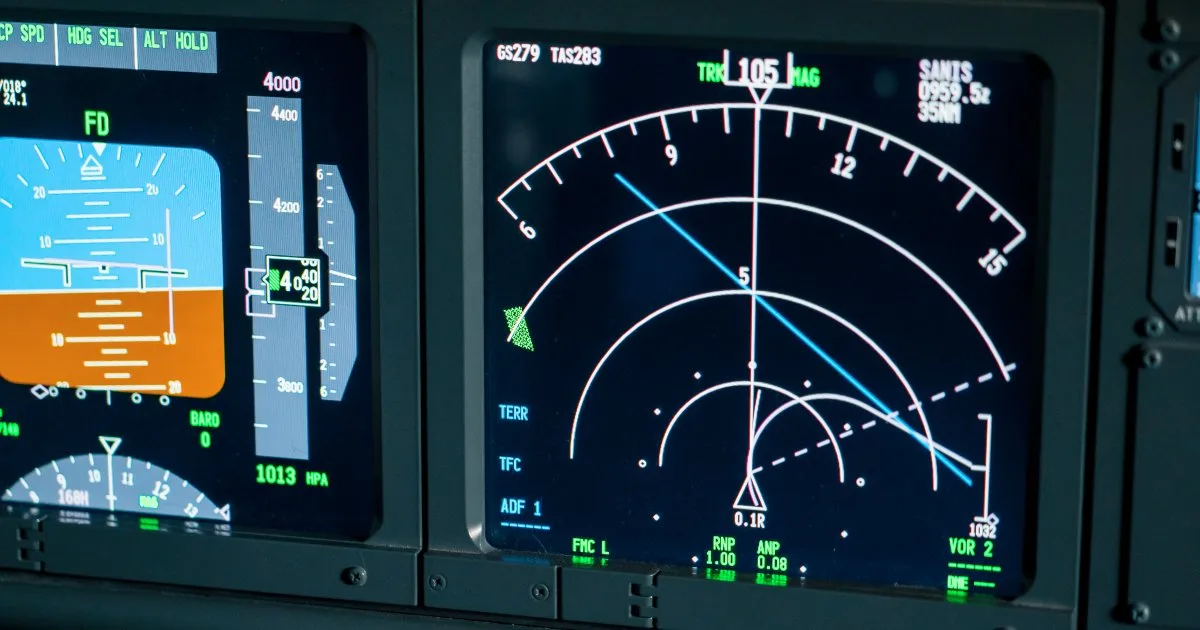
From mechanical cables to electronic signals: How fly-by-wire works, what protections it offers, and why Airbus and Boeing implement it differently.
Fly-by-Wire — how modern aircraft are actually controlled
From simple cable linkages to digital flight control systems with triple redundancy — flight controls have undergone a remarkable evolution. Fly-by-Wire (FBW) has revolutionized aviation, yet it is often misunderstood. This article traces the journey from mechanical controls to digital flight control computers, compares the philosophies of Airbus and Boeing, and shows how FBW is increasingly making its way into General Aviation.
Mechanical controls — where it all began
The earliest aircraft used purely mechanical flight control systems. The principle is straightforward: the pilot moves the control stick or yoke, and this movement is transmitted directly to the control surfaces (ailerons, elevator, rudder) via cables, push-pull rods, and bellcranks. There is a direct, physical connection between the pilot's hand and the control surface.
This system offers several advantages that are still valued today:
- Direct feedback: The pilot feels aerodynamic forces directly. As dynamic pressure increases, the controls become heavier — a natural warning system.
- Simplicity: Few moving parts, no electronics, no hydraulics.
- Reliability: A cable cannot "crash" like a computer. With proper maintenance, mechanical controls are extremely reliable.
- Maintainability: Inspection and repair work requires no specialized equipment.
Mechanical controls do have clear limitations, however. In larger, faster aircraft, aerodynamic forces become so great that a pilot can no longer move the control surfaces with muscle power alone. Above a certain aircraft size — typically from a maximum takeoff weight of about 12,000 to 20,000 lbs — some form of power assistance becomes necessary.
In today's General Aviation, virtually all light aircraft up to the Cessna 182 / Piper PA-28 class use purely mechanical controls. Maintenance is limited to periodic cable tension checks, pulley inspections, and lubrication of hinges and bearings.
Hydraulic servo-assistance — the transitional technology
As aircraft grew larger and faster, manufacturers introduced hydraulic servo systems. The fundamental principle of mechanical linkage is preserved, but control forces are amplified by hydraulic actuators — similar to power steering in a car.
In a hydraulically assisted system, the pilot moves a servo valve via cables or rods, which directs hydraulic pressure to the control surface actuator. The pilot's input is not transmitted directly to the control surface but instead controls the direction and magnitude of hydraulic pressure.
To give the pilot a natural control feel despite hydraulic assistance, artificial feel units are employed — spring systems that create artificial resistance that increases with airspeed. Without these systems, the pilot would have no feedback about actual aerodynamic forces.
Hydraulically assisted controls are found in aircraft such as the Boeing 737 Classic (hydraulically assisted with mechanical backup), many regional turboprops like the ATR 72, and in older-generation business jets such as the Cessna Citation III.
The central safety feature of these systems: in the event of total hydraulic failure, the pilot can — albeit with considerable effort — manually control the aircraft through the remaining mechanical linkage. This reversion capability was dramatically demonstrated during the legendary landing of United Airlines Flight 232 in Sioux City in 1989.
Fly-by-Wire — the digital age
In a Fly-by-Wire system, there is no mechanical connection between the pilot's control input device and the control surfaces. Instead, the chain works as follows:
- Sensor: A position sensor captures the pilot's input at the sidestick or yoke — direction, deflection, and rate of movement.
- Computer: Multiple redundant Flight Control Computers (FCCs) receive the sensor signal and process it together with data from air data sensors (airspeed, altitude, angle of attack), inertial reference systems (attitude, acceleration), and other systems.
- Computation: The computer calculates the optimal control surface deflection, taking into account flight physics, speed limits, structural load limits, and the current flight attitude.
- Actuator: Hydraulic or electric actuators move the control surfaces according to the computer's calculations.
The critical difference: the pilot no longer directly controls the surfaces, but communicates an intent to the computer. "I want 30 degrees of bank" — the computer determines what control inputs are needed and executes them. The pilot commands; the computer flies.
Flight Control Laws — the brain of the FBW system
The heart of every FBW system is the Flight Control Laws — the software algorithms that determine how pilot inputs are translated into control surface movements. Airbus, as the pioneer of civil FBW, defines three hierarchy levels:
Normal Law
In Normal Law, the system operates with full protection. The pilot controls flight parameters via the sidestick rather than direct surface movement:
- Pitch: Sidestick deflection commands a load factor (g) in normal flight or flight path angle at low speeds. When the pilot releases the sidestick, the aircraft maintains the current attitude — no retrimming required.
- Roll: The sidestick commands a roll rate. When released, the aircraft automatically returns to wings level (up to 33 degrees of bank).
- Yaw: Fully automatic coordination via the yaw damper. The rudder is automatically coordinated with aileron inputs. The pedals are primarily needed for crosswind correction during landing.
Alternate Law
If certain sensors or computers fail, the system degrades to Alternate Law. Not all protection functions remain available. The handling more closely resembles conventional flight controls with reduced protections. The pilot must pay greater attention to staying within operating limits.
Direct Law
In Direct Law — the lowest protection level — there is a proportional relationship between sidestick deflection and control surface deflection, without any computer-mediated modification or protection. The aircraft behaves like a conventional aircraft. This level is reached only during severe system failures.
Airbus Flight Envelope Protection — the digital guardian
In Normal Law, the Airbus FBW system provides extensive protection functions that prevent the aircraft from exceeding its structural or aerodynamic limits:
| Protection Function | Description | Limits |
|---|---|---|
| Alpha Protection | Prevents exceeding maximum angle of attack | Max alpha never exceeded, even at full aft stick |
| High-Speed Protection | Prevents exceeding Vmo/Mmo | Automatic pitch-up when approaching speed limits |
| Bank Angle Protection | Limits bank angle | Max 67 degrees with full sidestick, auto-return to 33 degrees on release |
| Pitch Attitude Protection | Limits pitch attitude | Max 30 degrees nose-up, 15 degrees nose-down |
| Load Factor Protection | Prevents structural overload | Limited to +2.5g / -1.0g (clean configuration) |
These protections mean that an Airbus pilot in Normal Law cannot stall the aircraft — regardless of how far aft the sidestick is pulled. The computer limits the angle of attack to the optimal value for maximum lift. Likewise, the pilot cannot exceed the structural load limits.
Boeing FBW — a different philosophy
Boeing came to Fly-by-Wire later and follows a fundamentally different philosophy. While Airbus gives the computer ultimate authority, Boeing insists that the pilot retains ultimate control.
The Boeing 777 was the first Boeing airliner with FBW in 1995. The Boeing 787 Dreamliner followed with an advanced system. Both feature:
- Control column (yoke) instead of sidestick: Boeing retains the traditional yoke. It provides more tactile feedback and both yokes move together — each pilot can see what the other is commanding.
- Force feedback: The yoke gives the pilot artificial control feel that simulates aerodynamic forces. At higher speeds, the yoke becomes heavier.
- Soft limits rather than hard limits: The Boeing FBW system warns the pilot through increasing resistance and tactile feedback when approaching operating limits, but in most cases does not prevent the pilot from exceeding them. The pilot can override the computer's "recommendation."
- Direct feedback between pilot seats: Since both yokes are mechanically interconnected, the other pilot sees and feels every input — a safety advantage that Airbus does not provide with its independent sidesticks.
Sidestick vs. Yoke — the eternal debate
The question "sidestick or yoke?" is almost as emotional in aviation as "Airbus or Boeing?" Both concepts have demonstrable advantages and disadvantages:
| Aspect | Sidestick (Airbus) | Yoke (Boeing) |
|---|---|---|
| Cockpit space | More space, clear tray table area | Yoke partially obstructs instrument view |
| Cross-cockpit visibility | Other pilot's inputs not visible | Both yokes move in sync |
| Control feel | Minimal tactile feedback, fixed spring force | Variable feedback, speed-dependent |
| Precision | Very precise, short control travel | Longer control travel, more intuitive fine control |
| Transition from GA aircraft | Requires adjustment | Similar control feel to GA aircraft |
A safety aspect that is intensively debated among experts is the lack of coupling between Airbus sidesticks. Since both sidesticks operate independently, it is possible for both pilots to simultaneously make opposing inputs without realizing it. This effect was identified as a contributing factor in the crash of Air France Flight 447 over the South Atlantic. Airbus subsequently enhanced dual-input warnings, and newer Airbus models such as the A350 offer optional active sidesticks with haptic coupling.
Backup systems and redundancy
Since FBW systems have no mechanical fallback, redundancy is the central safety concept. Systems are typically triple or quadruple redundant:
- Airbus A320 family: 5 Flight Control Computers — 2 ELAC (Elevator and Aileron Computer), 3 SEC (Spoiler and Elevator Computer). Each computer can independently handle basic flight control. Additionally, 2 FAC (Flight Augmentation Computer) for yaw damping and rudder trim.
- Boeing 777: 3 ACE (Actuator Control Electronics) with 3 internal channels each = effectively 9-fold redundancy. Additionally 3 PFC (Primary Flight Computer). Different hardware and software across channels (dissimilar redundancy) prevents a single software bug from affecting all systems simultaneously.
- Power supply: Multiple independent power sources — generators, APU, Ram Air Turbine (RAT) as last-resort emergency power. The RAT is a small propeller that deploys into the airstream in an emergency, generating enough power for basic flight control.
A particularly clever concept is dissimilar redundancy: the various computers intentionally use different hardware processors and independently developed software. This prevents a design flaw in software or hardware from bringing down all computers simultaneously — a scenario that would be theoretically possible with identical systems.
FBW in General Aviation
For a long time, Fly-by-Wire was reserved for airliners and military jets. That is changing. The most prominent representative of FBW in GA is the Cirrus Vision Jet SF50.
The Vision Jet uses a Garmin G3000-based FBW system with the following features:
- Sidestick control: Similar to Airbus, the pilots control via a sidestick
- Envelope protection: The system prevents stalls and excessive bank angles
- Autothrottle integration: Automatic thrust management for approach
- Emergency Autoland (Safe Return): The Garmin Autoland system can autonomously land the aircraft at a suitable airport in an emergency — fully automatic, including radio communications, approach, and landing
The Garmin Autoland feature deserves particular attention: in an emergency — such as pilot incapacitation — a passenger presses a single button. The system automatically selects the nearest suitable airport, computes the approach, communicates with ATC, flies the aircraft to the runway, and executes a fully automatic landing, including braking to a stop on the runway. This technology would be impossible without FBW.
Future of flight controls
The future of flight control lies in further integration of artificial intelligence and autonomy. Current research areas include:
- Fly-by-Light: Instead of electrical signals over copper wire, optical signals are transmitted via fiber-optic cables. Advantages: immunity to electromagnetic interference (EMI), lighter weight, higher bandwidth.
- Power-by-Wire: Replacement of hydraulics with fully electric actuators. The Airbus A380 already uses electro-hydrostatic actuators (EHA) in some applications, and the Boeing 787 makes extensive use of electric systems.
- Adaptive Flight Control: Systems that adapt in real time to structural damage or system failures. NASA demonstrated with its IRAC program (Intelligent Resilient Aircraft Control) that an adaptive FBW system can safely control an aircraft even after the loss of a control surface.
- Reduced Crew Operations: FBW technology as the foundation for single-pilot airline operations or even fully autonomous flight.
Fly-by-Wire has not only made aviation safer — it has laid the groundwork for technologies that were science fiction 30 years ago. Autoland, envelope protection, automatic turbulence compensation — none of this would be possible without digital flight controls. The question is no longer whether FBW will become the standard in GA, but when.
Conclusion: evolution, not revolution
Fly-by-Wire is the logical progression of flight control technology. From mechanical cable systems through hydraulic servos to fully digital FBW, each generation has improved safety, efficiency, and comfort. The differing philosophies of Airbus (computer has ultimate authority) and Boeing (pilot has ultimate authority) will be debated for years, if not decades — both approaches have their merits and their proven safety records.
For buyers and pilots in General Aviation, the FBW trend means: greater safety through envelope protection, better integration of autopilot and flight guidance, and in the long term, the ability to safely fly complex aircraft with less manual workload. Anyone buying an aircraft today should view FBW capability as a future investment — not as a luxury, but as an emerging standard.
