
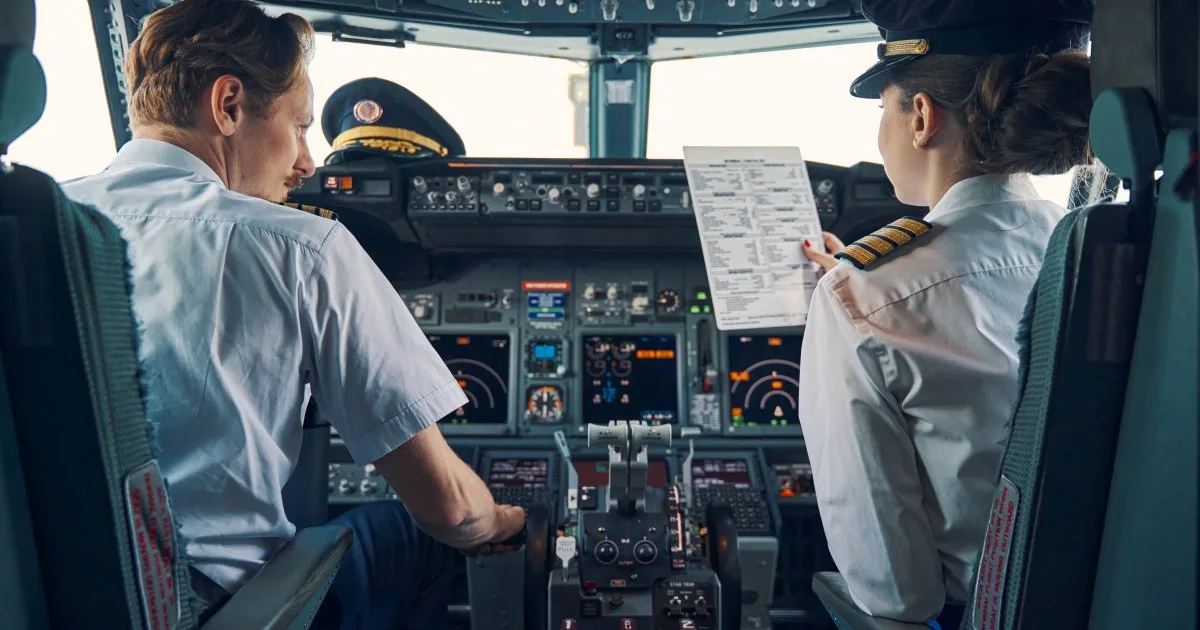
Airline career: From ATPL training through First Officer to the captain's upgrade — timeline, costs, and what airlines really expect.
From First Officer to Captain — A Realistic Career Path
The dream of the cockpit captivates many young people, but the road to get there is long, demanding, and expensive. Aspiring airline pilots need more than flying talent — they need perseverance, financial resources, and the willingness to spend years building experience as a First Officer. This article outlines the realistic career path from student pilot to airline captain, with concrete figures for the international market.
Flight Training: Integrated or Modular?
Prospective airline pilots face a fundamental decision at the outset: the integrated or the modular training route. Both paths lead to the same goal — the ATPL(A), the Airline Transport Pilot Licence — but differ considerably in structure, duration, and cost.
Integrated Training (Ab Initio)
Integrated training is designed for applicants with no prior flying experience. It is completed as a continuous program at an approved ATO (Approved Training Organisation) and typically takes 18 to 24 months. The curriculum is structured: theory and practical training alternate, and students progress through all phases as a cohort.
The cost of integrated training ranges between $75,000 and $130,000 (approximately 70,000 to 120,000 EUR in Europe). Well-known flight schools such as the European Flight Academy (Lufthansa Group), L3Harris, FlightSafety International, or airline-affiliated academies tend to be at the upper end of this range. In return, they often offer a pathway to employment with the parent airline.
The advantages of integrated training include clear structure, shorter total duration, and the frequent connection to an airline. The downside is the high cost, which typically must be financed before training begins.
Modular Training
Modular training allows students to acquire each licence level sequentially: first the PPL(A), then the Instrument Rating IR(A), the CPL(A), and finally the ATPL theory exams. This route is more flexible and can be completed alongside other employment, but generally takes 2 to 4 years.
Total costs for modular training typically range from $55,000 to $90,000 (approximately 50,000 to 80,000 EUR), and can be further reduced through careful planning and attending more affordable flight schools — for instance, training in the United States, Spain, or Eastern Europe for certain modules. However, the modular route demands more initiative and less frequently offers a direct airline connection.
ATPL(A) — Frozen and Unfrozen
A common misconception concerns the ATPL(A). Upon completing training — whether integrated or modular — the graduate initially receives a so-called frozen ATPL. This confirms that all 14 theory exams have been passed and the practical training is complete. The holder may fly as a First Officer (FO) on multi-engine transport aircraft.
The frozen ATPL is only "unfrozen" into a full, unrestricted ATPL once the pilot meets the following requirements:
- 1,500 flight hours total time as pilot of aeroplanes
- Of which at least 500 hours in Multi-Crew Operations (MCC)
- At least 100 hours PIC (Pilot in Command) or PICUS (Pilot in Command Under Supervision)
- At least 75 hours of instrument flight time
- At least 250 hours as PIC, or 70 hours PIC plus 180 hours PICUS
In practice, it takes a First Officer at an airline roughly 3 to 5 years to accumulate 1,500 hours. Only with an unrestricted ATPL does the formal path to the left seat become possible.
Airline Selection — The Hiring Process
Joining an airline is a multi-stage selection process that varies by carrier but typically includes the following elements:
Aptitude Tests
The first hurdle consists of computer-based aptitude tests that assess cognitive abilities, multitasking, spatial awareness, and psychomotor coordination. Well-known testing systems include the DLR test (German Aerospace Center, used by the Lufthansa Group), COMPASS (Aer Lingus, Ryanair), PILAPT, and the CASS test. In the United States, major airlines often use their own proprietary assessment batteries.
These tests have failure rates of 50 to 70 percent and can often only be attempted once or at limited intervals.
Assessment Center
Candidates who pass the aptitude tests are invited to an assessment center, where soft skills are evaluated: teamwork, communication, decision-making under pressure, and leadership qualities. Typical elements include group exercises, individual interviews, and case studies. Assessors pay particular attention to CRM competencies (Crew Resource Management) — the ability to work as a team and communicate clearly.
Simulator Check
The simulator check is the final practical assessment in the selection process. Applicants fly a standardized profile in a flight simulator. What matters is not perfect technique but the ability to handle unfamiliar situations, set priorities, and fly safely. Candidates who already hold a type rating on the relevant aircraft are held to a higher standard than ab initio applicants.
The Years as First Officer
After a successful hire, the actual career as a First Officer (FO) begins. The new pilot first completes a type rating on the assigned aircraft type — typically the A320 or B737 for short-haul, the A330/A350 or B777/B787 for long-haul. A type rating takes approximately 8 to 12 weeks and costs $27,000 to $45,000 (25,000 to 40,000 EUR), though many airlines cover this cost or finance it through a bonding arrangement.
This is followed by Line Training: under the supervision of a Training Captain, the new FO flies initial revenue flights. After 50 to 100 sectors and a passed Final Line Check, the FO is fully line-qualified.
The years as First Officer are defined by experience-building: the FO learns different airports, gains experience with varied weather conditions and operational scenarios, and accumulates flight hours. A typical FO at a major airline flies 600 to 800 hours per year.
The duration spent as First Officer before a potential upgrade to Captain varies widely: at fast-growing airlines or in regions experiencing a pilot shortage, it may be as few as 3 to 5 years; at established legacy carriers with strict seniority systems, it can be 8 to 12 years or more.
The Upgrade to Captain
The transition from First Officer to Captain is the most significant career milestone for an airline pilot. Beyond the formal qualifications (unrestricted ATPL, sufficient flight hours), it requires selection by the airline and passing the Command Upgrade Check.
Typical prerequisites for a command upgrade include:
- 3,000 to 5,000 total flight hours (depending on the airline)
- Unrestricted ATPL
- Positive evaluations from Training Captains and Line Checks
- Passing an internal assessment process
- Sufficient seniority (in seniority-based systems)
The command upgrade itself involves intensive training: first a Command Course in the simulator (typically 10 to 20 sessions), then a phase of Supervised Command, during which the new captain flies under the oversight of a Training Captain. The entire upgrade phase takes approximately 3 to 6 months.
In the simulator, scenarios are specifically designed to test the captain's leadership: decision-making during technical malfunctions, weather diversions, medical emergencies, passenger incidents, and managing an inexperienced First Officer. The captain is not merely a pilot but the commander of the aircraft — with all the legal and operational responsibilities that entails.
Pilot Salaries — An International Overview
Airline pilot salaries vary considerably depending on the carrier, position, and seniority. The following table provides a general overview:
| Airline Type | First Officer (Entry) | First Officer (Senior) | Captain |
|---|---|---|---|
| Low-Cost (Ryanair, Spirit, Frontier) | $50,000 — $65,000 | $60,000 — $82,000 | $100,000 — $145,000 |
| Regional / Charter | $55,000 — $72,000 | $65,000 — $88,000 | $110,000 — $155,000 |
| Legacy Short-Haul (Eurowings, JetBlue) | $65,000 — $82,000 | $82,000 — $105,000 | $130,000 — $175,000 |
| Legacy Long-Haul (United, Delta, Lufthansa) | $77,000 — $100,000 | $100,000 — $132,000 | $175,000 — $350,000 |
In addition to base salaries, most airlines offer further compensation components: sector pay (per-sector bonus), per diem (daily allowance for overnight stays away from base), overtime pay, and in some cases profit-sharing. At major U.S. carriers like United, Delta, and American, experienced long-haul captains can earn total compensation packages exceeding $350,000 annually. At European network carriers like Lufthansa or SWISS, senior captains typically reach packages above $220,000 (200,000 EUR).
Low-Cost vs. Legacy — Two Different Worlds
The choice between a low-cost carrier and a legacy airline has far-reaching consequences for a pilot's career. Low-cost carriers like Ryanair or easyJet often offer faster entry and a quicker path to command (sometimes after just 3 to 4 years), but at the cost of lower salaries, fewer benefits, and a heavier workload with up to 900 flight hours per year.
Legacy carriers such as United, Delta, Lufthansa, or SWISS pay significantly more, offer collective bargaining agreements with regulated working conditions, retirement plans, and career opportunities on long-haul widebody fleets. The trade-off: entry is more competitive, the command upgrade takes longer due to seniority-based systems, and corporate structures tend to be less flexible.
Many pilots use a position at a low-cost carrier as a stepping stone: they quickly build hours and experience there, then apply to better-paying airlines after a few years. Others deliberately stay at a low-cost carrier because the flexibility and faster advancement opportunities matter more to them than higher pay.
The Seniority System
The seniority system is the backbone of career planning at most airlines. It determines the order in which pilots are considered for command upgrades, fleet changes, and in some cases crew scheduling. Seniority is generally based on the date of hire — those who were hired first have higher seniority.
This system has profound implications: changing airlines typically means losing all accumulated seniority. An experienced captain on the A350 who moves to another carrier may start over as a junior First Officer on the short-haul fleet. This makes airline changes a strategic decision that must be carefully weighed.
Some airline groups now offer internal mobility agreements: within the Lufthansa Group, for example, pilots can transfer between subsidiaries under certain conditions without losing all their seniority. Such arrangements, however, remain the exception rather than the rule.
Continuing Development and Specialization
A pilot's career does not end with the command upgrade. Many captains pursue further specialization: as a Training Captain (TRI/TRE), a Line Check Captain, a Type Rating Examiner, or in management positions such as Chief Pilot or Director of Flight Operations. These roles bring additional responsibility, higher compensation, and the opportunity to train the next generation of pilots.
Biannual Recurrent Training and Proficiency Checks in the simulator accompany a pilot throughout their entire career. Every 6 months, every airline pilot must demonstrate in the simulator that they can safely handle the aircraft in emergency situations. In the U.S., the FAA mandates similar recurrent requirements under FAR Part 121 and Part 61. This continuous evaluation is a central element of aviation safety and ensures that the high standards of commercial aviation are maintained.
Challenges and Realities
Despite attractive salaries, the profession of airline pilot is not without challenges. Irregular working hours, red-eye flights, frequent time away from home, and the physical demands of flying — time zone changes, dry cabin air, pressure fluctuations — all take their toll. Medical requirements are strict: a Class 1 Medical must be renewed annually (biannually for pilots over 40 under EASA rules; the FAA requires a first-class medical every 12 months, or every 6 months for pilots over 40), and loss of medical fitness means the immediate end of a flying career.
The COVID-19 pandemic also demonstrated how vulnerable the industry can be: thousands of pilots worldwide were furloughed or had to accept massive pay cuts. The subsequent recovery, however, led to a significant pilot shortage that has markedly improved pilots' bargaining position and currently provides excellent entry-level opportunities.
Conclusion: A Rewarding but Long Journey
The path from student pilot to airline captain realistically takes 10 to 15 years and requires an investment of at least $55,000 to $130,000 for training. Those who bring a passion for aviation, pass the aptitude tests, and have the patience for the years as a First Officer will be rewarded with one of the most fascinating and well-compensated professions in existence. The four stripes on the shoulder are not merely a symbol of rank — they represent years of experience, competence, and the ability to safely transport hundreds of people to their destination.
