
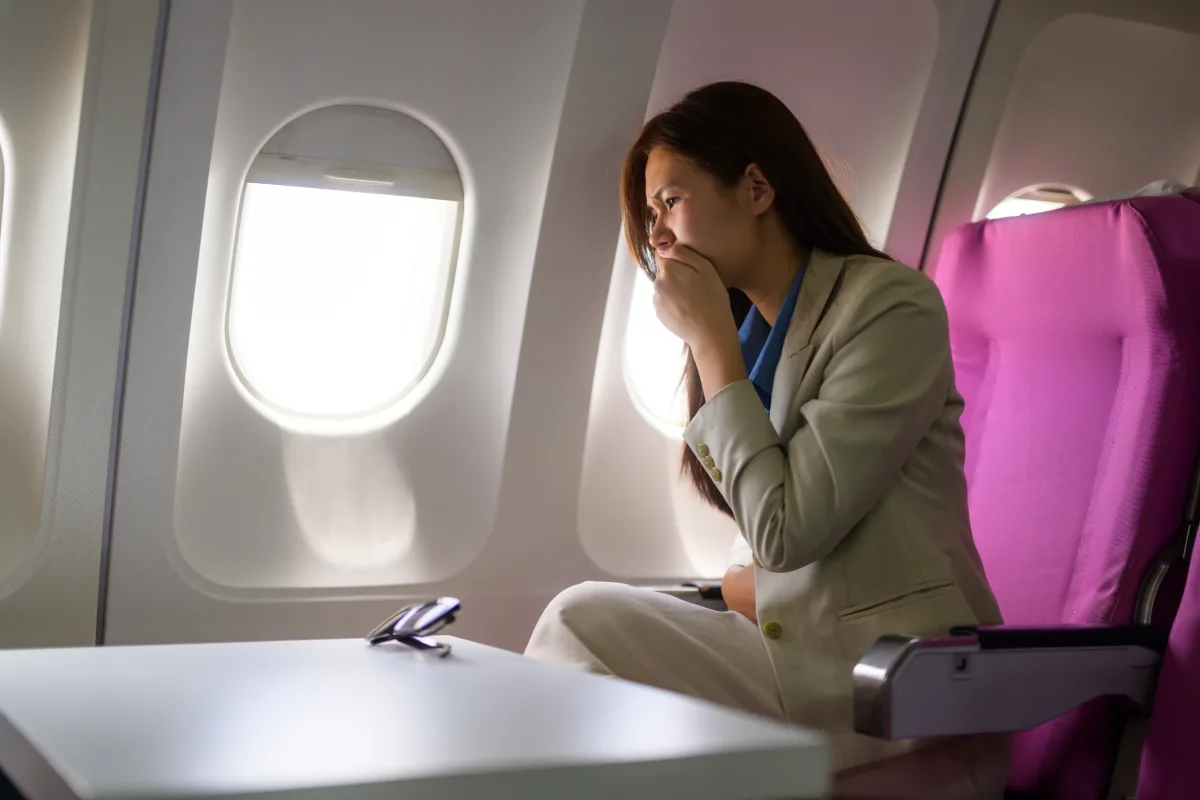
Landing gear noises, engine throttle reduction after takeoff, flap sounds, go-arounds, wing flex — all completely normal and explained here.
10 Things That Scare Passengers — But Are Completely Normal
Flying is an experience filled with unusual sounds, sensations, and observations for many people. What is daily routine for pilots and frequent flyers often causes unease or even panic in occasional travellers. In this article, we explain ten phenomena that regularly frighten passengers — even though they are completely normal, planned, and in many cases actually a sign that everything is functioning exactly as it should.
1. Engines become quieter after liftoff
The aircraft has barely lifted off and is climbing when the engines suddenly become noticeably quieter. For passengers with fear of flying, a nightmare moment: "Why are they shutting down the engines? Are we about to fall?"
The truth is reassuring and undramatic: what you hear is a planned thrust reduction that occurs on every single flight. For takeoff, the aircraft requires maximum or near-maximum engine power to accelerate to liftoff speed. Once the aircraft is safely airborne and has reached a certain altitude — typically 800 to 1,500 feet above ground — the thrust is reduced.
This happens for several reasons:
- Noise abatement: Airports have strict noise regulations, especially in densely populated areas. The thrust reduction after takeoff is a prescribed procedure (required by both EASA and FAA regulations) to minimise noise impact on nearby residents.
- Engine preservation: Maximum takeoff power places enormous stress on the engines. By reducing thrust as soon as it is no longer needed, engine lifespan is significantly extended.
- Fuel efficiency: Reduced thrust means lower fuel consumption.
At no point are the engines "shut down." They continue running — just at reduced power. The aircraft continues to climb. The climb angle becomes shallower, which intensifies the sensation that the aircraft is descending. But it is climbing. Always. Look out of the window at the horizon — you will see that the aircraft's nose is still pointing upward.
2. The wings flex — and they are designed to
A glance out of the window, and the wingtip appears to be bending alarmingly far upward. During turbulence, the wing visibly bobs up and down. It looks as though it is about to snap off. It will not.
Modern aircraft wings are deliberately designed to be flexible. A rigid wing would concentrate loads at a single point and break. A flexible wing distributes the energy across the entire span and absorbs it — similar to a bamboo rod that bends in the wind rather than breaking.
The numbers are impressive:
- Boeing 787 Dreamliner: The wingtips can deflect upward by over 10 feet (3 metres) during normal flight. In the static breaking test, the wings were bent upward by over 25 feet (7.6 metres) before they failed — at 150% of the maximum certified load.
- Airbus A350: The carbon fibre reinforced polymer (CFRP) wings flex approximately 8 feet (2.5 metres) during flight. In testing, they were deflected to over 26 feet (8 metres).
- Boeing 777: Legendary breaking test in 1995 — the wings bent upward by 24 feet (7.3 metres) before failing at 154% of maximum load.
The certification requirements (FAA 14 CFR Part 25 and EASA CS-25) mandate that the wing structure must withstand a load of 150% of the maximum expected operational load without breaking. This means: even in the worst conceivable turbulence a commercial aircraft could encounter, the wing still has a 50% reserve. The flexing you see is not a sign of weakness — it is engineering at its finest.
3. Go-around — the safe decision, not a failure
The aircraft is on approach, you can already see the runway, the engines are becoming quieter — and suddenly the engines roar to full power, the nose pitches up, and the aircraft climbs again. Panic in the passenger cabin: "What happened? Why can't we land?"
What happened is: the pilot has made a go-around decision. And that is not a sign of a problem — it is the most professional decision a pilot can make. Reasons for a go-around can include:
- Wind conditions: Crosswind too strong, wind shear detected, or sudden wind shift
- Runway not clear: Another aircraft, a vehicle, or an animal on the runway
- Unstabilised approach: Speed, altitude, or position does not match the prescribed parameters. In this case, the Standard Operating Procedures of most airlines require a go-around.
- Poor visibility: On a precision approach, the pilot must see the runway by the decision altitude (DA/DH). If they cannot, a go-around is mandatory.
- Separation from preceding aircraft: If the minimum separation is violated, air traffic control orders a go-around.
Every pilot trains go-arounds regularly in the simulator. It is a standard manoeuvre discussed as an option during every approach briefing. The rule is: "If anything is not right — go around." It is always better to fly a new approach than to force a risky landing. Statistically, a go-around decision leads to a safe outcome in virtually 100% of cases. Attempts to force a critical landing have, by contrast, led to serious accidents.
4. Loud sounds from the landing gear
Approximately 10 to 15 minutes before landing — sometimes earlier — loud, sometimes unsettling sounds emanate from beneath the fuselage: thumping, creaking, clacking, a muffled boom. The aircraft vibrates briefly. For some passengers, it sounds as though something is falling off.
What you hear is the landing gear being extended. The process involves:
- Opening of the gear doors: The doors on the underside of the fuselage and wings open — this causes a change in airflow noise and slight vibration.
- Hydraulic extension: The landing gear is pushed down by hydraulic pressure. The hydraulic cylinders produce a distinct sound.
- Lock engagement: When the landing gear reaches its deployed position, a mechanical lock engages — that is the distinctive "clack" or "boom" that vibrates through the entire structure.
- Wind noise: The extended landing gear significantly increases drag. The changed airflow creates new, louder wind sounds.
During retraction after takeoff, you hear the same sounds in reverse. The thumping beneath your feet shortly after liftoff is the landing gear retracting into its bay. Completely normal, on every flight, for decades.
5. Whirring and droning: landing flaps being deployed
During the approach, you hear an increasing whirr or rumble, accompanied by slight vibration. The aircraft seems to slow down and the nose rises slightly. What you are experiencing is the gradual deployment of the trailing-edge flaps and leading-edge slats.
Flaps are movable surfaces on the trailing edge of the wings. They increase the wing area and generate more lift, allowing the aircraft to fly at lower speeds — which is necessary for a safe landing. The slats on the leading edge open a slot through which air flows, stabilising the airflow over the wing.
Deployment occurs in several stages — on an Airbus A320, for example, in positions 1, 2, 3, and Full. Each stage is accompanied by a distinct sound as the hydraulic motors move the surfaces. On some aircraft types — particularly older Boeing models — the sound is especially loud and can resemble a mechanical wail or drone.
This is not a defect. This is the aircraft configuring itself for landing — a process performed on every flight, millions of times around the world.
6. Ear pressure and crackling bottles: cabin pressure changes
Your ears pop, PET bottles crinkle and deform, and you have the sensation that something is changing. That is correct — the cabin pressure is changing. But this is not a sign of a problem with the pressurisation system.
Modern commercial aircraft fly at altitudes of 30,000 to 43,000 feet (9,000 to 13,000 metres), where the outside pressure is so low that a person would lose consciousness within seconds. The pressurised cabin maintains the internal pressure at a tolerable level — but not at sea-level pressure. The so-called cabin altitude is typically 6,000 to 8,000 feet (1,800 to 2,400 metres). On the Boeing 787, thanks to the carbon fibre structure, it is reduced to approximately 6,000 feet (1,800 metres), which is noticeably more comfortable.
During climb and descent, the cabin pressure changes slowly and in a controlled manner. You feel this change as ear pressure — the air in your middle ear must adjust to the changed pressure. Swallowing, yawning, or the Valsalva manoeuvre (pinching your nose and gently blowing against it) equalises the pressure.
The crackling bottles are a physical phenomenon: during climb, the air inside the sealed bottle expands (as outside pressure drops); during descent, the bottle is compressed (as outside pressure rises). No defect — pure physics.
7. Fog in the cabin — condensation from temperature difference
Sometimes, especially on hot, humid days, fog or mist suddenly streams from the air conditioning vents into the cabin. It looks like smoke. It is not smoke.
What you see is condensation. The aircraft's air conditioning system cools the cabin air. When warm, moist outside air meets the cold, air-conditioned cabin air, the moisture condenses into tiny water droplets — visible as fog. The same principle creates your visible breath on a cold winter day.
This phenomenon is particularly common:
- In tropical and subtropical regions with high humidity
- When the air conditioning is switched on while still on the ground, before the cabin has reached temperature
- During descent, when temperature conditions change
- On certain aircraft types more than others (the A320 is known for it)
The fog is harmless, odourless, and disappears within seconds to minutes. If you smell actual smoke — burning plastic, electrical odours — that is a different matter. But white, odourless fog from the air conditioning vents is physics, not danger.
8. Tilted position: turns and bank angles
The aircraft banks into a turn, and out of the window you see the ground where there was sky moments before. The tilt feels dramatic — as though the aircraft is tipping onto its side. This moment triggers a feeling of loss of control in many passengers.
The reality: in normal flight operations, the maximum bank angle is approximately 25 to 30 degrees. This feels far more dramatic from inside than it actually is — because you have no external reference showing you the actual angle of bank.
For comparison: a Boeing 737 is certified for bank angles of up to 67 degrees. At 30 degrees of bank, the aircraft is far from any critical attitude. The aerodynamics of a banked turn are well understood: in the turn, the lift generated by the wings provides both the supporting force (against gravity) and the centripetal force (for the turn). At 30 degrees of bank, the G-loading increases to approximately 1.15 G — barely perceptible.
The famous demonstration flight by Boeing test pilot Tex Johnston in 1955 illustrates the margins dramatically: he performed a complete roll (360 degrees) with a Boeing 707 prototype in front of spectators over Lake Washington. The aircraft came through without any issue whatsoever. The 30 degrees you experience on a scheduled flight are child's play by comparison.
9. Flying in circles: holding patterns
The aircraft has been flying for a while, the landing should have happened long ago — but instead it is flying in circles. Out of the window you keep seeing the same landscape. The captain may come on and say something about a "delay" or "holding pattern." Passengers become nervous: "Why can't we land? Is something wrong?"
Holding patterns are one of the most routine procedures in air traffic management. They are used when:
- High traffic volume: Too many aircraft want to land at the same time. Air traffic control distributes them over time by placing individual aircraft in holding patterns.
- Weather at the destination airport: A thunderstorm over the airport delays arrivals and departures. Once the weather has passed, landing clearance is issued.
- Runway closure: A runway is temporarily closed — perhaps because a flock of birds has been sighted, a vehicle is on the runway, or a preceding aircraft is still vacating.
- Sequencing: Major airports such as London Heathrow, Frankfurt, or Dubai have tightly scheduled landing sequences. If an aircraft arrives slightly too early, it is placed in a holding pattern until its "slot" is available.
Holding patterns have a standardised oval shape (racetrack pattern) and are flown at defined altitudes. Fuel consumption in a holding pattern is accounted for — every aircraft carries reserve fuel for at least 30 minutes of holding, plus fuel for a diversion to an alternate airport, plus additional reserves. If fuel becomes low, the pilot declares "Minimum Fuel" or "Fuel Emergency," and air traffic control gives them priority. In practice, this occurs extremely rarely.
10. Lights are dimmed: preparation for an emergency that will not happen
During night landings and night takeoffs, the cabin lighting is dimmed. Window shades must be opened. Some passengers find this eerie — why does it go dark precisely when you want to feel safe?
The explanation is a textbook example of proactive safety thinking: the cabin lighting is dimmed so that your eyes can adapt to the darkness. If an evacuation were to become necessary, you might need to find the exit in the dark and jump down an emergency slide onto a dark taxiway or runway. If your eyes are accustomed to bright cabin lighting and this suddenly fails, your eyes need 20 to 30 minutes to fully adapt to the darkness. By dimming early, this adaptation process is anticipated.
The opened window shades serve a similar purpose:
- Rescue crews can see into the cabin: In an emergency, fire and rescue teams can assess the situation inside through the windows — where is smoke, where are people, which side is safe?
- Passengers can see outside: During an evacuation, it is helpful to see whether fire or other hazards exist on your side of the aircraft before opening the exit.
- Orientation: Natural light — whether daylight or airport lighting — provides additional orientation in an emergency situation.
Dimming the lights is neither a cost-saving measure nor an atmospheric effect. It is a safety precaution — one of hundreds that demonstrate how thoroughly every detail in commercial aviation is thought through.
Why we perceive normal things as dangerous
All ten phenomena in this article share one thing in common: they are experiences that passengers cannot contextualise because they lack the background knowledge. Our brains are programmed to evaluate the unknown as a potential threat — an evolutionary defence mechanism that was useful on the savannah but leads to false alarms in an aircraft.
The solution is knowledge. Every sound you can place loses its menace. Every process you understand transforms from a threat into a confirmation: "Everything is working as it should."
| What you experience | What your brain thinks | What is actually happening |
|---|---|---|
| Engines become quieter | "Engine failure!" | Planned thrust reduction, noise abatement |
| Wings flex | "It's going to snap off!" | Design-intended flexibility, 150% safety margin |
| Go-around | "Something is broken!" | Professional safety decision |
| Thumping beneath the fuselage | "Something is falling off!" | Landing gear being retracted/extended |
| Loud whirring | "Mechanical failure!" | Flaps being configured |
| Ear pressure, crackling bottles | "Decompression!" | Normal, controlled pressure adjustment |
| Fog from vents | "Smoke! Fire!" | Condensation from temperature difference |
| Aircraft tilts | "We're tipping over!" | Normal banked turn, max. 30 degrees |
| Flying in circles | "We can't land!" | Routine traffic management |
| Lights are dimmed | "Why is it going dark?" | Eye adaptation for safety |
Conclusion: the safest mode of transport has the loudest sounds
A modern commercial aircraft is a machine with millions of components working in harmony. This collaboration produces sounds — mechanical, hydraulic, aerodynamic. Every one of those sounds has a reason, and none of them is a sign of danger. On the contrary: the sounds you hear are the sound of a system functioning exactly as it was designed to.
The next time the engines become quieter after takeoff, the wing flexes, or there is thumping beneath your feet — remember this article. Not "What is broken?" should be your question, but "What is working right now?" The answer is almost always: everything.
Safety First
Flying is the safest mode of transport in the world — thanks to decades of experience, cutting-edge technology and the strictest regulations. Knowledge builds trust: The more you understand about aviation safety, the more relaxed you fly.
