
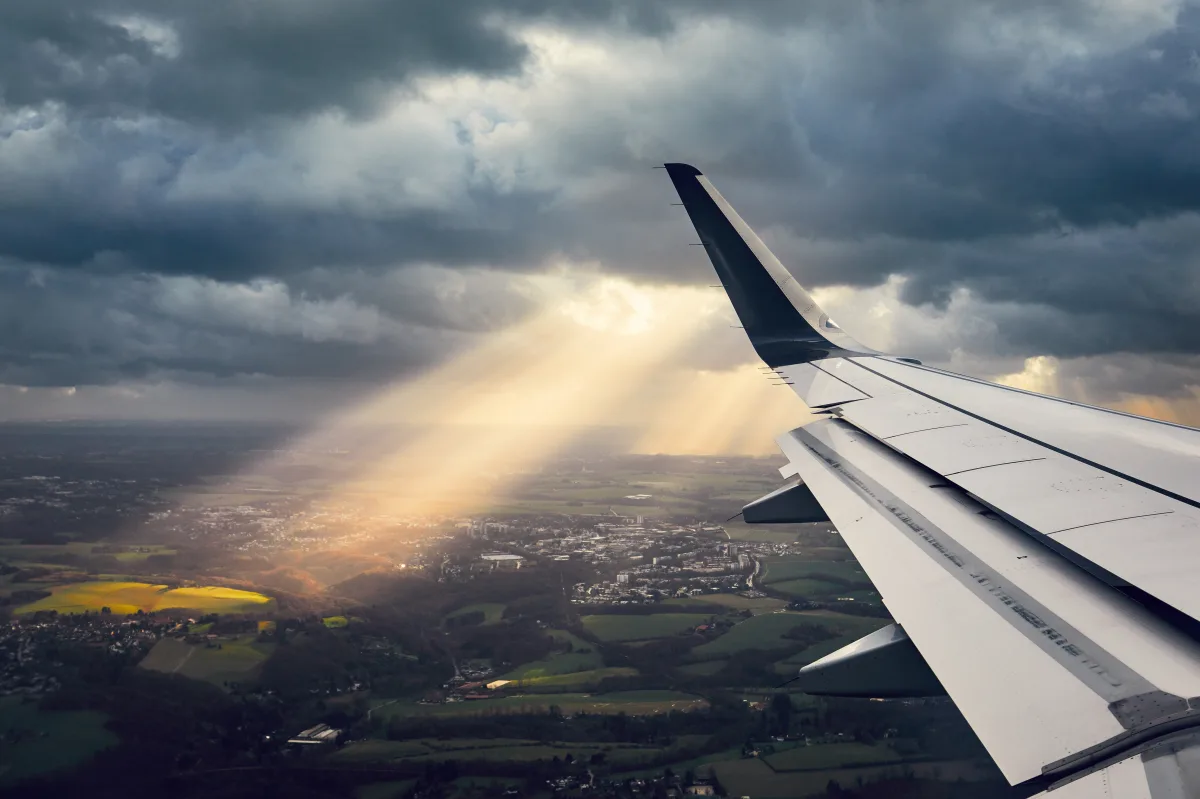
What turbulence physically is, why it feels worse than it actually is, and why no modern aircraft has ever crashed due to turbulence.
Turbulence — Why Your Aircraft Will Not Crash
Turbulence is the thing air travelers fear the most. Drinks slosh, the seatbelt digs into your abdomen, and for a moment the aircraft seems to fall. Yet what is actually happening is far less dramatic than it feels. No modern commercial aircraft has ever crashed due to turbulence alone. In this article, we explain what turbulence is from a physics standpoint, the different types that exist, why aircraft are built to handle it — and why the only real danger lies in not having your seatbelt fastened.
What turbulence actually is — the physics
Turbulence is caused by irregular air movements in the atmosphere. The air through which an aircraft flies is not a uniform, smooth flow. It consists of different layers moving at different speeds and in different directions. When an aircraft enters a region where these airflows change abruptly, it experiences sudden variations in vertical and horizontal velocity. Passengers feel this as jolts, vibrations, or brief drops.
Think of a road: on a well-paved motorway you drive smoothly. On a dirt track with potholes you get shaken around. But your car does not fall apart — it is built for that. The same applies to aircraft in turbulence.
In physical terms, turbulence briefly changes the angle of attack of the wings, which causes fluctuations in lift. However, these fluctuations are tiny compared to what the aircraft's structure is designed to withstand. Typical turbulence produces accelerations of about 0.2 to 0.5 G in addition to normal gravity. The structure of a commercial aircraft is certified to handle many times that amount.
The four types of turbulence
1. Clear Air Turbulence (CAT)
CAT is the most treacherous form because it is invisible. It occurs at the edges of jet streams — narrow, fast-moving air currents at high altitude (typically 23,000 to 39,000 feet / 7,000 to 12,000 metres). Where fast and slow air masses meet, eddies form. Since no clouds are involved, CAT cannot be detected by weather radar. Pilots rely on pilot reports (PIREPs), wind data, and increasingly on real-time turbulence sensors such as the LIDAR systems being developed by Boeing and Airbus.
CAT has increased in recent years — studies from the University of Reading show that severe CAT over the North Atlantic has increased by 55% since 1979. This is attributed to climate change, which is amplifying temperature differentials in the upper troposphere.
2. Convective turbulence
This is caused by thunderstorm cells and strong updrafts. Warm air rises, cold air sinks — the resulting updrafts and downdrafts can reach speeds of over 100 feet per second (30 metres per second). Convective turbulence is the strongest form, but it is visible on weather radar. Pilots fly well clear of thunderstorm cells — the minimum separation is 20 nautical miles laterally.
3. Mechanical turbulence (orographic turbulence)
When wind flows over mountains, eddies form on the lee side — similar to water behind a rock in a stream. This type of turbulence is particularly relevant during approaches near mountainous terrain, such as at Innsbruck, Funchal, or Queenstown. Rotors — horizontal vortex rolls — can be particularly intense.
4. Wake turbulence
Every aircraft leaves rotating air vortices at its wingtips — known as wake turbulence or wingtip vortices. The heavier the aircraft, the stronger the vortices. An Airbus A380 produces wake turbulence that can still be felt several minutes after it has passed. This is why ICAO prescribes strict minimum separation distances between aircraft during takeoff and landing. For a small aircraft following an A380, the minimum separation is 8 nautical miles.
The severity scale
| Severity | G-loading | What passengers feel | Effect on the aircraft |
|---|---|---|---|
| Light | 0.2 — 0.5 G | Slight jolts, drinks barely move | No effect whatsoever, autopilot remains active |
| Moderate | 0.5 — 1.0 G | Noticeable shaking, walking becomes difficult | No structural stress, speed adjustment made |
| Severe | 1.0 — 2.0 G | Violent jolts, loose objects thrown about | Precautionary inspection, but no damage |
| Extreme | Over 2.0 G | Uncontrollable body movements | Extremely rare, inspection required |
Important: severe turbulence is extremely rare. According to an FAA study, commercial aircraft experience less than one minute of severe turbulence per 10,000 flight hours on average. The overwhelming majority of turbulence encounters fall into the "light" and "moderate" categories.
Why modern aircraft are built for turbulence
The structure of every certified commercial aircraft must withstand loads far beyond what actually occurs in reality. The certification requirements of the FAA (14 CFR Part 25) and EASA (CS-25) mandate that the structure must withstand a load of at least +2.5 G to -1.0 G — without permanent deformation. The actual ultimate load (breaking strength) is a further 50% above that, at +3.75 G.
To put that in perspective: the most severe turbulence ever recorded in commercial aviation produced momentary loads of approximately 2.0 G. The aircraft was still more than 1.75 G away from its ultimate breaking point. That represents an enormous safety margin.
The wings of modern aircraft are deliberately designed to flex. On a Boeing 787, the wingtips can deflect upward by over 10 feet (3 metres) during flight. In static testing, the wings were bent upward by over 25 feet (7.6 metres) before they failed — and that was at 150% of the maximum operational load. In the normal turbulence range, this flexing is entirely harmless and intentional: a flexible wing absorbs energy better than a rigid one.
No modern commercial aircraft has crashed due to turbulence
This is the most important fact in this entire article: No modern commercial aircraft, certified to current standards, has ever been structurally destroyed or brought down solely by atmospheric turbulence. There were historical cases in the 1960s, when design standards were different — such as BOAC Flight 911 (1966), which broke apart in a mountain rotor wave. But since the introduction of modern certification standards, no turbulence event has structurally destroyed an aircraft.
What turbulence can cause is injuries to passengers and cabin crew — and that is where the actual risk lies.
What pilots do during turbulence
Pilots are not passive observers during turbulence. Their actions include:
- Speed reduction to VA (manoeuvring speed): At this speed, the aircraft is most resistant to gust loads. The aerodynamics ensure that the wing would stall before the structure becomes overloaded.
- Route adjustment: Pilots can request different altitudes or lateral deviations from air traffic control to fly around known turbulence zones.
- Weather radar analysis: Modern onboard weather radar displays precipitation and — indirectly — thunderstorm cells. Pilots interpret the returns to fly around thunderstorm cells with a minimum clearance of 20 nautical miles.
- PIREPs (Pilot Reports): Pilots report turbulence to air traffic control, which relays this information to following aircraft. This creates a real-time picture of the turbulence situation along a route.
- Seatbelt sign activation: Pilots switch on the "Fasten Seatbelt" sign early — often several minutes before turbulence becomes noticeable.
- Cabin crew notification: The flight attendants are warned via intercom so they can discontinue service and secure themselves.
Why turbulence feels worse than it actually is
Our bodies are poor instruments for measuring accelerations. Several factors distort our perception:
- No visual reference points: Inside the aircraft, we cannot see how the surroundings are moving. Our vestibular system signals motion, but our eyes see a stable cabin. This sensory conflict amplifies discomfort.
- Loss of control: In a car, we feel potholes similarly, but we are behind the wheel. In an aircraft, we have no control — and that intensifies the fear.
- Altitude awareness: We know we are 33,000 feet (10 kilometres) above the ground. A slight wobble on the ground would never trouble us — but in the air, it immediately triggers alarm in the brain.
- Negativity bias: A flight with 4 hours of smooth air and 30 seconds of light turbulence will be remembered as a "turbulent flight."
- Overestimating altitude loss: Passengers often believe the aircraft "dropped 300 feet." In reality, moderate turbulence typically causes altitude variations of 10 to 20 feet (3 to 6 metres) — comparable to a pothole on the road.
Singapore Airlines Flight SQ321 (May 2024)
On 21 May 2024, an Airbus A350-900 operated by Singapore Airlines on a flight from London to Singapore encountered severe turbulence over Myanmar. The aircraft had to make an emergency diversion to Bangkok. A 73-year-old passenger died — presumably from a heart attack — and over 100 people were injured, some severely with spinal injuries.
This case confirms two central points:
- The aircraft was completely intact. Despite extreme turbulence — with momentary accelerations estimated at -1.5 G to +2.0 G — the A350's structure sustained no damage whatsoever. The aircraft landed safely under its own power.
- The injuries affected almost exclusively people who were not wearing seatbelts. Passengers who had their seatbelts fastened were largely uninjured. The severe injuries occurred because unrestrained individuals were hurled against the cabin ceiling at speeds of several metres per second.
Singapore Airlines Flight SQ321 is not an example of turbulence being dangerous for aircraft. It is an example that the seatbelt is the most important piece of safety equipment on board an aircraft.
Tips for passengers
- Always keep your seatbelt fastened: Even when the seatbelt sign is off. Loosely across your hips is sufficient. This is the only measure that actually protects against turbulence injuries.
- Seat selection: Seats over the wings are at the aircraft's centre of gravity — turbulence is felt least here. At the tail, it is felt most.
- Fly in the morning: Convective turbulence is strongest in the afternoon, because solar heating creates updrafts. Early morning air is typically calmer.
- Don't panic at announcements: When the captain announces "light to moderate turbulence," it is a routine information update, not a warning of danger.
- Avoid hot beverages: During turbulence, spilled hot drinks cause scalding. If bumpy weather is expected, stick with cold beverages.
- Stow carry-on luggage securely: Open overhead bins and loose objects become projectiles during turbulence.
Conclusion: turbulence is uncomfortable, but not dangerous
Turbulence is an atmospheric phenomenon that is as much a part of flying as waves are a part of sailing. Modern commercial aircraft are certified for loads far beyond what nature can produce. No modern aircraft has been destroyed by turbulence. The only real danger is for people who are not wearing seatbelts — and that danger can be completely eliminated with a single click.
The next time you encounter turbulence: look at the wingtip. It will flex — and that is exactly what it is designed to do. Look at your drink. It will move slightly. And then remember: the aircraft is built to withstand three times what you are currently experiencing. Sit back, keep your seatbelt fastened, and let the aircraft do its job.
Safety First
Flying is the safest mode of transport in the world — thanks to decades of experience, cutting-edge technology and the strictest regulations. Knowledge builds trust: The more you understand about aviation safety, the more relaxed you fly.
