
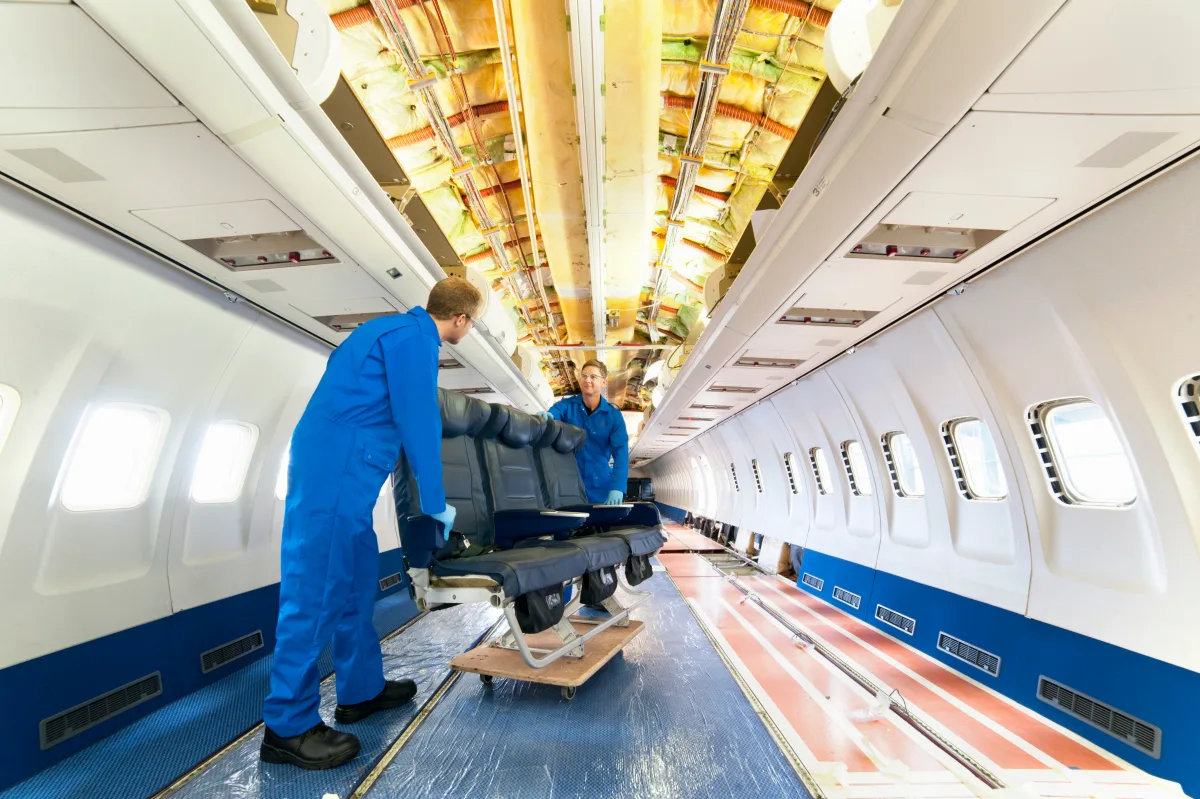
Brace position, counting exits, using oxygen masks correctly. Why every seat on an airplane is a carefully designed safety system.
The Safety Briefing — Why These 3 Minutes Can Save Your Life
You know the ritual: the aircraft taxis to the runway, the flight attendants stand in the aisle, and a voice — live or recorded — explains emergency exits, life vests, and oxygen masks. Most passengers stare at their phones, read a book, or doze off. It is the most consistently ignored safety measure in the modern world. And that very fact has cost people their lives.
The pre-departure safety briefing lasts about three minutes. In those three minutes, you are given information that could mean the difference between life and death in an emergency. This article explains why every single element of the briefing is based on real accidents, investigations, and biomechanical research — and why you should pay attention.
British Airtours Flight 28M — The accident that changed everything
On 22 August 1985, a Boeing 737-236 operated by British Airtours stood ready at Manchester Airport for departure to Corfu. During the takeoff roll, the combustion chamber of the left engine ruptured. A fire broke out. The captain immediately aborted the takeoff and brought the aircraft to a stop. Up to this point, everything had gone correctly.
But then everything went wrong. The wind drove the flames directly onto the rear fuselage. The cabin walls melted. Toxic smoke filled the cabin within seconds. Of the 137 people on board, 55 died — not from impact, not from the fire directly, but from toxic smoke inhalation and panic. Many of the victims were found in their seats, belted in, but unable to orient themselves or reach the emergency exits.
The investigation by the Air Accidents Investigation Branch (AAIB) found that passengers who knew where the exits were and who could move quickly survived. Passengers who were disoriented, had no idea which exit was nearest, or did not know how to breathe in smoke, perished.
This accident led to fundamental changes: floor-level emergency lighting was introduced, cabin materials were made more fire-resistant, and the safety briefing became mandatory. Every single change is based on the lessons learned from Manchester.
The brace position — biomechanically proven
The brace position is often ridiculed or dismissed as useless. Some conspiracy theories even claim it exists solely to hasten death so that airlines pay less in compensation. This is not just wrong — it is dangerous.
The brace position has been extensively researched by the Cranfield Impact Centre in the United Kingdom and the FAA Civil Aerospace Medical Institute — using crash-test dummies, simulations, and analysis of real accidents. The biomechanics are clear:
- Head protection: The head is bent forward and — depending on seat pitch — pressed against the hands or the seat in front. This reduces the speed at which the head strikes the seat ahead on impact and distributes the force over a larger area. The risk of traumatic brain injury is reduced by up to 40%.
- Spinal protection: The bent posture reduces axial loading on the spine. On impact, the energy is distributed along the entire length of the upper body rather than concentrating on individual vertebrae.
- Limb protection: The feet are placed flat on the floor, slightly behind the knees. This prevents the legs from sliding under the seat in front and breaking on impact — which would destroy the ability to evacuate.
- Secondary impact reduction: The body is already in a compact position. The distance between the resting position and the impact surface is minimal, which reduces acceleration forces.
A study by the Cranfield Institute analysed survivability in survivable accidents and concluded that passengers who correctly adopt the brace position have a significantly higher probability of survival at impact forces up to 14 G — which covers the majority of survivable accidents.
Counting rows — The technique that saves lives in smoke
The safety briefing instructs you to locate your nearest emergency exit and count the number of seat rows to it. That sounds pedantic. It is life-saving.
In a smoke-filled cabin, visibility is zero. Literally zero — not "reduced," but non-existent. Within 90 seconds, a cabin can fill with so much smoke that you cannot see your own hand in front of your face. In that situation, there is only one way to find the exit: you count the seat rows.
The technique: before takeoff, count the rows between your seat and the nearest exit — both forward and aft. In an emergency, grip the headrests and pull yourself row by row toward the exit. At row zero, you are there. This works in darkness, in smoke, in panic.
NTSB data shows that passengers who know their nearest exit and have internalised the route to it reach the exit an average of 31% faster during evacuations than passengers who must first orient themselves. In a fire, those seconds can decide between life and death.
The oxygen mask — why "yourself first"
The instruction to put the oxygen mask on yourself first, before helping children or those needing assistance, triggers resistance in many parents. It goes against every parental instinct. But the physiology is unambiguous.
During a sudden decompression at cruising altitude — whether caused by a hole in the fuselage or failure of the pressurisation systems — the oxygen partial pressure in the cabin drops within seconds to levels equivalent to breathing at 23,000 to 33,000 feet (7,000 to 10,000 metres). The so-called Time of Useful Consciousness (TUC) — the time during which you remain conscious and capable of action — is:
| Altitude | TUC (Adults) |
|---|---|
| 25,000 ft (7,600 m) | 3 — 5 minutes |
| 30,000 ft (9,100 m) | 1 — 2 minutes |
| 35,000 ft (10,700 m) | 30 — 60 seconds |
| 40,000 ft (12,200 m) | 15 — 20 seconds |
| 43,000 ft (13,100 m) | 9 — 12 seconds |
At a typical cruising altitude of 36,000 feet (11,000 metres), you have approximately 30 to 45 seconds before losing consciousness. Putting on a mask takes about 3 seconds. If you first try to put a mask on a child — who is struggling, crying, turning their head — 15 to 20 seconds can pass. Then you put on your own mask and have 10 seconds of consciousness left. If it does not work immediately, you lose consciousness. Then the child dies because there is no one left to help.
The correct sequence saves both: mask on yourself — mask on child. Three seconds for you, then all the time in the world for your child, because you remain conscious and capable of action.
The life vest — when to inflate and when not to
The life vest is located under or between your seat. The instruction is clear: "Do not inflate the vest until you have left the aircraft." Why?
When an aircraft ditches on water — as US Airways Flight 1549 did in the Hudson River in 2009 — water enters the cabin. An inflated life vest causes you to float upward in the rising water — against the cabin ceiling. You can no longer dive down to reach the exit if it is below the waterline. You are pressed against the ceiling and drown inside the cabin.
This phenomenon was tragically documented on Ethiopian Airlines Flight 961 (1996). The Boeing 767 ditched in the Indian Ocean following a hijacking. Many passengers had already inflated their life vests inside the cabin. When water entered, they were pressed against the cabin ceiling and could no longer reach the exits. Of the 175 people on board, only 50 survived.
Remember: put the vest on — yes, immediately. Inflate — no, only once outside. The red inflation handle is pulled only when you are standing in the doorway or already in the water.
Floor-level emergency lighting — follow the light
Since the lessons of the Manchester accident of 1985, all commercial aircraft must be equipped with floor-level emergency lighting. These light strips run along the cabin floor and lead to the emergency exits. Their colours follow a system:
- White or green: Follow this light to the exit
- Red: You have arrived at the exit
This lighting operates independently of the aircraft's main power supply and has a minimum illumination duration of 10 minutes on battery backup. In smoke, in darkness, in panic — these lights on the floor are your guide. That is why the instruction "Stay low, follow the lights on the floor" is not a platitude but a survival strategy.
The seatbelt — different from a car
The safety briefing explains how to open the aircraft seatbelt. That may seem silly — who cannot open a seatbelt? The answer: a startlingly large number of people in a stress situation.
The aircraft seatbelt is opened by lifting the metal plate. The car seatbelt is opened by pressing a button. In a panic situation, when the brain reverts to automated actions, many passengers instinctively press a non-existent button — a motion they have practised thousands of times in a car. They fail to unbuckle.
This phenomenon is documented in accident reports. During the investigation of Air Florida Flight 90 (1982) and other survivable accidents, passengers were found belted in their seats, apparently unable to open the seatbelt. Consciously memorising the belt release technique — lift the metal plate — can make the difference in a stress situation.
Statistics: those who pay attention survive more often
The University of Greenwich conducted a comprehensive study on survivability in aircraft accidents on behalf of the UK Civil Aviation Authority (CAA). The findings:
- Passengers who had studied the safety card and knew the position of the exits reached the exit an average of 31% faster
- Passengers seated more than 5 rows from an exit had a significantly lower survival rate in fire-related accidents
- The overall survival rate in survivable accidents was over 95% — but the rate varied considerably depending on passenger preparedness
- Passengers travelling with a companion had higher survival rates — presumably because they motivated and coordinated with each other
NTSB data from the United States confirms this: of 568 aircraft accidents with casualties between 1983 and 2000, 95.7% of all occupants survived. The notion that an aircraft accident is synonymous with death is a myth. Most accidents are survivable — if you know what to do.
The safety card — do not ignore it
In the seat pocket in front of you is a safety card. It is created for the specific aircraft type and contains:
- The position of all emergency exits — which varies by aircraft type
- The correct brace position for this particular seat type
- How to operate the emergency exits
- The location of the life vest
- Instructions for evacuation via emergency slides
Even if you are a frequent flyer: read the safety card on every flight. An A320 has different exit positions than a 737. A 777-200 has different overwing exits than a 777-300. The two minutes you invest in the safety card could save your life.
What the safety briefing does not say — but you should know
- Smoke kills faster than fire: The greatest danger in a cabin fire is toxic gases — carbon monoxide, hydrogen cyanide, and phosgene. Three breaths can lead to unconsciousness. Stay low, where the air remains breathable longer.
- Count the rows with your fingers: Place your hand on the headrest of the seat in front and count. This tactile method works in zero visibility.
- Keep your shoes on: During an evacuation across debris fields or hot tarmac, shoes protect your feet. However, put high heels under the seat — they can damage emergency slides.
- Have a plan: When you sit down, consciously think once: "If something happens now — what is my way out?" That single thought can give you the decisive head start in an emergency.
Conclusion: three minutes for your life
The safety briefing is not a bureaucratic ritual. It is the result of decades of accident investigation, hundreds of investigation reports, biomechanical studies, and the lessons drawn from the dead of Manchester, Tenerife, and dozens of other accidents. Every word, every gesture, every instruction is based on the experiences of people who did not survive — so that you can.
Three minutes. That is the duration of the briefing. In those three minutes, you learn how to adopt a brace position that increases your chances of survival by 40%. You learn where the nearest exit is — giving you a 31% time advantage. You learn why you must put the oxygen mask on yourself first — which saves both your life and your child's. Three minutes that may one day become the most important of your life.
Safety First
Flying is the safest mode of transport in the world — thanks to decades of experience, cutting-edge technology and the strictest regulations. Knowledge builds trust: The more you understand about aviation safety, the more relaxed you fly.
