
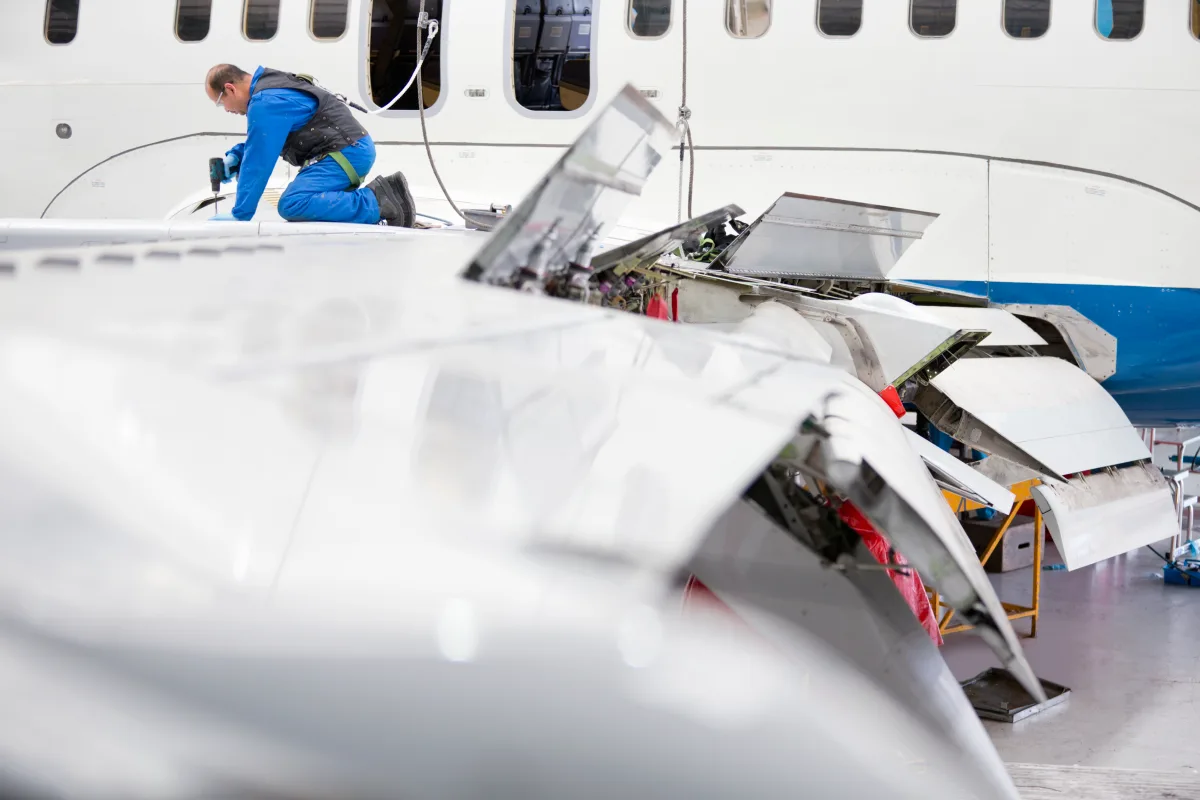
Why every walk-around inspection matters, real cases where skipped checks proved fatal, and the key points of a thorough preflight inspection.
Preflight Check — No Detail Is Too Small
In aviation, every safe flight begins long before the aircraft reaches the runway. The preflight check is the foundation of flight safety. It is the last line of defense against technical defects, human errors, and unforeseen hazards. What may appear at first glance to be a routine task is in reality a carefully developed system built on decades of experience, accident analysis, and the knowledge that a single overlooked detail can make the difference between a safe flight and a catastrophe.
What Is a Preflight Check?
A preflight check comprises the systematic inspection of the aircraft and all relevant factors before departure. It is mandatory for every flight — whether a private flight in a Cessna 172 or an intercontinental service on an Airbus A380. Both EASA (European Union Aviation Safety Agency) and the FAA (Federal Aviation Administration) mandate the completion of a preflight check in their respective regulations.
The preflight check essentially consists of two components:
- The walk-around (external inspection): The physical inspection of the aircraft from the outside, during which the pilot circles the aircraft and systematically checks all visible components.
- Cockpit preparation: The verification of all instruments, systems, and documentation in the cockpit before engine start.
The Walk-Around — What Pilots Look For
The walk-around follows a standardized sequence defined for each aircraft type in the Aircraft Operating Manual (AOM) or Pilot Operating Handbook (POH). Although the details vary by aircraft type, a typical external inspection covers the following areas:
| Area | Inspection Points | Why Important |
|---|---|---|
| Fuselage and surfaces | Dents, cracks, missing rivets, corrosion, leaks | Structural integrity, pressure seal |
| Wings | Slats, flaps, ailerons, surface condition, ice formation | Aerodynamics, controllability |
| Engines | Intake clear of foreign objects, fan blades, oil leaks, mounting | Engine performance, FOD prevention |
| Pitot tubes and static ports | Free from blockages, protective covers removed | Accurate airspeed and altitude indication |
| Landing gear | Tire condition, brakes, hydraulic leaks, struts | Safe landing and ground operations |
| Control surfaces | Freedom of movement, damage, control locks removed | Full controllability in flight |
| Antennas and sensors | Secure mounting, damage, freedom from ice formation | Navigation, communication, weather radar |
| Lighting | Navigation lights, landing lights, strobe lights | Visibility, collision avoidance |
| Fuel | Quantity, quality (water test / sump check), fuel caps secured | Range, engine performance |
| Doors and hatches | Properly closed and latched, cargo doors secured | Pressure seal, structural safety |
In General Aviation (GA), the pilot personally conducts the walk-around. For transport category aircraft, pilots and ground crew share the responsibility: the Captain or First Officer performs the walk-around while the ground crew works through their own checklists.
When the Preflight Check Fails — Three Tragic Examples
The importance of the preflight check becomes most apparent when examining cases where it failed or was skipped. Three accidents illustrate in sobering detail what a single overlooked detail can cause.
AeroPerú Flight 603 — Taped-Over Static Ports (1996)
On October 2, 1996, a Boeing 757-200 operated by AeroPerú crashed into the Pacific Ocean shortly after takeoff from Lima airport. All 70 people on board perished.
The cause: a maintenance technician had covered the three static pressure ports on the left side of the fuselage with masking tape during cleaning operations the day before — a standard practice to prevent cleaning agents from entering the sensors. After completing the cleaning, he forgot to remove the tape. The polishing tape was silver in color and virtually indistinguishable from the fuselage surface in the darkness of the night on which the flight took place.
The consequences were devastating: the static ports supply the flight computer with data for altitude, airspeed, and vertical speed. With the ports taped over, the pilots received completely erroneous readings. The altimeter displayed an incorrect altitude; the airspeed indication was unreliable. The pilots could no longer determine how high or how fast they were actually flying.
In the darkness over the open ocean, without a visual horizon, Captain Eric Schreiber and First Officer David Fernandez lost spatial orientation. Despite repeated warnings from the ground radar operator, who could see the aircraft at sea level, the 757 crashed into the ocean after 25 minutes of desperate struggle.
Lesson: A piece of tape — a detail that would have been immediately noticed during a thorough preflight check in daylight — cost 70 lives.
Birgenair Flight 301 — Wasp Nest in the Pitot Tube (1996)
On February 6, 1996, a Boeing 757-225 operated by Birgenair crashed into the Atlantic shortly after takeoff from Puerto Plata in the Dominican Republic. All 189 people on board perished — one of the deadliest aviation accidents in the Caribbean.
The cause: the aircraft had sat unused at the airport for over 20 days. During this time, wasps or mud daubers had built a nest inside one of the three pitot tubes — the total pressure sensors that measure airspeed. The pitot covers, which are designed to prevent such blockages, had not been installed during the idle period.
At takeoff, the captain received erroneous airspeed readings on his airspeed indicator. Despite contradictory readings between the three instruments, the pilots chose to continue the takeoff. In flight, the false airspeed data led to a cascade of wrong decisions. The stick shaker (stall warning) activated erroneously, then the overspeed warning sounded — both simultaneously, which is physically impossible. The confused pilots reduced thrust, the aircraft decelerated, stalled, and crashed.
Lesson: A tiny blockage in a tube just a few centimeters in diameter — caused by an insect — resulted in the deaths of 189 people. A preflight check with proper inspection of the pitot tubes and the use of pitot covers during idle periods would have prevented the accident.
Helios Airways Flight 522 — Pressurization Switch Set to Manual (2005)
On August 14, 2005, a Boeing 737-300 operated by Helios Airways crashed near Mount Grammatiko north of Athens. All 121 people on board died. It was the deadliest aviation accident in Greek history.
The cause: during maintenance the night before, a technician had set the pressurization mode selector from "Auto" to "Manual" to conduct a pressure leak test. After completing the maintenance, he forgot to return the switch to "Auto."
During the pilots' preflight check the following morning, the switch position was not noticed. During climb, the cabin was not automatically pressurized. The cabin altitude warning sounded at approximately 12,040 feet but was mistakenly interpreted by the pilots as a takeoff configuration warning. The pilots failed to recognize the actual problem.
At approximately 18,000 feet cabin altitude, the passenger oxygen masks deployed in the cabin. The cockpit crew progressively lost cognitive function due to insidious hypoxia and eventually lost consciousness. The aircraft continued flying on autopilot until the fuel ran out. The Boeing 737 crashed in an uncontrolled descent.
One flight attendant, Andreas Prodromou, who held a private pilot license, had fought his way to the cockpit using a portable oxygen bottle. The Greek F-16 interceptors, which had scrambled for identification, observed him in the left pilot seat. But it was too late — the engines had already flamed out, and the situation was beyond recovery.
Lesson: A single switch in the wrong position — an item that appears on every preflight checklist — resulted in the deaths of 121 people. The preflight check could and should have caught this error.
Checklist Discipline — Why "From Memory" Is Not Enough
The three accidents described share a common element: the preflight check was either not performed thoroughly enough, or critical items were overlooked. This leads to one of the most important concepts in aviation safety — checklist discipline.
A checklist is not an optional guide but a mandatory instrument. It is not used to remember what needs to be done, but to confirm that it has been done. This distinction is fundamental:
- Do-list: The pilot performs actions by following the list — step by step. Typical in GA and for certain emergency procedures.
- Challenge-and-response: One pilot reads the item aloud, the other confirms the correct status. Standard in airline operations for critical checklists.
- Verification: The pilot performs actions from memory and then uses the checklist afterward for confirmation. Common for flow checks in the cockpit.
Research clearly demonstrates: pilots who use checklists consistently and systematically make fewer errors than those who rely on memory — regardless of their experience level.
Beyond the Walk-Around — The Extended Flight Preparation
The preflight check is not limited to the physical inspection of the aircraft. A responsible pilot reviews a range of additional factors before every flight:
Weather Briefing
Reviewing weather conditions is an integral part of every flight preparation. Pilots analyze:
- METAR: The current weather report at the departure and destination airports as well as at alternate airports.
- TAF: The Terminal Aerodrome Forecast for the relevant airports.
- SIGMET and AIRMET: Warnings of significant meteorological phenomena such as thunderstorms, icing, turbulence, or volcanic ash.
- Winds and temperature at cruise altitude: For flight planning and fuel calculations.
- Surface wind at the destination airport: For landing planning and establishing personal minimums.
NOTAMs (Notices to Air Missions)
NOTAMs inform pilots of temporary hazards or restrictions not contained in regular publications. These include:
- Closed runways or taxiways
- Inoperative navigation aids
- Military exercise areas
- Airport construction work
- Temporary flight restriction areas (TFRs)
- Changes to approach procedures
Overlooking a NOTAM can have fatal consequences — for example, if a pilot plans an ILS approach but the ILS system is out of service for maintenance.
Weight and Balance
Correct weight and balance calculation is not an optional exercise but a safety-critical computation. An aircraft with its center of gravity outside the permissible limits can become uncontrollable. If overloaded, the required takeoff distance may be insufficient, climb performance is reduced, and structural limits may be exceeded.
| W&B Parameter | Risk If Disregarded |
|---|---|
| CG too far forward | Increased trim drag, higher landing speed, more difficult rotation at takeoff |
| CG too far aft | Pitch instability, stall risk, reduced controllability |
| Overweight | Longer takeoff roll, reduced climb performance, structural limits exceeded |
Personal Minimums — The Pilot as Part of the Equation
An often underestimated aspect of flight preparation is the pilot's honest self-assessment. The IMSAFE mnemonic is a widely used self-check tool, recognized by both the FAA and EASA in their safety promotion materials:
- Illness — Am I sick? Cold, headache, gastrointestinal issues?
- Medication — Am I taking any medication that could impair my performance?
- Stress — Am I under significant stress (professional, personal, financial)?
- Alcohol — Have I consumed alcohol in the last 8 to 12 hours? (FAA: 8 hours minimum per 14 CFR 91.17; many airlines: 12 hours)
- Fatigue — Am I rested? Have I had enough sleep?
- Eating — Have I eaten and hydrated adequately?
Personal minimums go further: every pilot should define personal limits that are more conservative than the regulatory minimums. A pilot with 200 hours of experience should not fly in the same weather conditions in which a pilot with 5,000 hours can operate safely.
The Swiss Cheese Model — How Accidents Happen
British psychologist James Reason developed the "Swiss Cheese Model" of accident causation, which today forms the foundation of aviation safety philosophy. The model envisions the various safety layers of a system as slices of Swiss cheese — each slice has holes (weaknesses), but the holes are in different positions.
An accident occurs only when the holes in multiple slices align simultaneously — when several safety barriers fail at the same time. The slices represent different layers of defense:
- Organizational factors: Corporate culture, budget decisions, staffing levels
- Supervision and management: Quality control, inspection intervals, training standards
- Preconditions: Maintenance condition, workload, environmental conditions
- Unsafe acts: Errors or violations by individual pilots, technicians, or controllers
The preflight check is one of the last "cheese slices" in this chain. It is the final opportunity to discover a problem before the aircraft takes to the air. If all previous safety barriers have failed — the manufacturer made an error, maintenance overlooked a problem, quality control did not catch it — then the preflight check is the last chance.
This is precisely why no detail is too small. The piece of tape over a static port. The wasp nest in a pitot tube. The switch in the wrong position. Each of these details was the moment when the last cheese slice could have caught the error — and did not.
GA vs. Airline Operations — Differences in Practice
In General Aviation (GA), the pilot is frequently solely responsible for the entire flight preparation. He or she conducts the walk-around personally, checks fuel and oil, plans the route, and calculates weight and balance. The responsibility is concentrated, and there is no second person to catch errors.
In airline operations, the preflight check is a distributed process involving multiple participants: pilots, dispatchers, ground crew, and maintenance technicians. This provides more redundancy but also carries the risk of diffusion of responsibility — "someone else has surely already checked that."
Both EASA and the FAA have therefore defined clear responsibilities: ultimately, the Pilot in Command (PIC) is responsible for determining that the aircraft is airworthy and suitable for the planned flight. This responsibility cannot be delegated.
The Culture of Diligence
The preflight check is more than a checklist. It is a mindset. It requires the willingness to be thorough even when performing the walk-around for the thousandth time. It requires the courage to cancel a flight when something is not right — even when passengers are waiting, the schedule is pressing, and the pressure is high.
Aviation has built this culture of diligence over decades, often paid for with the highest price — human lives. Every item on a checklist exists because, at some point, someone overlooked that item and people died as a result.
This is why aviation holds to the principle: no detail is too small. No item on the checklist is unimportant. No walk-around is routine. Because the chain of flight safety is only as strong as its weakest link — and sometimes that weakest link is a piece of tape, an insect nest, or a forgotten switch.
Safety First
Flying is the safest mode of transport in the world — thanks to decades of experience, cutting-edge technology and the strictest regulations. Knowledge builds trust: The more you understand about aviation safety, the more relaxed you fly.
