
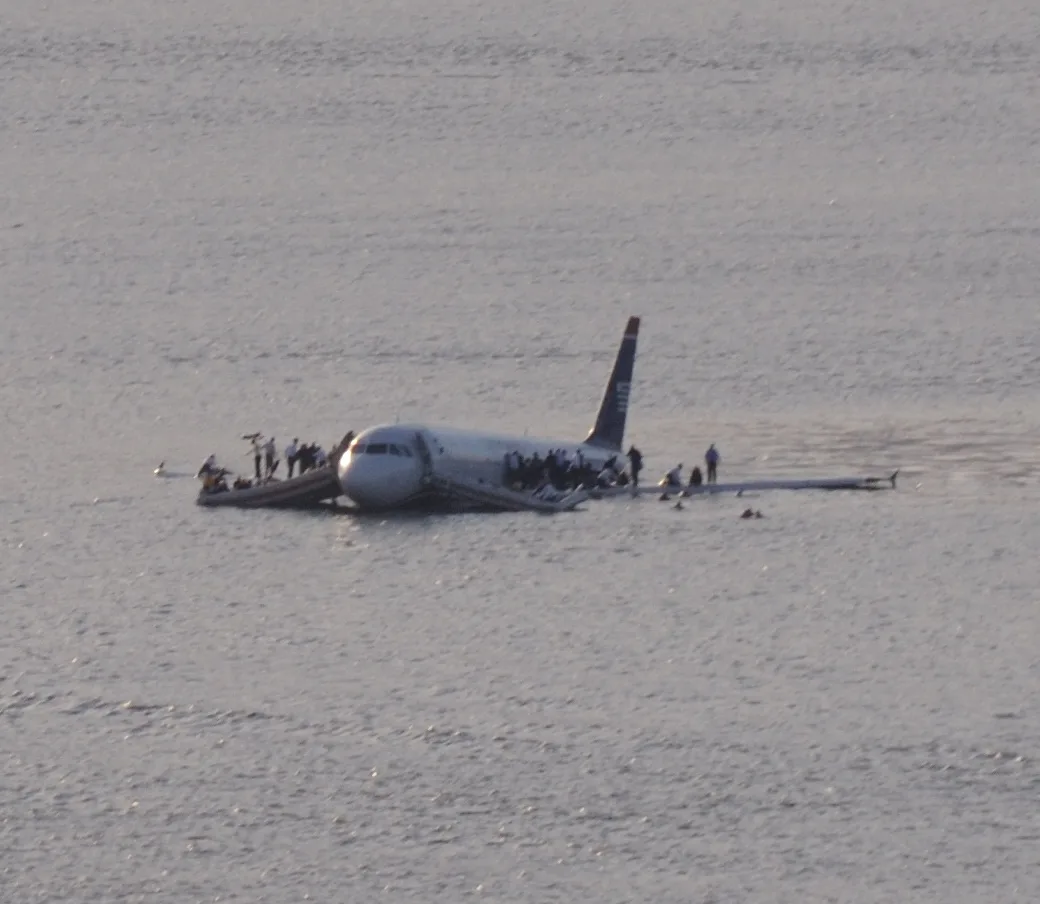
US Airways Flight 1549: Bird strike, both engines out, emergency landing on the Hudson River. How Captain Sullenberger saved 155 lives.
The Miracle on the Hudson — How 155 People Survived
On January 15, 2009, one of the most remarkable incidents in civil aviation history occurred over New York City. US Airways Flight 1549, an Airbus A320-214 carrying 150 passengers and five crew members, lost both engines to a bird strike shortly after takeoff from LaGuardia Airport. What followed were 208 seconds that made aviation history — and saved 155 lives.
The Flight and Its Crew
Flight 1549 was a routine domestic service from New York-LaGuardia to Charlotte, North Carolina. In the cockpit sat two experienced pilots:
- Captain Chesley Burnett "Sully" Sullenberger III — 57 years old, over 19,000 total flight hours. A former US Air Force fighter pilot (F-4 Phantom), aviation safety expert, and accident investigator. Sullenberger had been with US Airways and its predecessor airlines since 1980 and possessed extensive knowledge in Crew Resource Management and aviation safety theory.
- First Officer Jeffrey Skiles — 49 years old, over 20,000 flight hours. Skiles was on one of his first flights on the A320 that day following a type transition, despite being an extremely experienced pilot.
Also on board were three flight attendants: Donna Dent, Doreen Welsh, and Sheila Dail. The aircraft, registration N106US, was in perfect technical condition and had already completed a flight without any issues earlier that morning.
3:25 PM — Takeoff and the First Minute
At 3:25:56 PM local time, the Airbus A320 lifted off from Runway 04 at LaGuardia Airport. First Officer Skiles was the Pilot Flying, while Captain Sullenberger served as Pilot Monitoring. The takeoff was entirely normal. The weather was clear at minus six degrees Celsius, with excellent visibility.
At 3:27:10 PM, barely 90 seconds after liftoff, at an altitude of approximately 2,818 feet (about 860 meters) above ground, the unthinkable happened.
The Bird Strike — Canada Geese Hit the A320
A flock of Canada geese (Branta canadensis) collided with the aircraft. Canada geese, weighing four to six kilograms each, are significantly larger than most bird species for which engines are certified. The FAA certification requirements at the time mandated that engines withstand the impact of a single bird weighing approximately 1.8 kilograms (4 lbs) — not the simultaneous ingestion of multiple heavy geese. EASA standards (then JAA) similarly had not yet accounted for large flock encounters of this magnitude.
Both CFM56-5B4 engines ingested multiple geese. Within seconds, both engines failed. The Cockpit Voice Recorder (CVR) documented Sullenberger's initial reaction: "Birds." Then, after a brief pause: "We got one rol— Loss of thrust on both engines. We're turning back towards LaGuardia."
208 Seconds — The Decision-Making Process
The next three and a half minutes are among the best-documented and most analyzed minutes in aviation history. Sullenberger immediately took control of the aircraft from Skiles with the words "My aircraft." Skiles confirmed: "Your aircraft."
Sullenberger contacted air traffic controller Patrick Harten at New York Approach Control. Harten immediately offered Runway 13 at LaGuardia, which would have meant an immediate return to the departure airport. But Sullenberger recognized in a split second that this was not possible:
| Option | Distance | Assessment | Risk |
|---|---|---|---|
| LaGuardia Runway 13 | Approx. 4.3 nm | Too far, too low, turn over densely populated area required | Extremely high — crash over the Bronx likely |
| LaGuardia Runway 22 | Approx. 3 nm | Also required a turn, insufficient altitude | Very high |
| Teterboro Airport (New Jersey) | Approx. 6 nm | Harten offered Runway 01, but distance was too great | High — crash over densely populated New Jersey |
| Hudson River (water landing) | Directly beneath the aircraft | Only reachable surface without buildings | High, but manageable |
Sullenberger's now-famous words to the air traffic controller: "We're gonna be in the Hudson." It was one of the most critical decisions in aviation history, made within seconds, based on decades of experience and training.
The NTSB Simulations — Was Sullenberger Right?
The subsequent investigation by the National Transportation Safety Board (NTSB) had experienced pilots recreate the scenario in simulators. Under ideal conditions — immediate decision, perfect execution, no reaction time for situation analysis — some simulator pilots managed to reach LaGuardia or Teterboro. But when the NTSB factored in a realistic 35-second delay for diagnosis and decision-making, every single attempt failed. The pilots crashed into densely populated residential areas. Sullenberger's decision was demonstrably the only correct one.
The Water Landing — Skill and Technique
A water landing, known in aviation terminology as "ditching," is one of the most dangerous maneuvers in aviation. Water behaves almost like concrete at high speed. Yet Sullenberger executed one of the cleanest emergency landings of all time:
- Speed: Touchdown occurred at approximately 125 knots (about 144 mph / 231 km/h) — near minimum controllable speed, but slow enough to minimize structural loads.
- Sink rate: Approximately 12.5 feet per second (3.8 m/s) — comparable to a firm but entirely survivable runway landing.
- Angle of attack: Sullenberger held the nose slightly elevated so that the aft fuselage and engine nacelles contacted the water first. This prevented the nose from plunging in, which could have caused immediate breakup.
- Alignment: Touchdown was slightly upstream, approximately parallel to the Hudson's flow direction, minimizing relative speed to the water.
- Wing attitude: The wings were nearly level with the water surface at touchdown, preventing a wingtip from digging in and causing a cartwheel.
At 3:31 PM, just 208 seconds after the bird strike, the A320 touched down on the Hudson River, approximately at the level of 48th Street in Manhattan.
Crew Resource Management in Perfection
The incident is recognized worldwide as one of the most outstanding examples of effective Crew Resource Management (CRM). While Sullenberger flew the aircraft, Skiles systematically worked through the dual engine failure checklist — a checklist designed for a high-altitude situation with ample time. In the time available, Skiles was only able to complete three of the numerous steps, including the critical attempt at an engine restart (APU start).
Communication between the two pilots was concise, precise, and efficient. There was no hesitation, no rank disputes, no panic. Each knew what the other was doing and trusted it. This is the essence of CRM — a concept that was, ironically, developed from the investigation of earlier accidents.
The Rescue — New York's Ferries as Lifesavers
After touchdown, the aircraft slowly began to sink. Passengers evacuated through emergency exits onto the wings and the inflatable evacuation slides, which served as life rafts. Several passengers stood knee-deep in the ice-cold waters of the Hudson (approximately two degrees Celsius / 35 degrees Fahrenheit).
Rescue came with remarkable speed. The New York Waterway ferries, which regularly shuttle between Manhattan and New Jersey, were on scene within minutes. Captains such as Brittany Catanzaro and Vincent Lombardi steered their ferries directly alongside the sinking Airbus. Within 24 minutes, all 155 occupants were rescued from the water. NYPD divers, the Coast Guard, and firefighters were also quickly on scene.
Captain Sullenberger was the last to leave the aircraft. He walked through the entire cabin twice to ensure no one was left behind before exiting the airplane.
Why the A320 Survived the Landing — Design Features
The Airbus A320 was one of the few aircraft types to have undergone complete ditching certification. This certification, required under both EASA (CS-25) and FAA (14 CFR Part 25) regulations, mandates specific design features that make a water landing survivable:
- Ditching valves: Valves in the lower fuselage that close automatically during a water landing, slowing water ingress.
- Fuselage structure: The A320's cylindrical fuselage distributed impact forces evenly. The aft fuselage did crack open and take on water, but the forward section remained largely intact.
- Wing integrity: The wings remained attached to the fuselage and served as rescue platforms for evacuating passengers.
- Emergency exits: All emergency exits above the waterline functioned correctly.
- Slide/rafts: The combination slide-rafts deployed correctly and served as floating islands.
Airbus emphasized after the incident that the A320's design philosophy was engineered precisely for such scenarios. The A320's fly-by-wire flight control system also played a role: the flight envelope protection prevented Sullenberger from placing the aircraft in an aerodynamically uncontrollable state, even under extreme stress.
The NTSB Investigation — Findings and Recommendations
The NTSB published its final investigation report on May 1, 2010. The key findings and recommendations:
- Cause: The dual engine failure was caused by the ingestion of a flock of Canada geese. Both engines ingested multiple birds whose size exceeded the engine certification limits.
- Recommendation — Bird strike standards: The NTSB recommended revising FAA certification standards for bird strike resistance. Tests should be conducted with larger birds and multiple simultaneous impacts. EASA subsequently harmonized similar requirements under CS-E 800.
- Recommendation — Wildlife management: Enhanced programs to reduce bird populations in the vicinity of airports, particularly for large species such as Canada geese.
- Recommendation — Ditching training: Improved training for pilots and flight attendants in water landing procedures.
- Recommendation — Life vests: Review of the accessibility and usability of life vests stowed under seats.
Lessons for Aviation Safety
The "Miracle on the Hudson" has had a lasting impact on aviation and delivered important insights:
- Decision-making under time pressure: Sullenberger's decision demonstrates how critical it is for pilots to be not only technically proficient but also capable of making the right decision under extreme time pressure. His decades of experience and knowledge of aviation safety were decisive.
- CRM works: The seamless cooperation between Captain and First Officer, despite Skiles' limited experience on the A320, proved the value of systematic CRM training.
- Redundancy in aircraft design: The A320 was designed so that a water landing was survivable. This design redundancy saved 155 lives.
- Cabin crew: The three flight attendants evacuated passengers professionally and prevented panic, even though one of them was injured herself.
- Bird strike as a real hazard: The incident brought the issue of bird strikes into public awareness and led to concrete improvements in engine certification and wildlife management at airports.
The Legacy
Captain Sullenberger became a public figure for aviation safety after the incident. He advocated for better working conditions and training for pilots and warned against the increasing cost pressures in the industry that jeopardize safety margins.
The recovered Airbus A320 with registration N106US is now on display at the Carolinas Aviation Museum in Charlotte, North Carolina — a testament to what is possible when professional training, thoughtful engineering, and human skill converge.
The "Miracle on the Hudson" is ultimately not a miracle in the mystical sense. It is the result of decades of work on aviation safety — from pilot training to CRM procedures to aircraft design. It shows that the system of aviation safety works, even when the unthinkable occurs. And it serves as a reminder that behind the statistics and procedures are people whose professionalism and decision-making ability can, in 208 seconds, make the difference between catastrophe and survival.
Safety First
Flying is the safest mode of transport in the world — thanks to decades of experience, cutting-edge technology and the strictest regulations. Knowledge builds trust: The more you understand about aviation safety, the more relaxed you fly.
