
Flight vs. driving statistics, which airplane noises are perfectly normal, what the pilot is doing right now, and proven coping strategies for fear of flying.
Overcoming Fear of Flying — Facts Against Panic
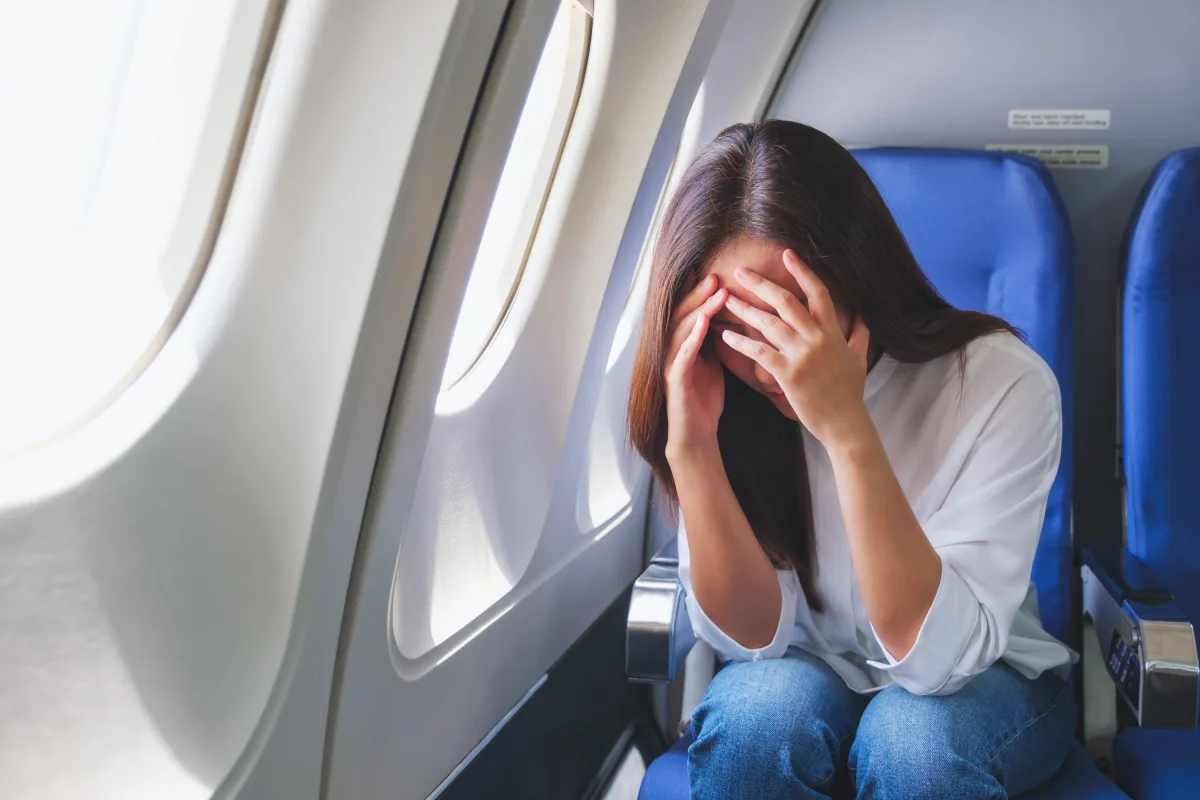
You are sitting in the aircraft, the engines accelerate, and your heart races. Sweaty hands grip the armrests. Every sound — a thud beneath the fuselage, a change in engine tone, a slight wobble — triggers a wave of fear. You know rationally that flying is safe. But your body does not believe your mind. That is fear of flying, and you are not alone.
Between 25 and 40 percent of all people experience some form of fear of flying — from mild unease to paralysing panic. Approximately 6 percent of the population suffer from aviophobia, a clinically significant flight phobia that prevents them from boarding an aircraft at all. This article offers no platitudes, only facts. Because facts are the most effective weapon against irrational fear.
The risk in numbers — why flying is the safest mode of transport
The question "How safe is flying?" can be answered with numbers so unambiguous that they leave little room for interpretation:
| Mode of transport | Fatalities per billion passenger-kilometres | Relative risk |
|---|---|---|
| Aircraft | 0.003 | 1x (reference) |
| Rail | 0.04 | 13x higher |
| Bus | 0.07 | 23x higher |
| Car | 3.1 | 1,033x higher |
| Motorcycle | 108.9 | 36,300x higher |
| Bicycle | 44.6 | 14,867x higher |
| On foot | 54.2 | 18,067x higher |
Source: European Transport Safety Council (ETSC), Eurostat, compiled across multiple years.
The individual risk of dying on a flight with an airline from an IATA member country is approximately 1 in 11 million. Statistically, you would have to fly every single day — for over 30,000 years — before a fatal accident became statistically "due." For comparison: the lifetime risk of dying in a car accident is approximately 1 in 5,000.
2023 was the safest year in the history of commercial aviation. Across over 36 million flights worldwide, there was not a single fatal accident involving a modern passenger jet of an IATA airline. 2017 was likewise a year without a fatal accident in regulated jet operations. These zero-fatality years are becoming the norm.
Why your brain ignores the statistics
If flying is so safe, why do so many people fear it? The answer lies in psychology, not in reality:
- Illusion of control: In a car, we believe we are in control. In an aircraft, we are passive. Our brain rates situations in which we have control as safer — regardless of the actual risk. In truth, the "in-control" driver is responsible for over 90% of all car accidents.
- Availability heuristic: Aircraft accidents are broadcast worldwide for days on end. Car accidents, which kill 3,700 people globally every day, do not make the news. Our brain considers what it can easily recall to be probable.
- Catastrophe bias: An aircraft accident may kill many people at once. That frightens us more than the same number of deaths spread across individual car accidents. Psychologically, we rate a single event with 200 fatalities as more dramatic than 200 individual deaths — even though the outcome is identical.
- Evolutionary conditioning: Humans are ground-dwelling creatures. Being at great height contradicts 200,000 years of evolutionary experience. Fear of heights is one of the oldest phobias — and fear of flying is frequently a variant of it.
What those sounds on the aircraft actually mean
For people with fear of flying, every sound is an alarm signal. Here are the most common sounds — and what they actually mean:
| Sound | When | What it is |
|---|---|---|
| Single chime ("ding") | Various phases | Intercom signal between cockpit and cabin, or a passenger has pressed the flight attendant call button |
| Double chime ("ding-dong") | Usually before takeoff and landing | Signal from the captain to the cabin crew — often "cabin ready for takeoff/landing" |
| Loud thudding beneath the fuselage | After liftoff / before landing | Landing gear being retracted or extended — hydraulic mechanism, completely normal |
| Engines become quieter | Shortly after liftoff | Thrust is being reduced because full takeoff power is no longer needed — a planned procedure |
| Whirring and humming | During approach | Flaps and slats being extended — aerodynamic configuration for lower airspeed |
| Clicking and vibrating | During flight | Air conditioning, pressure valves, hydraulic pumps — the aircraft "lives" |
| Barking dog-like sound | On the ground, before takeoff | Power Transfer Unit (PTU) — a hydraulic pump, particularly typical on Airbus aircraft |
| Wind noise increases | Descent | Speed changes create different airflow sounds along the fuselage |
What the pilot does during each flight phase
For passengers with fear of flying, the opacity of what is happening is a major problem. You do not know what is going on up front in the cockpit. Here is an overview:
- Before takeoff: Both pilots work through an extensive checklist. Every system is checked — engines, hydraulics, electrics, flight instruments, weather, fuel. The runway, takeoff power settings, V-speeds (V1, VR, V2), and the abort procedure are discussed. Nothing is left to chance.
- Takeoff: The flying pilot (Pilot Flying) accelerates the aircraft. At V1 — the decision speed — the takeoff is committed. At VR the aircraft is rotated (nose up). The non-flying pilot (Pilot Monitoring) monitors all instruments and calls out any deviations. Both pilots have clear, defined roles.
- Climb: After liftoff, the landing gear and flaps are retracted, thrust is reduced, and the route in the Flight Management System is confirmed. Contact with air traffic control is established.
- Cruise: The autopilot takes over the flying. The pilots monitor systems, weather, fuel, and the flight route. They communicate with air traffic control and receive regular weather updates. Contrary to the notion that "they just sit there," the pilots are continuously engaged in monitoring.
- Descent and approach: The most demanding phase. Speed reduction, flap configuration, gear extension, setting up the ILS or RNAV approach, working through checklists. Two pilots work as a team — one flies, one monitors.
- Landing: The pilot flies the approach — manually or with autopilot assistance. In poor visibility, an automatic landing system (autoland) can be used. After touchdown, reverse thrust and brakes are activated.
At every point during the flight, two highly qualified pilots with typically over 15,000 combined flight hours are in the cockpit. They have trained for hundreds of emergency scenarios in simulators. They hold medical certificates and are subject to strict duty time and rest regulations as mandated by both EASA and the FAA.
Cognitive behavioural therapy — the most effective treatment
Fear of flying is a specific phobia, and specific phobias are among the most treatable psychological conditions of all. Cognitive behavioural therapy (CBT) shows success rates of 70 to 90 percent for specific phobias.
The CBT approach to fear of flying encompasses several components:
- Psychoeducation: Understanding how flying works, which sounds are normal, why turbulence is not dangerous. Knowledge reduces fear because it eliminates the "unknown."
- Cognitive restructuring: Catastrophic thoughts ("The plane is going to crash!") are replaced by realistic appraisals ("The aircraft is experiencing light turbulence. This is normal. The structure can withstand many times this load.")
- Exposure therapy: Gradual approach to the anxiety trigger — from videos, to airport visits, simulator experiences, through to an actual flight. Each step is repeated until the anxiety response subsides.
- Relaxation techniques: Breathing techniques, progressive muscle relaxation, and mindfulness exercises are learned as tools for acute anxiety situations.
Many airlines offer fear-of-flying courses — often in collaboration with psychologists and experienced pilots. Lufthansa has been offering such courses for decades, as have British Airways, KLM, and Austrian Airlines. The success rate of these seminars is 93 to 98 percent — meaning nearly all participants are able to fly after completing the course.
Breathing technique for acute anxiety on board
When anxiety strikes in the aircraft, your body responds with a fight-or-flight reaction: adrenaline is released, heart rate increases, breathing becomes shallow and rapid. The most effective immediate measure is controlled breathing:
- 4-7-8 technique: Breathe in for 4 seconds (through the nose) — hold for 7 seconds — slowly breathe out for 8 seconds (through the mouth). Four repetitions. This technique activates the parasympathetic nervous system and measurably reduces heart rate within 60 seconds.
- Abdominal breathing: Place one hand on your abdomen. Breathe so that your abdomen rises — not your chest. Chest breathing is stress breathing. Abdominal breathing is calm breathing.
- Extended exhalation: The exhalation should always be longer than the inhalation. The signal to the vagus nerve: "Everything is safe."
These techniques are not pseudoscience. They are neurophysiologically validated and recommended by the American Psychological Association and leading European psychology bodies as first-line interventions for anxiety disorders.
When turbulence comes — what to tell yourself
Turbulence is the most common trigger for fear-of-flying episodes. In the moment of turbulence, it can help to consciously recall the following facts:
- "No modern commercial aircraft has ever crashed due to turbulence."
- "This aircraft is built to withstand 2.5 times the maximum turbulence forces."
- "What I am feeling is an altitude change of perhaps 10 to 20 feet — not 300 feet."
- "The pilots know this situation. They have experienced and trained for it hundreds of times."
- "Turbulence is like potholes on a road. Uncomfortable, but harmless."
Some therapists recommend writing these sentences on a small card and carrying it in your wallet. Reading the text during an anxiety episode gives the rational brain material to regulate the overreacting amygdala (the fear centre).
Children and flying
Children frequently acquire their fear of flying from their parents. If you fly with children and have fear of flying yourself, the most important thing is: do not transfer your own anxiety to the child. Children observe their caregivers' reactions and interpret them as an assessment of the situation.
- Preparation: Explain to the child before the flight what will happen — the sounds, the acceleration, the liftoff. Make it an adventure, not an ordeal.
- During the flight: Stay calm. When turbulence comes, say: "Those are air bumps, like potholes on the road. The aircraft can handle that."
- Distraction: Children who are occupied — with games, books, films — develop fear of flying less frequently.
- Positive experiences: The more positive flying experiences a child has, the lower the likelihood of developing a flight phobia later.
Medications — an overview
Some sufferers resort to medication. Here is a factual overview of the common options — none of which should be taken without medical consultation:
- Benzodiazepines (e.g. lorazepam, diazepam): Fast-acting anxiolytics, but: they are addictive, impair reaction time (relevant during an evacuation!), and recent studies show they can worsen fear of flying in the long term because the brain does not store the safe flight as a "passed test."
- Beta-blockers (e.g. propranolol): Reduce the physical symptoms of anxiety (rapid heartbeat, sweating, trembling) without impairing mental clarity. Recommended by some physicians for situational anxiety.
- Antihistamines (e.g. hydroxyzine): Mildly sedating, prescription-required, lower addiction potential than benzodiazepines.
- Alcohol: Not a medicine, but frequently used as "self-medication." Alcohol at cruising altitude has a stronger effect than at ground level (reduced air pressure). It dehydrates, impairs reaction time, and can actually intensify anxiety after it wears off (rebound effect). Experts strongly advise against it.
The recommendation of most fear-of-flying therapists: therapy before medication. Medications treat the symptoms, not the cause. Only therapy — particularly exposure therapy — can resolve the fear permanently.
Famous aviophobes who overcame their fear
Fear of flying is not a sign of weakness. Numerous famous personalities have had or currently have fear of flying:
- Dennis Bergkamp: The Dutch football star refused to fly to away matches. He travelled by car or train instead, sometimes for days. His fear began after a bomb scare during the 1994 World Cup.
- Whoopi Goldberg: The actress suffered from severe fear of flying for years after witnessing a mid-air collision over San Diego as a child. She overcame her phobia through Virgin Atlantic's fear-of-flying programme and is now a regular flyer.
- Ben Affleck: The actor has spoken publicly about his fear of flying and overcame it through therapy.
- Jennifer Aniston: The actress developed fear of flying after a severe turbulence experience and used therapy and breathing techniques to be able to fly again.
These examples show: fear of flying is conquerable. Not by ignoring it, not by willpower alone, but through information, understanding, and — if necessary — professional help.
Practical tips for your next flight
- Seat selection: Over the wings, movement is least pronounced. Aisle seats give a feeling of more space and control. Window seats can help because the visual contact with the outside world improves spatial orientation.
- Fly early in the morning: Less turbulence, calmer air.
- Choose large aircraft: A Boeing 777 or an A350 absorbs turbulence better than a regional jet.
- Inform the crew: Tell the flight attendants that you have fear of flying. They are trained for this and can reassure you — some will come by and explain what is happening.
- Use distraction: Audiobooks, podcasts, films. The brain cannot simultaneously be immersed in a story and be panicking.
- Avoid caffeine and sugar: Both increase heart rate and can intensify anxiety symptoms.
- Use turbulence apps: Apps such as "Turbcast" or "SkyGuru" show the expected turbulence on your route. Knowing what is coming reduces surprise — and thus the anxiety.
Conclusion: fear is normal — and conquerable
Fear of flying is neither a weakness nor an exaggeration. It is an understandable, if irrational, response by our brain to an evolutionarily unfamiliar situation. But it is treatable — with success rates that are unmatched in psychotherapy. The facts are clear: flying is the safest mode of transport humanity has ever developed. Every flight is operated by two highly qualified pilots in a multiply redundant aircraft certified for extreme loads, designed by hundreds of engineers and maintained by dozens of technicians.
If you suffer from fear of flying: seek professional help. Read about the technology. Understand the sounds. And then fly — perhaps a short route first, then a longer one. With each flight, your brain says more quietly: "Danger!" — and eventually it understands what the statistics have long known: this place, at 35,000 feet, at 560 knots, is one of the safest places in the world.
Safety First
Flying is the safest mode of transport in the world — thanks to decades of experience, cutting-edge technology and the strictest regulations. Knowledge builds trust: The more you understand about aviation safety, the more relaxed you fly.
