
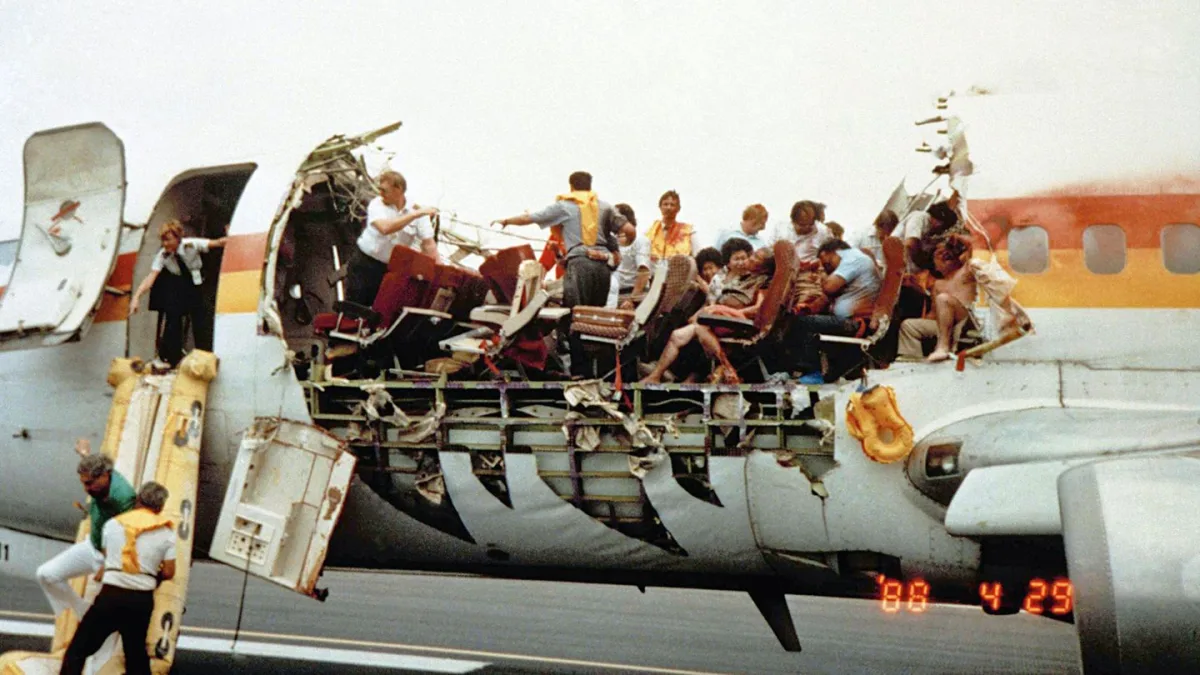
Structural failure at 24,000 feet: The cabin roof of a Boeing 737 tore off — and the pilots still landed the aircraft safely.
Aloha Airlines 243 — When the Cabin Roof Tore Off
On April 28, 1988, at a cruising altitude of 24,000 feet, a section of fuselage skin over 18 feet long tore away from a Boeing 737-200 operated by Aloha Airlines. The explosive decompression exposed the cabin to open sky — passengers suddenly found themselves in an aircraft without a roof. Of the 95 people on board, 94 survived. Flight attendant Clarabelle Lansing, who was standing in the aisle when the structure failed, was swept out of the aircraft and lost her life. This incident fundamentally and permanently changed how the aviation industry deals with aging aircraft.
Aloha Airlines — Short-Haul Flights Under Extreme Conditions
Aloha Airlines was a Hawaiian regional carrier that shuttled between the islands of the archipelago. Flights were short — typically 20 to 30 minutes — but each flight represented a complete pressurization cycle: pressurization during climb, depressurization during descent. This is the critical stress factor for aircraft structure — not flight hours.
The affected Boeing 737-297, registration N73711, had been delivered in 1969 and was nearly 19 years old at the time of the incident. But the decisive number was not its age — it was the number of pressurization cycles: 89,680 pressurization cycles. This was the second-highest cycle count of any 737 in service worldwide at that time. For comparison: a typical Boeing 737 flying long-haul routes would accumulate perhaps 30,000 to 40,000 cycles in 19 years.
Additionally, the aircraft operated in a particularly aggressive environment: the salt-laden marine air of Hawaii significantly accelerated corrosion processes. The combination of extremely high cycle count and corrosive environment created the preconditions for what followed.
The Incident — Flight 243 on April 28, 1988
Flight 243 was a scheduled domestic service from Hilo on Big Island to Honolulu on Oahu. On board were 89 passengers and 6 crew members. In the cockpit sat:
- Captain Robert Schornstheimer — An experienced pilot with over 8,500 flight hours, of which more than 6,700 were on the Boeing 737.
- First Officer Madeline "Mimi" Tompkins — One of the few female pilots at a US airline in the 1980s, with over 3,500 flight hours of experience.
At 1:48 PM local time, approximately 23 minutes after takeoff and at an altitude of 24,000 feet (FL240), the explosive decompression occurred. Without warning, a section of the upper fuselage skin on the left side tore away — a piece approximately 18 feet (5.5 meters) long, extending from the area just aft of the cockpit to beyond the forward entry door.
The Image of Catastrophe
The photographs of the landed aircraft are among the most iconic images in aviation history: a Boeing 737 whose forward fuselage resembles an opened sardine can. The upper fuselage skin was missing over an entire cabin section; the structural stringers and frames of the cabin wall jutted skyward like ribs.
Inside the cabin, the situation was apocalyptic. The explosive decompression hurled loose objects through the cabin and out of the aircraft. The noise of the 300-mph airstream made any communication impossible. Cabin insulation, trim panels, and passengers' personal belongings were ripped away.
Flight attendant Clarabelle "C.B." Lansing was in the forward cabin aisle near rows 4 and 5 at the moment of decompression — directly in the area of structural failure. She was swept out of the aircraft through the opening. Despite extensive search operations, her body was never recovered. Lansing was 58 years old and had been a flight attendant with Aloha Airlines for 37 years.
In the Cockpit — Flying Without a Roof
Captain Schornstheimer and First Officer Tompkins faced an unprecedented situation. The cockpit door had been torn away; they could see directly into the open cabin. The noise was deafening. Debris flew through the cockpit. Oxygen masks dropped, but with the rapid decompression, there was little time before hypoxia (oxygen deprivation) would impair cognitive function.
Schornstheimer and Tompkins reacted immediately: initiate emergency descent. The standard procedure for a decompression at that altitude is an immediate descent to 10,000 feet or below, where the air is breathable. Schornstheimer pushed the 737's nose down and initiated the emergency descent.
During the descent, the crew found that the flight controls still worked — a small miracle given the extent of the structural damage. However, communication between cockpit and cabin was impossible. The pilots did not know how many passengers were injured or had lost their lives.
Flight Attendant Michelle Honda — Heroine in the Open Cabin
While the pilots kept the aircraft under control, flight attendant Michelle Honda displayed extraordinary courage. Despite her own injuries, she crawled through the aisle of the open cabin, reassuring passengers and checking that everyone was strapped in. The second remaining flight attendant, Jane Sato-Tomita, had been severely injured by flying debris and was unable to assist.
Honda worked her way through the entire cabin while the aircraft flew through the air with its fuselage structure exposed. She ensured all passengers had their oxygen masks on and were buckled in, and prepared the cabin as best she could for an emergency landing.
The Landing on Maui
Schornstheimer chose to make an emergency landing at Kahului Airport on Maui — the nearest airport. During the approach, the landing gear had to be extended manually because the hydraulic system was damaged. First Officer Tompkins confirmed that the main gear was locked, but the nose gear gave no definitive indication.
At 1:58 PM, just ten minutes after the decompression, Schornstheimer safely set the Boeing 737 down on Runway 02 at Kahului. The nose gear was in fact extended and locked. The landing was firm but controlled. Fire crews stood ready.
| Time | Event | Altitude |
|---|---|---|
| 1:25 PM | Takeoff from Hilo | Ground level |
| 1:48 PM | Explosive decompression | 24,000 feet (FL240) |
| 1:49 PM | Emergency descent initiated | 24,000 feet descending |
| 1:53 PM | Below 10,000 feet, oxygen masks no longer needed | Below 10,000 feet |
| 1:55 PM | Approach to Kahului, Maui | Descending |
| 1:58 PM | Safe landing | Ground level |
Of the 95 people on board, 94 survived. In addition to the death of Clarabelle Lansing, 65 people were injured, eight of them seriously.
The Cause — Metal Fatigue and the Failure of Inspection
The investigation by the National Transportation Safety Board (NTSB) identified the cause as Multisite Fatigue Damage (MSD) — simultaneous fatigue cracks at multiple rivet joints in the fuselage skin.
The early-production Boeing 737-200 had a so-called "cold bond" structure: the fuselage skin panels were not only riveted but additionally bonded with adhesive. This bonding was meant to distribute loads and increase fatigue life. In N73711, however, the combination of several factors had led to failure:
- Extreme cycle count: 89,680 pressurization cycles had stressed the rivet rows at the panel joints far beyond their design limits.
- Bonding failure: The adhesive between the fuselage panels had degraded over the years, partly due to moisture ingress and corrosion. Without the bonding, the rivets alone had to carry the entire load — a purpose for which they were not designed.
- Corrosion: The salt-laden tropical air of Hawaii accelerated both the degradation of the adhesive and the corrosion of the aluminum.
- Inadequate inspection: The existing inspection programs had failed to detect the fatigue cracks in time. Visual inspections were not sensitive enough to identify the small cracks at the rivets before they became critical.
Particularly troubling was the finding that an inspection the evening before the accident had discovered a fatigue crack along the rivet line — but the aircraft was nonetheless cleared for service the next day, as the crack was classified as "not requiring immediate action."
Why the Aircraft Did Not Break Apart
One of the most remarkable aspects of the incident is that the Boeing 737, despite the massive structural loss, did not disintegrate in flight. There are several reasons:
- Fail-safe design: The Boeing 737 was built with a "fail-safe" concept. The fuselage structure consisted of multiple redundant load paths — frames, stringers, and skin panels. Even when one load path (the upper fuselage skin) failed completely, the remaining structural elements could carry the loads.
- Frames as crack stoppers: The circumferential fuselage frames acted as crack stoppers, preventing the crack in the fuselage skin from propagating uncontrolled around the entire circumference.
- Lower fuselage intact: The lower fuselage shell remained intact and held the aircraft structurally together.
- Immediate pressure relief: The large opening allowed cabin pressure to dissipate immediately, eliminating further structural loading from internal pressure.
The "Aloha Directives" — A Revolution in Aging Aircraft Inspection
The Aloha Airlines 243 incident triggered a fundamental reorientation of the aviation industry's approach to aging aircraft. The effects were far-reaching and lasting:
- FAA Aging Aircraft Program: The FAA established a comprehensive program for monitoring aging aircraft. Aircraft were no longer evaluated primarily by flight hours but, crucially, by pressurization cycles. EASA later adopted equivalent requirements through its Aging Aircraft Structures Programme (AASP).
- Mandatory Corrosion Prevention and Control Programs (CPCP): Compulsory corrosion prevention programs were introduced for all transport category aircraft.
- Supplemental Structural Inspection Programs (SSIP): Additional structural inspections were mandated for older aircraft operating beyond their original design service life.
- Airworthiness Directives: Immediate airworthiness directives were issued for all Boeing 737-200s and similar aircraft types, mandating detailed inspections of fuselage structure and bonded joints.
- Damage Tolerance instead of Safe Life: The philosophy shifted definitively from the "safe life" assumption (a component will last a specified lifetime) to the "damage tolerance" philosophy (cracks are expected but must be detected before they become critical). This principle is now codified in both FAA (14 CFR 25.571) and EASA (CS-25.571) regulations.
The U.S. Congress responded in 1991 with the "Aging Aircraft Safety Act," which obligated the FAA to issue stricter regulations for the operation of older aircraft. This legislation served as a model worldwide.
The Lessons — Understanding Multisite Fatigue Damage
Before Aloha 243, the aviation industry assumed that a single fatigue crack would grow slowly and be detected during routine inspections before it became critical. Aloha 243 revealed a different scenario: Multisite Fatigue Damage — many small cracks at different locations, each individually non-critical, but growing simultaneously and capable of suddenly linking up into catastrophic failure.
This concept revolutionized structural analysis and inspection philosophy in aviation. Today, all modern inspection programs account for the possibility of MSD and employ advanced inspection methods such as eddy current testing and ultrasonic inspection, which can reliably detect even the smallest cracks.
Remembrance and Legacy
The Aloha Airlines 243 incident is one of the most important case studies in aviation safety. It is taught in pilot training, engineering education, and aircraft maintenance technician programs worldwide.
Captain Schornstheimer and First Officer Tompkins received numerous awards for their performance under extreme conditions. Flight attendant Michelle Honda was honored for her courage and selflessness in the open cabin.
Clarabelle Lansing, the sole fatality, is honored in the aviation community as a reminder that behind every accident statistic is a human fate. Her death was not in vain: the safety improvements that emerged from the investigation of this incident have undoubtedly saved hundreds, if not thousands, of lives in the decades that followed.
Boeing 737-200 N73711 was not repaired after the incident. The images of the aircraft with its missing roof have become a symbol — a symbol of what can happen when metal fatigue is underestimated, but also of how robust a well-designed aircraft can be even under the most extreme conditions.
Safety First
Flying is the safest mode of transport in the world — thanks to decades of experience, cutting-edge technology and the strictest regulations. Knowledge builds trust: The more you understand about aviation safety, the more relaxed you fly.
